

 README

conch
A terminal orchestrator for AI coding agents. A background server owns the terminals your agents run in, so they keep working when you close the UI. The TUI organises everything as a tree — machines, projects, git branches, agents and terminals — beside a live view of whatever you select.
Works with Claude Code, Codex, Gemini CLI, OpenCode and Devin, on your machine or on remote machines over SSH.
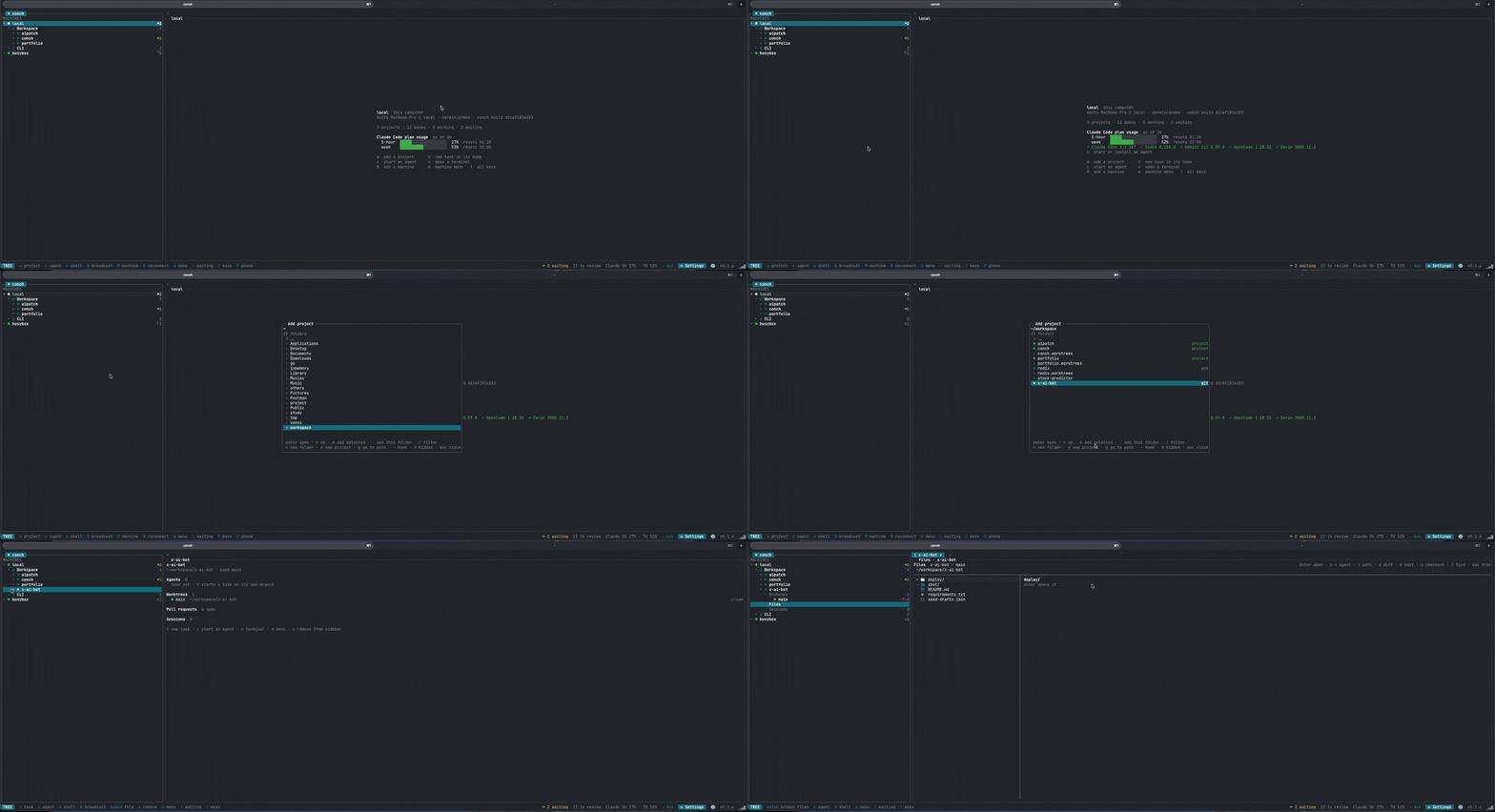
Adding a project: pick a folder, and its branches, agents and terminals are there to open.
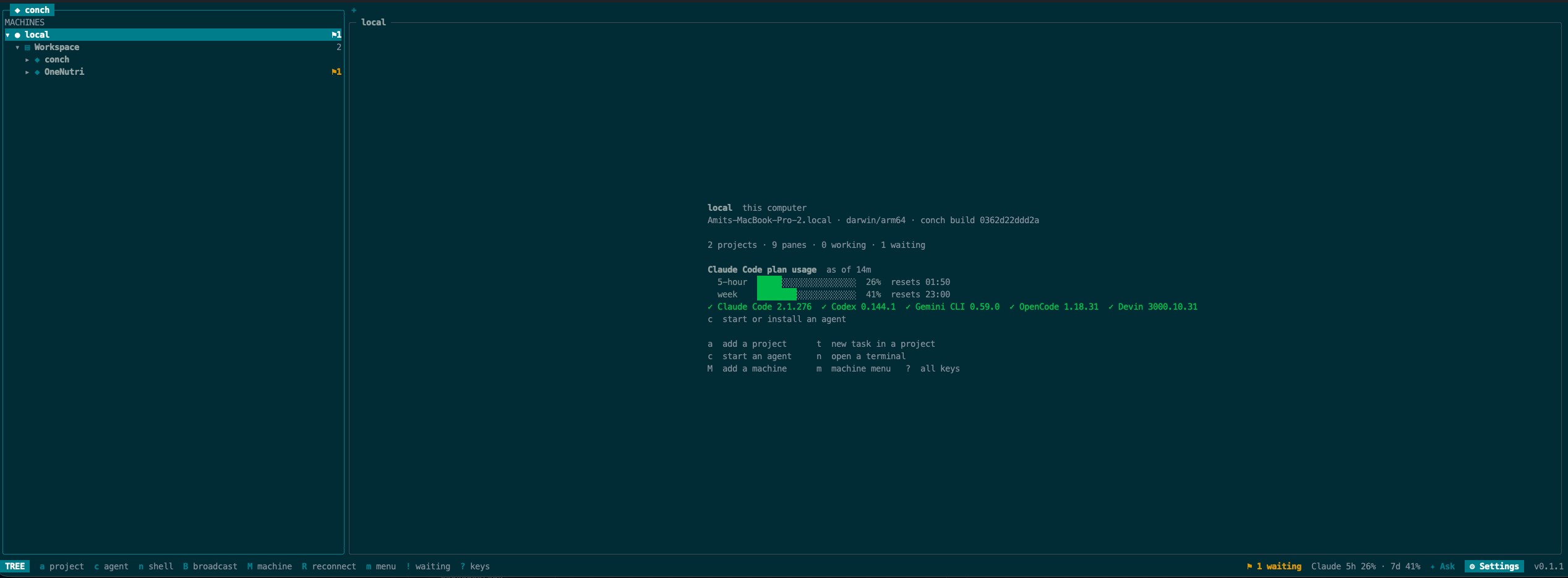
A machine at a glance: what is running, how much of the plan window is left, and which agents are installed.
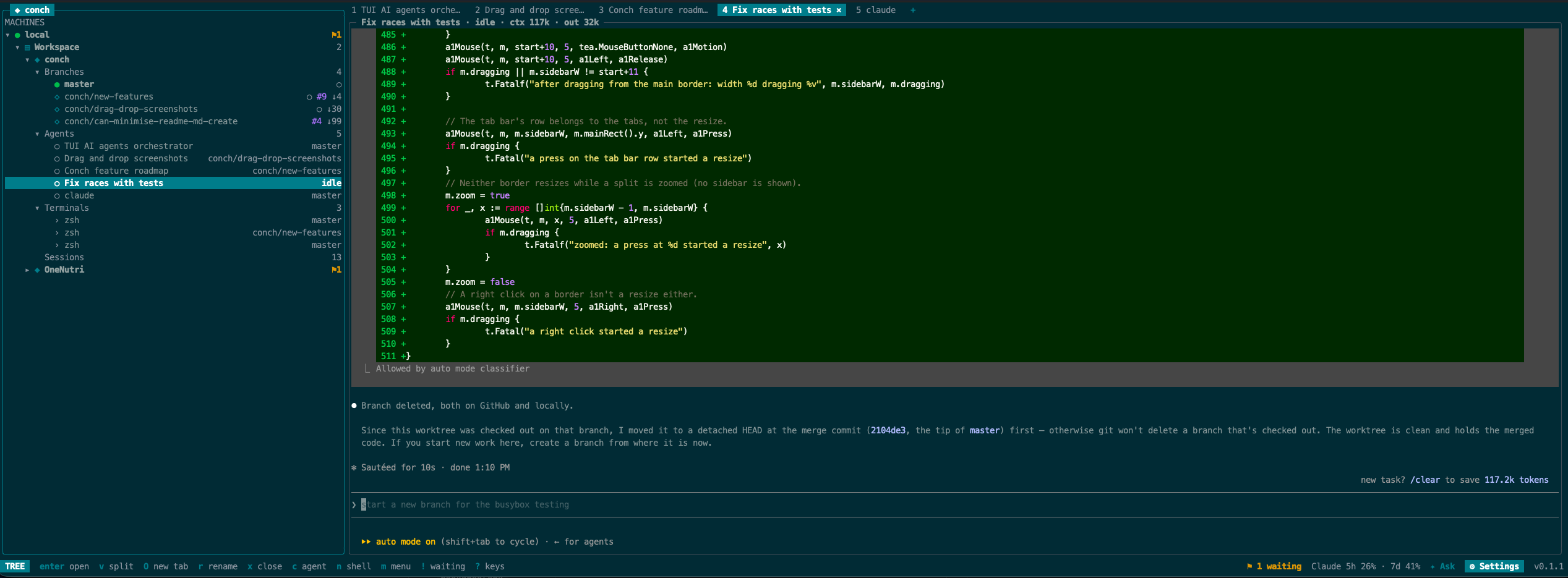
A project expanded into branches, agents and terminals, with a tab per agent and its work live in the pane.
Install
macOS and Linux (amd64 and arm64):
curl -fsSL https://raw.githubusercontent.com/Amitgb14/conch/master/install.sh | sh
Or with Go 1.25+: go install github.com/Amitgb14/conch/cmd/conch@latest.
conch update upgrades to the newest release, conch update list shows
what is published and conch update rollback goes back to the version
before it; conch server reload moves the server onto a new build without
stopping your agents.
Quick start
conch                                   # open the TUI (starts the server)
conch task -cwd ~/src/api "Add a health check endpoint"   # branch + worktree + agent
conch machine add gpu-box               # add a remote machine over ssh
conch status                            # panes with agent state
In the TUI: t new task · c start an agent · : ask in plain words ·
B broadcast to a group · ! jump to the next agent waiting for you · ? all keys ·
q detach.
Development
make build        # bin/conch
make test         # go test -race ./...
The website and documentation live in web/, a Next.js and
shadcn/ui app (pnpm dev there).
License
Apache License 2.0 — see LICENSE.
 Directories

| Path | Synopsis |
|---|---|
|
cmd
|
|
|
conch
command
Command conch is a terminal orchestrator for AI coding agents.
|
Command conch is a terminal orchestrator for AI coding agents. |
|
internal
|
|
|
adapter
Package adapter knows how to launch each supported agent with conch's integration wired in.
|
Package adapter knows how to launch each supported agent with conch's integration wired in. |
|
agentsetup
Package agentsetup reports what an agent loads when it starts in a directory: instruction files, skills, commands, subagents, MCP servers and plugins, from the user's configuration and the project.
|
Package agentsetup reports what an agent loads when it starts in a directory: instruction files, skills, commands, subagents, MCP servers and plugins, from the user's configuration and the project. |
|
brain
Package brain is conch's model-backed intelligence: it turns requests typed in the command bar into plans of conch actions, and summarises what agents are doing.
|
Package brain is conch's model-backed intelligence: it turns requests typed in the command bar into plans of conch actions, and summarises what agents are doing. |
|
buildinfo
Package buildinfo identifies this conch binary, so a client can tell whether a remote machine runs the same build.
|
Package buildinfo identifies this conch binary, so a client can tell whether a remote machine runs the same build. |
|
client
Package client talks to a conch server over its socket.
|
Package client talks to a conch server over its socket. |
|
config
Package config resolves conch's on-disk locations and loads config.toml.
|
Package config resolves conch's on-disk locations and loads config.toml. |
|
detect
Package detect works out which agent runs in a pane and what it is doing, from the terminal's foreground process, the visible screen, and lifecycle hooks the agent reports.
|
Package detect works out which agent runs in a pane and what it is doing, from the terminal's foreground process, the visible screen, and lifecycle hooks the agent reports. |
|
ghx
Package ghx reads pull requests through the GitHub CLI, so conch uses the user's existing gh login and never handles tokens itself.
|
Package ghx reads pull requests through the GitHub CLI, so conch uses the user's existing gh login and never handles tokens itself. |
|
gitx
Package gitx reads and manipulates git repositories for the sidebar: repository discovery, worktrees, branches, status and diffs.
|
Package gitx reads and manipulates git repositories for the sidebar: repository discovery, worktrees, branches, status and diffs. |
|
pane
Package pane runs a program on a pseudo-terminal and keeps an emulated screen of its output, so the server can render it to any number of clients and keep it alive while none are attached.
|
Package pane runs a program on a pseudo-terminal and keeps an emulated screen of its output, so the server can render it to any number of clients and keep it alive while none are attached. |
|
phone
Package phone is the gateway `conch web` runs: HTTP and a WebSocket for a phone, in front of the local conch server, which it talks to as a client like the TUI does.
|
Package phone is the gateway `conch web` runs: HTTP and a WebSocket for a phone, in front of the local conch server, which it talks to as a client like the TUI does. |
|
proto
Package proto defines conch's client/server protocol: newline-delimited JSON messages over a stream (a unix socket locally, an SSH bridge remotely).
|
Package proto defines conch's client/server protocol: newline-delimited JSON messages over a stream (a unix socket locally, an SSH bridge remotely). |
|
remote
Package remote connects to conch servers on other machines over the system's OpenSSH: it probes the machine, installs conch there when needed, and bridges the protocol through `conch bridge`.
|
Package remote connects to conch servers on other machines over the system's OpenSSH: it probes the machine, installs conch there when needed, and bridges the protocol through `conch bridge`. |
|
sandbox
Package sandbox creates and manages sandboxes with a hosted provider.
|
Package sandbox creates and manages sandboxes with a hosted provider. |
|
server
Package server is the conch daemon: it owns panes and serves the protocol on a unix socket so clients can come and go without killing agents.
|
Package server is the conch daemon: it owns panes and serves the protocol on a unix socket so clients can come and go without killing agents. |
|
sessions
Package sessions finds the conversations agents saved for a directory, so conch can list and resume them.
|
Package sessions finds the conversations agents saved for a directory, so conch can list and resume them. |
|
tools/clicker
command
Command clicker clicks a cell of a pane through conch's protocol, for driving a TUI under test by hand:
|
Command clicker clicks a cell of a pane through conch's protocol, for driving a TUI under test by hand: |
|
tui
Package tui is conch's Bubble Tea client: a tree of machines, projects, branches and agents beside the selected pane, branch changes or project.
|
Package tui is conch's Bubble Tea client: a tree of machines, projects, branches and agents beside the selected pane, branch changes or project. |
|
update
Package update finds newer conch builds — a rebuilt or downloaded binary, a GitHub release, machines running older builds — and applies them without stopping panes: binaries are replaced, servers reloaded.
|
Package update finds newer conch builds — a rebuilt or downloaded binary, a GitHub release, machines running older builds — and applies them without stopping panes: binaries are replaced, servers reloaded. |
|
usage
Package usage totals an agent session's token usage from its transcript.
|
Package usage totals an agent session's token usage from its transcript. |
|
web
|
|
|
scripts/tui-capture/_fakeclaude
command
Fake `claude` for website screenshots: draws a Claude Code-like screen, reports hooks and token usage to conch, and never talks to any API.
|
Fake `claude` for website screenshots: draws a Claude Code-like screen, reports hooks and token usage to conch, and never talks to any API. |