

 README
¶
conch
A terminal orchestrator for AI coding agents. A background server owns the
terminals your agents run in, so they keep working when you close the UI. The
TUI organises everything as a tree — machines, projects, git branches, agents
and terminals — beside a live view of whatever you select. It is not the only
way in: Conch.app is the same thing in a native Mac
window, and conch web hands it to your phone.
Works with Claude Code, Codex, Gemini CLI, OpenCode, Devin, Copilot CLI, Cline, Qwen Code and Goose — and runs a dozen more, from Kiro and Crush to Mistral Vibe — on your machine or on remote machines over SSH.
Is it for you?
It is for running several agents at once and keeping track of them — which one is waiting on you, what each has changed, and getting back to them after your laptop slept. It earns its keep from the third agent, not the first.
It is the wrong shape if you run one agent in one repo (use the agent's own
CLI, with tmux if you want it to survive a dropped ssh session), if you branch
and commit by hand (a plain multiplexer gives you panes without the opinions),
or if review means a conversation with other people — conch reads diffs side
by side, stages hunks, and a note on a line goes to the agent, which answers
it in the thread; Conch.app submits a pull request review (approve, request
changes, comment), but a reply to a colleague's own comment happens on
GitHub, so pair it with gh or your forge for that. It is macOS and Linux;
on Windows, WSL. And it waits for Enter on purpose: nothing the brain
proposes runs until you confirm, so it is not the tool for unattended
swarms.
The longer version, losses included.
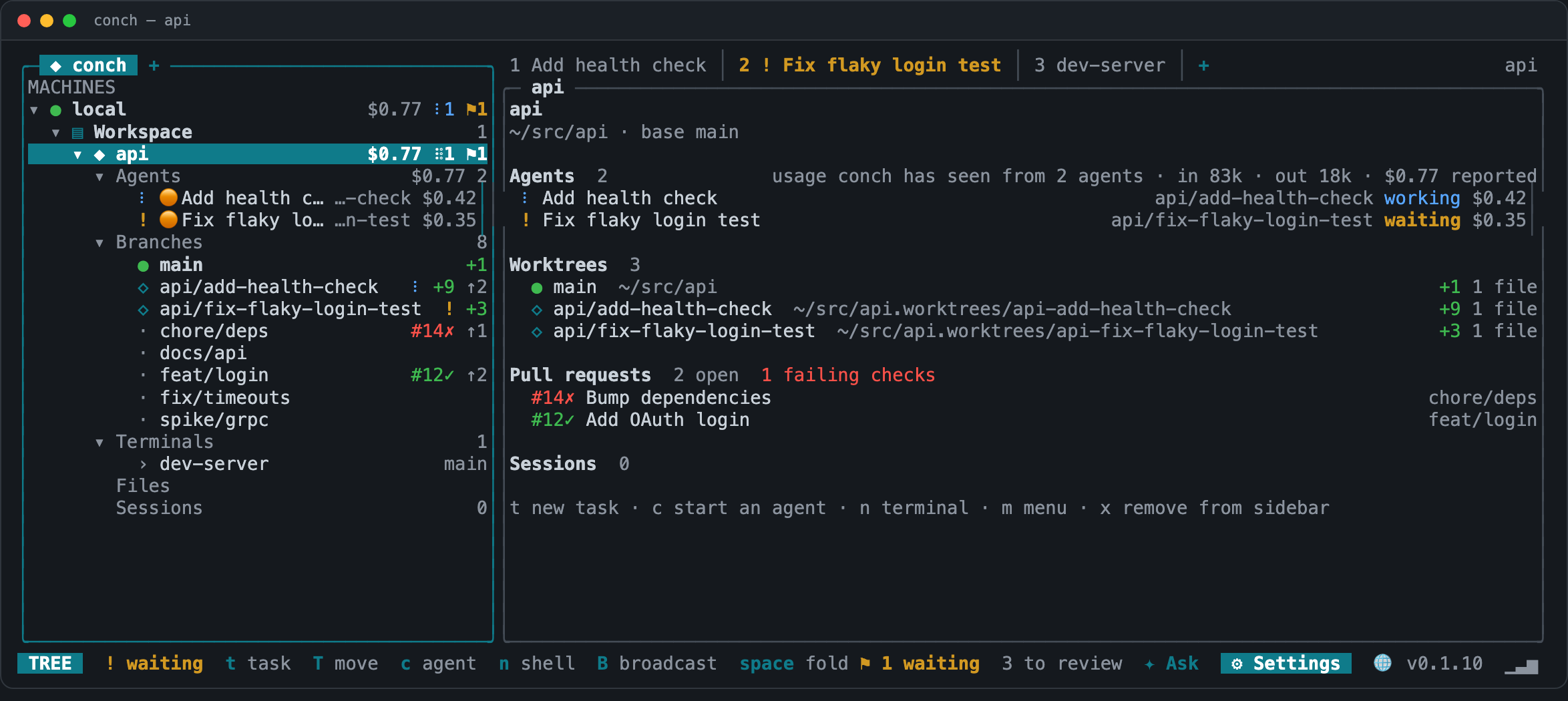
A project expanded into branches, agents and terminals, with a tab per agent — and beside it what the project holds: each worktree, the open pull requests and their checks, and what the agents have spent.
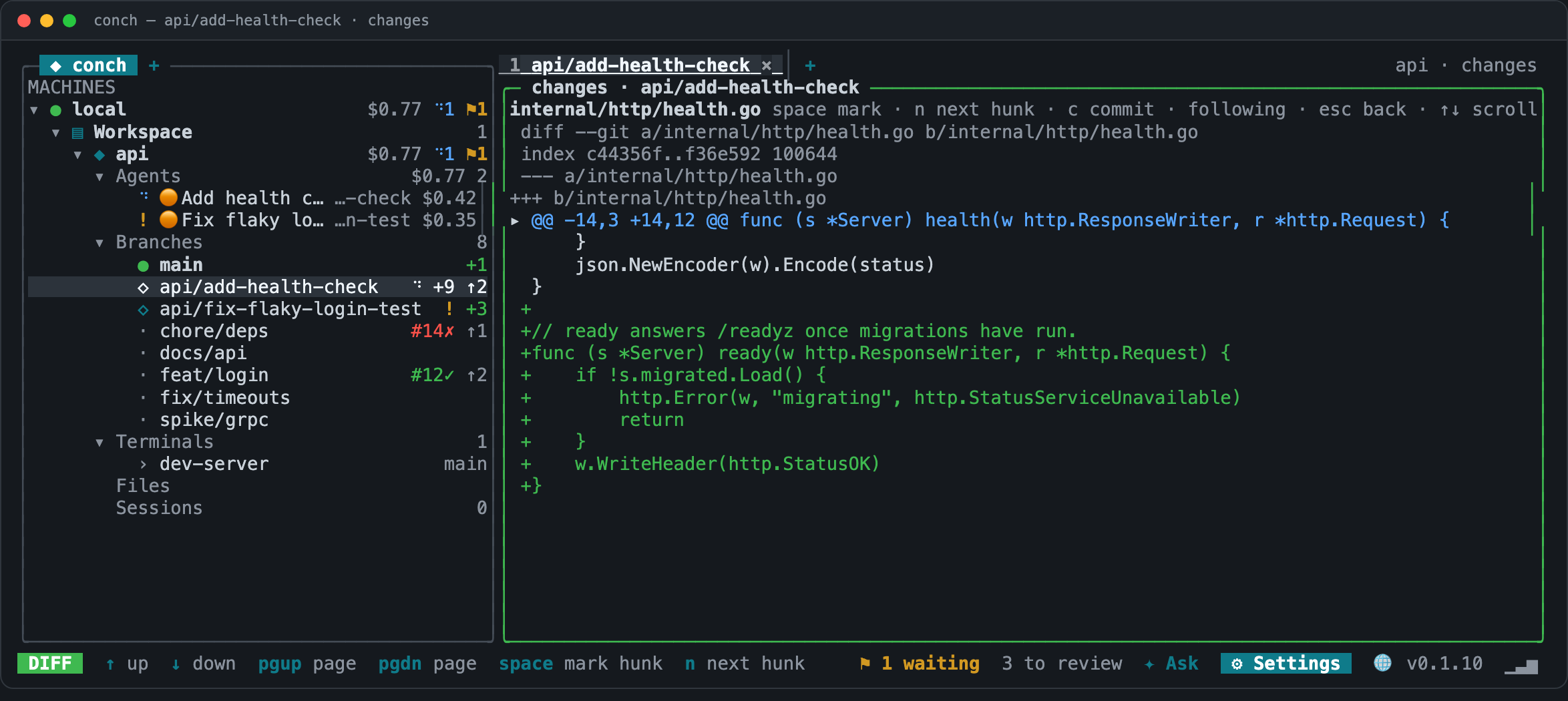
Review an agent's work before it lands: a branch's uncommitted files and
commits ahead, each diff hunk by hunk, and space to stage one.
Install
macOS and Linux (amd64 and arm64):
curl -fsSL https://raw.githubusercontent.com/Amitgb14/conch/master/install.sh | sh
With Homebrew, on macOS or Linux:
brew install Amitgb14/conch/conch
Or with Go 1.25+: go install github.com/Amitgb14/conch/cmd/conch@latest.
conch update upgrades to the newest release, conch update list shows
what is published and conch update rollback goes back to the version
before it; conch server reload moves the server onto a new build without
stopping your agents. A Homebrew install is updated with brew upgrade conch
instead, and conch then offers to reload onto it.
Quick start
conch                                   # open the TUI (starts the server)
conch task -cwd ~/src/api "Add a health check endpoint"   # branch + worktree + agent
conch machine add gpu-box               # add a remote machine over ssh
conch project move api -to gpu-box      # branches, worktrees and agents, moved there
conch status                            # panes with agent state
conch read gpu-box:p3                   # a pane's screen, by the ID every view shows
In the TUI: t new task · c start an agent · : ask in plain words ·
B broadcast to a group · ! jump to the next agent waiting for you · ? all keys ·
q detach.
Conch.app, on a Mac
Conch.app is conch in a native macOS window — another client of the same
servers, so it shows the agents the TUI shows and closing it stops none of
them. Panes are drawn by Ghostty; a branch's changes,
its files and the dev server's page sit in tabs beside the agents; ⌘K finds a
pane, a branch or a file. It is in beta:
download it or build it
from macos/.
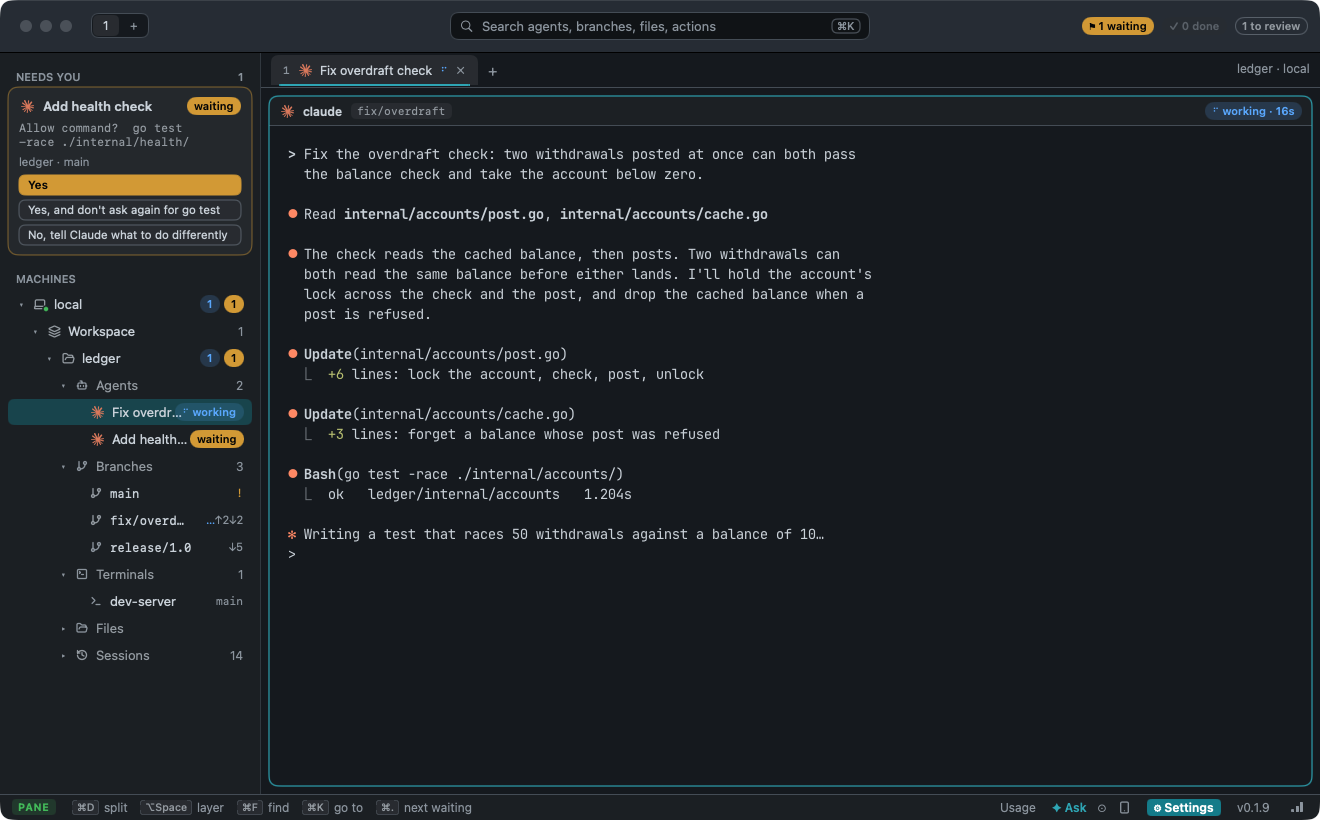
An agent in a Ghostty pane, the tree beside it, and what needs you at the top left: the question a waiting agent asked, with its answers to click.
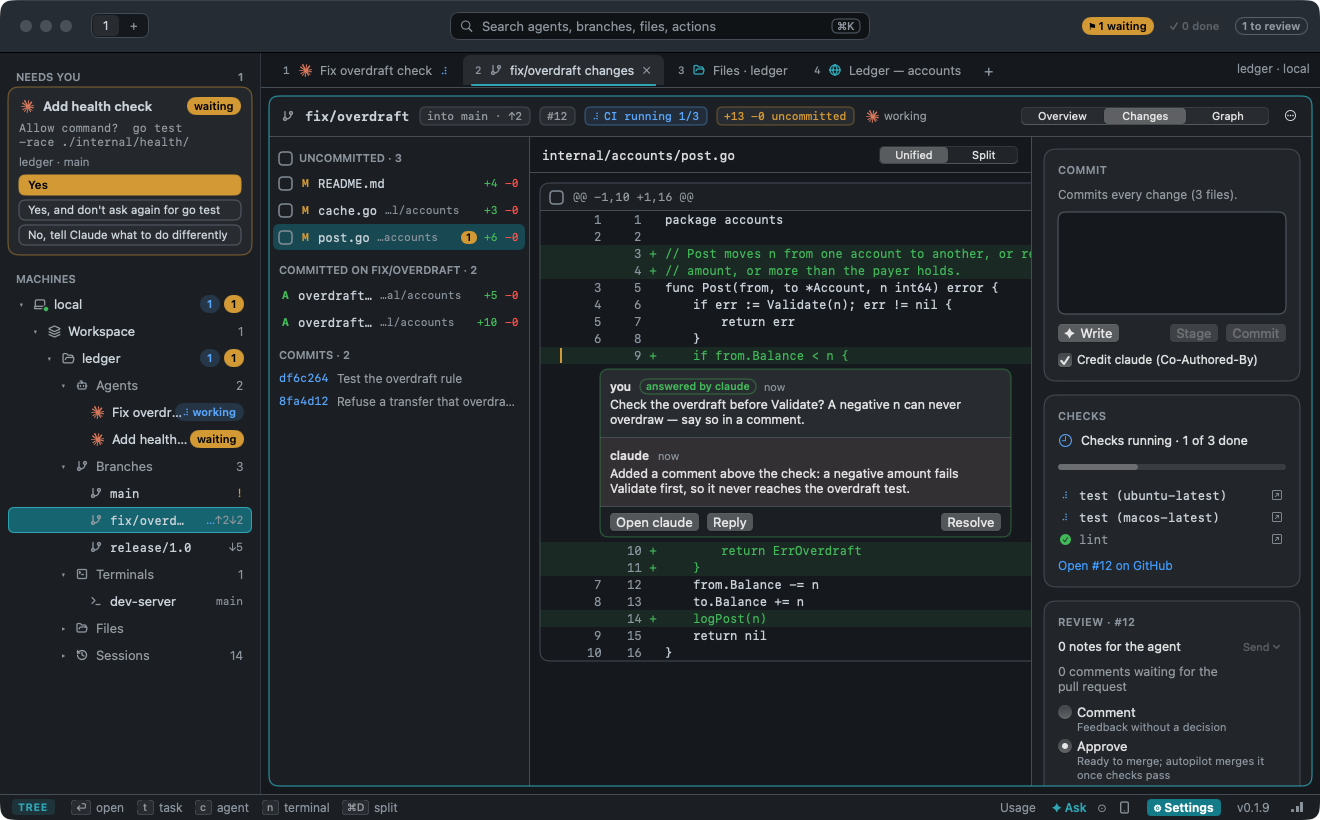
A branch's changes in a tab of their own: stage a hunk, write the commit message, watch the pull request's checks, and leave the agent a note on a line — it answers in the thread.
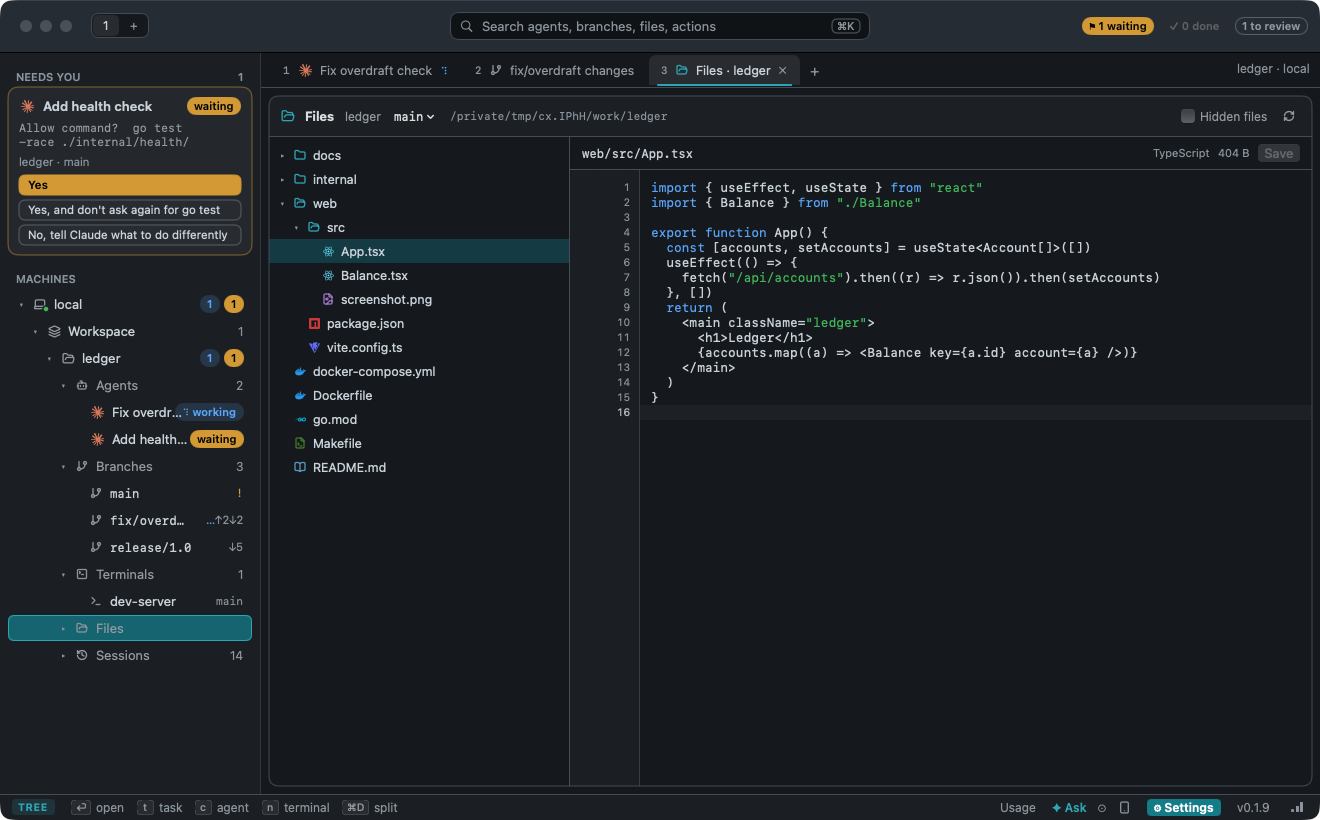
The project's files in a tab too: the tree on the left, the file open with its syntax coloured, and ⌘S to save — checked against what the agents may have written in the meantime.
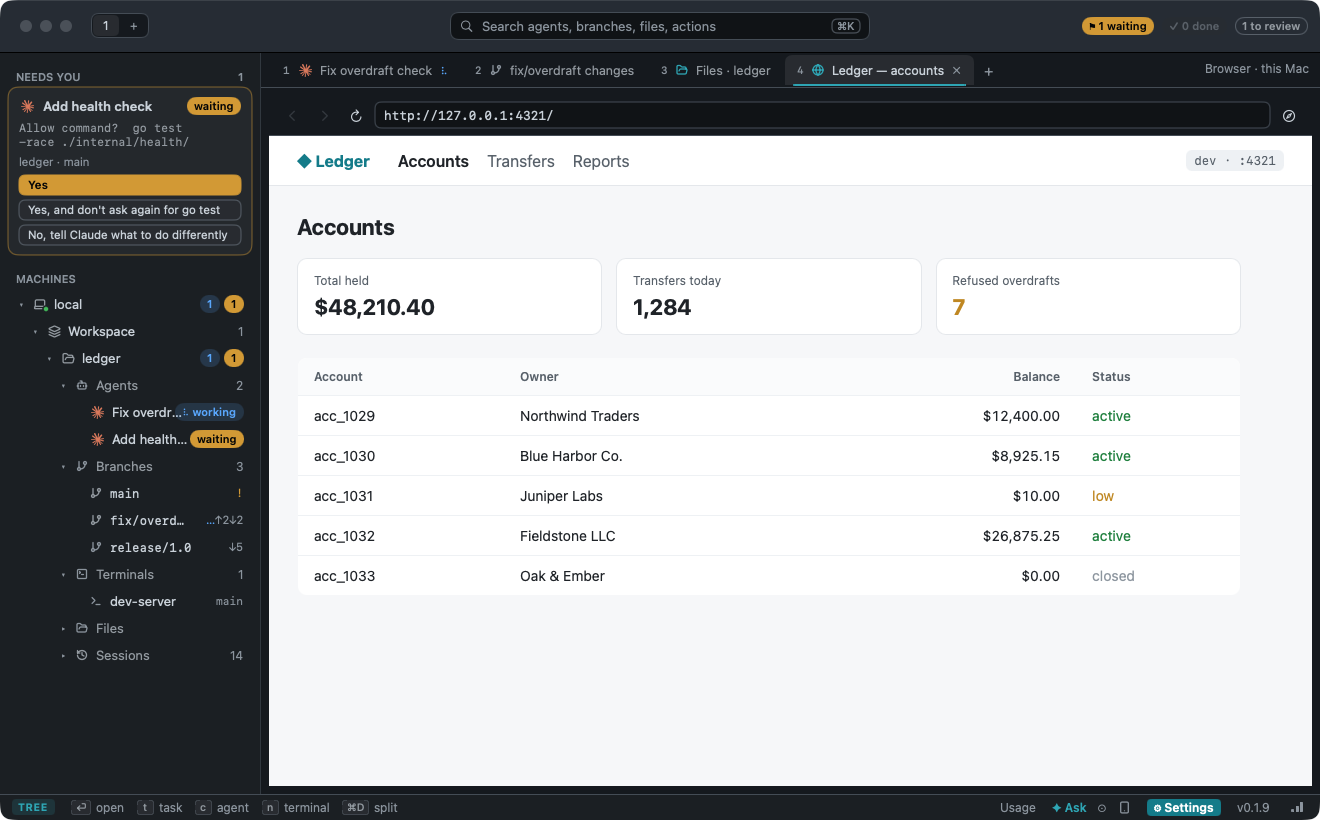
And the dev server's own page in a tab beside them, so what the agent just changed is a glance away rather than another window.
What the window holds, key by key.
From your phone
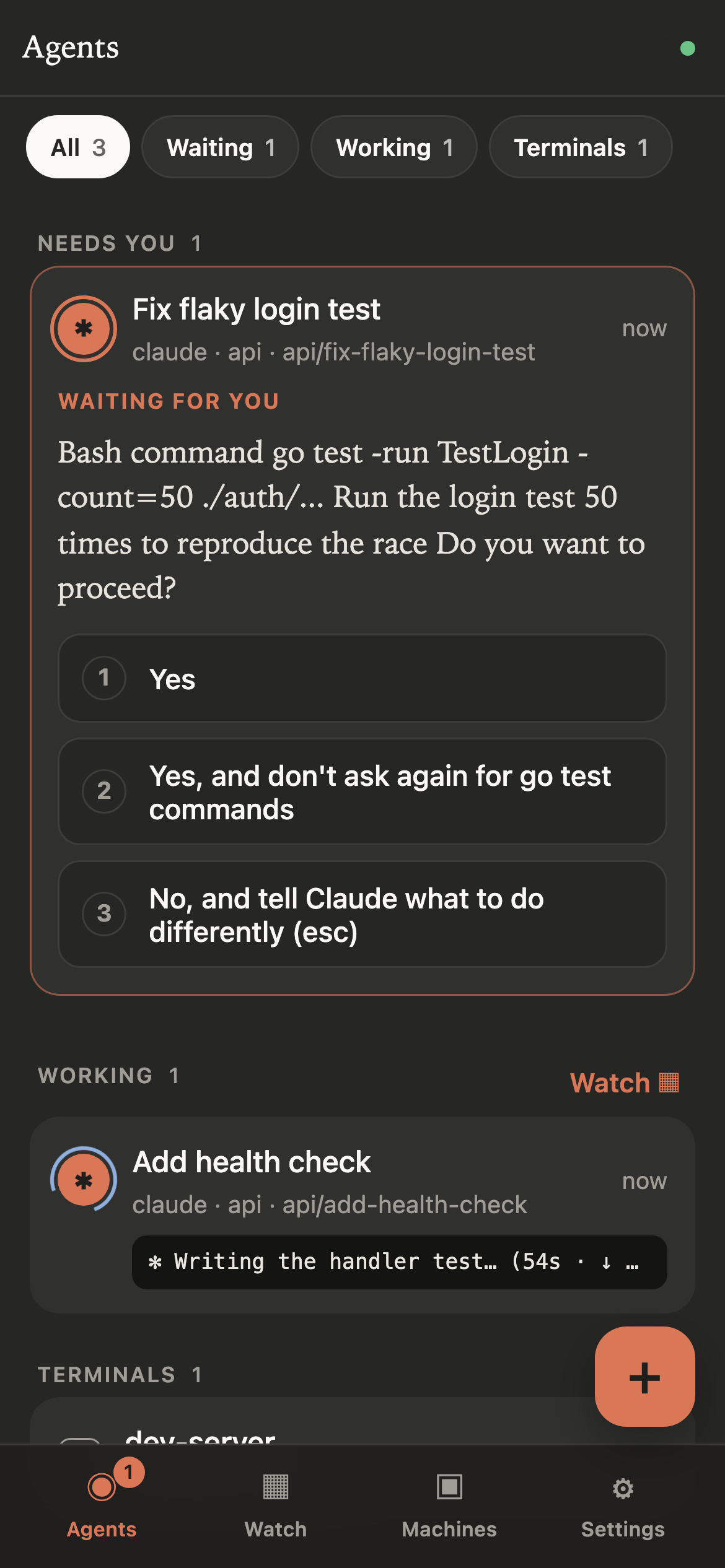
conch web serves the same agents to a phone: what each one is doing, the
question it is waiting on with its answers as buttons, every screen at once,
and a keyboard into any terminal. It is a page the gateway serves itself —
nothing to install, and no service of conch's in between.
conch web          # the gateway, in front of the same server
conch web pair     # a QR code and a one-time code for the phone
On your own tailnet the phone reaches the laptop directly. From any other
network it goes through a relay you run yourself (conch relay): the
phone and the laptop both connect out to it, and what it carries it cannot
read — they make a Noise session whose key
travels in the QR code, through the camera rather than the network. See
Phone.
Skills for your agents
conch carries skills that teach an agent to run other agents: start a
helper and read its answer (conch), several at once (conch-team),
review until clean (conch-review), tests to a merged pull request
(conch-ship), a ticket all the way (conch-factory), and the automated
workflow for a project (conch-autopilot). Install them for every agent
— Claude Code, Codex, Gemini CLI, OpenCode, Devin, Copilot CLI, Cline, Qwen Code and Goose:
conch agent skill -apply
Or, in Claude Code, as a plugin from this repository:
/plugin marketplace add Amitgb14/conch
/plugin install conch@conch
Then ask an agent in a conch pane: "take issue 123 to a merged pull request", "set up an automated workflow for this project". They act only inside conch. See Agents working together.
Development
make build        # bin/conch
make test         # go test -race -timeout 20m ./...
make lint         # gofmt, go vet, staticcheck — CI's lint job
make gate         # lint, then the suite with internal/server in shards — what CI runs, on one machine
The tests of the phone app and the settings page run with node and skip
without it. The settings page (internal/configweb/app) is committed as
built; after changing it, run make settings-ui (needs pnpm) and commit
internal/configweb/dist. AGENTS.md has the rules for
contributing, including keeping tests away from your own running conch.
The website and documentation live in web/, a Next.js and
shadcn/ui app (pnpm dev there). Most of its screenshots are regenerated
rather than taken by hand: web/scripts/tui-capture/capture.sh stages a
demo project in a scratch conch and saves the TUI's screens,
web/scripts/phone-capture/capture.sh photographs the phone app in
headless Chrome, and both keep away from your own server and agents.
Conch.app's are taken in the app by hand — a native window is nobody's
script.
License
Apache License 2.0 — see LICENSE.
 Directories
¶
| Path | Synopsis |
|---|---|
|
cmd
|
|
|
conch
command
Command conch is a terminal orchestrator for AI coding agents.
|
Command conch is a terminal orchestrator for AI coding agents. |
|
internal
|
|
|
accounts
Package accounts keeps the agent accounts a machine has besides each agent's own: a work and a personal Claude subscription, two Max plans.
|
Package accounts keeps the agent accounts a machine has besides each agent's own: a work and a personal Claude subscription, two Max plans. |
|
adapter
Package adapter knows how to launch each supported agent with conch's integration wired in.
|
Package adapter knows how to launch each supported agent with conch's integration wired in. |
|
agentsetup
Package agentsetup reports what an agent loads when it starts in a directory: instruction files, skills, commands, subagents, MCP servers and plugins, from the user's configuration and the project.
|
Package agentsetup reports what an agent loads when it starts in a directory: instruction files, skills, commands, subagents, MCP servers and plugins, from the user's configuration and the project. |
|
brain
Package brain is conch's model-backed intelligence: it turns requests typed in the command bar into plans of conch actions, and summarises what agents are doing.
|
Package brain is conch's model-backed intelligence: it turns requests typed in the command bar into plans of conch actions, and summarises what agents are doing. |
|
buildinfo
Package buildinfo identifies this conch binary, so a client can tell whether a remote machine runs the same build.
|
Package buildinfo identifies this conch binary, so a client can tell whether a remote machine runs the same build. |
|
client
Package client talks to a conch server over its socket.
|
Package client talks to a conch server over its socket. |
|
cloud
Package cloud is conch's client of Conch Cloud's control plane: signing a device in (the device flow), keeping its tokens, and the calls a person's conch makes — the account, its devices, its machines and how to reach one (contract conch-cloud/contract, openapi.yaml's userToken side and PROTOCOL.md §3.2).
|
Package cloud is conch's client of Conch Cloud's control plane: signing a device in (the device flow), keeping its tokens, and the calls a person's conch makes — the account, its devices, its machines and how to reach one (contract conch-cloud/contract, openapi.yaml's userToken side and PROTOCOL.md §3.2). |
|
cloud/cloudtest
Package cloudtest is a fake Conch Cloud control plane for conch's tests: the client side of the contract on httptest — the device flow, tokens that rotate (a reused refresh token revokes the device, as the real one does), machines, connect with single-use tickets — and a relay that checks those tickets in front of conch's own.
|
Package cloudtest is a fake Conch Cloud control plane for conch's tests: the client side of the contract on httptest — the device flow, tokens that rotate (a reused refresh token revokes the device, as the real one does), machines, connect with single-use tickets — and a relay that checks those tickets in front of conch's own. |
|
cloudagent
Package cloudagent is `conch cloud agent`: the program that runs inside a Conch Cloud machine, beside its conch server.
|
Package cloudagent is `conch cloud agent`: the program that runs inside a Conch Cloud machine, beside its conch server. |
|
cloudcontract
Package cloudcontract checks requests and answers against Conch Cloud's contract (conch-cloud's contract/openapi.yaml), for the fakes conch's tests put in the control plane's place.
|
Package cloudcontract checks requests and answers against Conch Cloud's contract (conch-cloud's contract/openapi.yaml), for the fakes conch's tests put in the control plane's place. |
|
config
Package config resolves conch's on-disk locations and loads config.toml.
|
Package config resolves conch's on-disk locations and loads config.toml. |
|
configweb
Package configweb is a page in the browser for editing config.toml: every setting the TUI's Settings screen has, and the ones it only names (actions, permission rules, check commands), as a form.
|
Package configweb is a page in the browser for editing config.toml: every setting the TUI's Settings screen has, and the ones it only names (actions, permission rules, check commands), as a form. |
|
detect
Package detect works out which agent runs in a pane and what it is doing, from the terminal's foreground process, the visible screen, and lifecycle hooks the agent reports.
|
Package detect works out which agent runs in a pane and what it is doing, from the terminal's foreground process, the visible screen, and lifecycle hooks the agent reports. |
|
doctor
Package doctor is what `conch doctor` finds and how it is said: a check of something conch leans on, its outcome, and the fix.
|
Package doctor is what `conch doctor` finds and how it is said: a check of something conch leans on, its outcome, and the fix. |
|
fleet
Package fleet keeps a client per machine — this computer and every enabled machine in the catalog — for a program that shows them all at once: the phone gateway.
|
Package fleet keeps a client per machine — this computer and every enabled machine in the catalog — for a program that shows them all at once: the phone gateway. |
|
ghx
Package ghx reads pull requests through the GitHub CLI, so conch uses the user's existing gh login and never handles tokens itself.
|
Package ghx reads pull requests through the GitHub CLI, so conch uses the user's existing gh login and never handles tokens itself. |
|
gitx
Package gitx reads and manipulates git repositories for the sidebar: repository discovery, worktrees, branches, status and diffs.
|
Package gitx reads and manipulates git repositories for the sidebar: repository discovery, worktrees, branches, status and diffs. |
|
integration
Package integration reads integration files: descriptions of a service's HTTP API for one kind of job conch already does, so a service conch has no code for can still be used.
|
Package integration reads integration files: descriptions of a service's HTTP API for one kind of job conch already does, so a service conch has no code for can still be used. |
|
keymap
Package keymap is what a key pressed after conch's prefix does, and which key that is.
|
Package keymap is what a key pressed after conch's prefix does, and which key that is. |
|
nodetest
Package nodetest finds node for the tests that run conch's JavaScript: the phone's app (internal/phone) and the settings page (internal/configweb).
|
Package nodetest finds node for the tests that run conch's JavaScript: the phone's app (internal/phone) and the settings page (internal/configweb). |
|
pane
Package pane runs a program on a pseudo-terminal and keeps an emulated screen of its output, so the server can render it to any number of clients and keep it alive while none are attached.
|
Package pane runs a program on a pseudo-terminal and keeps an emulated screen of its output, so the server can render it to any number of clients and keep it alive while none are attached. |
|
phone
Package phone is the gateway `conch web` runs: HTTP and a WebSocket for a phone, in front of the local conch server, which it talks to as a client like the TUI does.
|
Package phone is the gateway `conch web` runs: HTTP and a WebSocket for a phone, in front of the local conch server, which it talks to as a client like the TUI does. |
|
preview
Package preview reaches the phones a mobile developer runs their app on while an agent works on it: the iOS simulators Xcode installs and the Android emulators and devices adb sees.
|
Package preview reaches the phones a mobile developer runs their app on while an agent works on it: the iOS simulators Xcode installs and the Android emulators and devices adb sees. |
|
proto
Package proto defines conch's client/server protocol: newline-delimited JSON messages over a stream (a unix socket locally, an SSH bridge remotely).
|
Package proto defines conch's client/server protocol: newline-delimited JSON messages over a stream (a unix socket locally, an SSH bridge remotely). |
|
relay
Package relay is how a phone reaches conch web without Tailscale: both connect out to a relay, which pairs a phone's WebSocket with one the gateway opens for it and copies messages between the two.
|
Package relay is how a phone reaches conch web without Tailscale: both connect out to a relay, which pairs a phone's WebSocket with one the gateway opens for it and copies messages between the two. |
|
relocate
Package relocate moves a whole project to another machine: the repository (cloned there from its origin, or a project there that has it), every task worktree with its commits and uncommitted work, every branch holding commits its origin hasn't (given a worktree here first, so it travels the same way), and the agents — each continued there with its conversation, then closed here.
|
Package relocate moves a whole project to another machine: the repository (cloned there from its origin, or a project there that has it), every task worktree with its commits and uncommitted work, every branch holding commits its origin hasn't (given a worktree here first, so it travels the same way), and the agents — each continued there with its conversation, then closed here. |
|
remote
Package remote connects to conch servers on other machines over the system's OpenSSH: it probes the machine, installs conch there when needed, and bridges the protocol through `conch bridge`.
|
Package remote connects to conch servers on other machines over the system's OpenSSH: it probes the machine, installs conch there when needed, and bridges the protocol through `conch bridge`. |
|
report
Package report builds what somebody hitting a problem can hand over in one keystroke: the facts about their conch, written out for a GitHub issue, and the link that opens one with it already filled in.
|
Package report builds what somebody hitting a problem can hand over in one keystroke: the facts about their conch, written out for a GitHub issue, and the link that opens one with it already filled in. |
|
sandbox
Package sandbox creates and manages sandboxes with a hosted provider.
|
Package sandbox creates and manages sandboxes with a hosted provider. |
|
server
Package server is the conch daemon: it owns panes and serves the protocol on a unix socket so clients can come and go without killing agents.
|
Package server is the conch daemon: it owns panes and serves the protocol on a unix socket so clients can come and go without killing agents. |
|
sessions
Package sessions finds the conversations agents saved for a directory, so conch can list and resume them.
|
Package sessions finds the conversations agents saved for a directory, so conch can list and resume them. |
|
sshtest
Package sshtest is a stand-in for ssh in tests, so the files of a host a terminal is logged in to (fs.ssh.v1) are tested without a network: the test binary, run under the name ssh, logs in by waiting as a shell would, and asked for sftp serves a folder of this machine as the host's home.
|
Package sshtest is a stand-in for ssh in tests, so the files of a host a terminal is logged in to (fs.ssh.v1) are tested without a network: the test binary, run under the name ssh, logs in by waiting as a shell would, and asked for sftp serves a folder of this machine as the host's home. |
|
sysstat
Package sysstat reads the machine conch's server runs on: its CPU and each core, memory and where it goes, load, disk, and every process with its CPU and memory — for system.stats, the window beside the resource monitor.
|
Package sysstat reads the machine conch's server runs on: its CPU and each core, memory and where it goes, load, disk, and every process with its CPU and memory — for system.stats, the window beside the resource monitor. |
|
tools/clicker
command
Command clicker clicks or drags a cell of a pane through conch's protocol, for driving a TUI under test by hand:
|
Command clicker clicks or drags a cell of a pane through conch's protocol, for driving a TUI under test by hand: |
|
tools/standin
command
Command standin is a program conch detects as an agent, for driving the paths that need one without running one:
|
Command standin is a program conch detects as an agent, for driving the paths that need one without running one: |
|
tracker
Package tracker reads and updates tickets in the trackers teams use besides GitHub issues — Linear and Jira Cloud — so a task can start from one and its branch and pull request can be linked back to it.
|
Package tracker reads and updates tickets in the trackers teams use besides GitHub issues — Linear and Jira Cloud — so a task can start from one and its branch and pull request can be linked back to it. |
|
transfer
Package transfer packs a folder for copying between machines and unpacks it at the other end, and picks the name a copy lands under.
|
Package transfer packs a folder for copying between machines and unpacks it at the other end, and picks the name a copy lands under. |
|
tui
Package tui is conch's Bubble Tea client: a tree of machines, projects, branches and agents beside the selected pane, branch changes or project.
|
Package tui is conch's Bubble Tea client: a tree of machines, projects, branches and agents beside the selected pane, branch changes or project. |
|
update
Package update finds newer conch builds — a rebuilt or downloaded binary, a GitHub release, machines running older builds — and applies them without stopping panes: binaries are replaced, servers reloaded.
|
Package update finds newer conch builds — a rebuilt or downloaded binary, a GitHub release, machines running older builds — and applies them without stopping panes: binaries are replaced, servers reloaded. |
|
usage
Package usage totals an agent session's token usage from its transcript.
|
Package usage totals an agent session's token usage from its transcript. |
|
when
Package when reads the times people give conch for later — 14:05, +30m, 2026-10-15 09:00 — and how often to repeat — daily, 6h — the same way in the command line and the TUI.
|
Package when reads the times people give conch for later — 14:05, +30m, 2026-10-15 09:00 — and how often to repeat — daily, 6h — the same way in the command line and the TUI. |
|
scripts
|
|
|
registry-key
command
Command registry-key makes the key an integrations registry signs its index with, and signs one — for the registry's CI.
|
Command registry-key makes the key an integrations registry signs its index with, and signs one — for the registry's CI. |