

 README

README

echo-swagger
echo middleware to automatically generate RESTful API documentation with Swagger 2.0.



[!IMPORTANT] This repository is just an updated fork of swaggo/echo-swagger. The main reason for this fork is to keep the module up-to-date with the latest Echo and Swag versions, as the original repository takes some time to approve changes and release updates.
Usage
Start using it
- Add comments to your API source code, See Declarative Comments Format.
- Download Swag for Go by using:
$ go get -d github.com/swaggo/swag/cmd/swag

# 1.21 or newer
$ go install github.com/swaggo/swag/cmd/swag@latest
- Run the Swag in your Go project root folder which contains
main.gofile, Swag will parse comments and generate required files(docsfolder anddocs/doc.go).
$ swag init
- Download echo-swagger by using:
$ go get -u github.com/BrunoKrugel/echo-swagger
And import following in your code:
import "github.com/BrunoKrugel/echo-swagger" // echo-swagger middleware
Canonical example:
OpenAPI Specification (OAS) 2.0
package main

import (
	"github.com/labstack/echo/v4"
	"github.com/BrunoKrugel/echo-swagger"

	_ "github.com/BrunoKrugel/echo-swagger/example/docs" // docs is generated by Swag CLI, you have to import it.
)

// @title Swagger Example API
// @version 1.0
// @description This is a sample server Petstore server.
// @termsOfService http://swagger.io/terms/

// @contact.name API Support
// @contact.url http://www.swagger.io/support
// @contact.email support@swagger.io

// @license.name Apache 2.0
// @license.url http://www.apache.org/licenses/LICENSE-2.0.html

// @host petstore.swagger.io
// @BasePath /v2
func main() {
	e := echo.New()

	e.GET("/swagger/*", echoSwagger.WrapHandler)

	e.Logger.Fatal(e.Start(":1323"))
}
OpenAPI Specification (OAS) 3.0
package main

import (
	"github.com/labstack/echo/v4"
	"github.com/BrunoKrugel/echo-swagger"

	_ "github.com/BrunoKrugel/echo-swagger/example/docs" // docs is generated by Swag CLI, you have to import it.
)

// @title Swagger Example API
// @version 1.0
// @description This is a sample server Petstore server.
// @termsOfService http://swagger.io/terms/

// @contact.name API Support
// @contact.url http://www.swagger.io/support
// @contact.email support@swagger.io

// @license.name Apache 2.0
// @license.url http://www.apache.org/licenses/LICENSE-2.0.html

// @host petstore.swagger.io
// @BasePath /v2
func main() {
	e := echo.New()

	e.GET("/swagger/*", echoSwagger.WrapHandlerV3)

	e.Logger.Fatal(e.Start(":1323"))
}
- Run it, and browser to http://localhost:1323/swagger/index.html, you can see Swagger 2.0 Api documents.
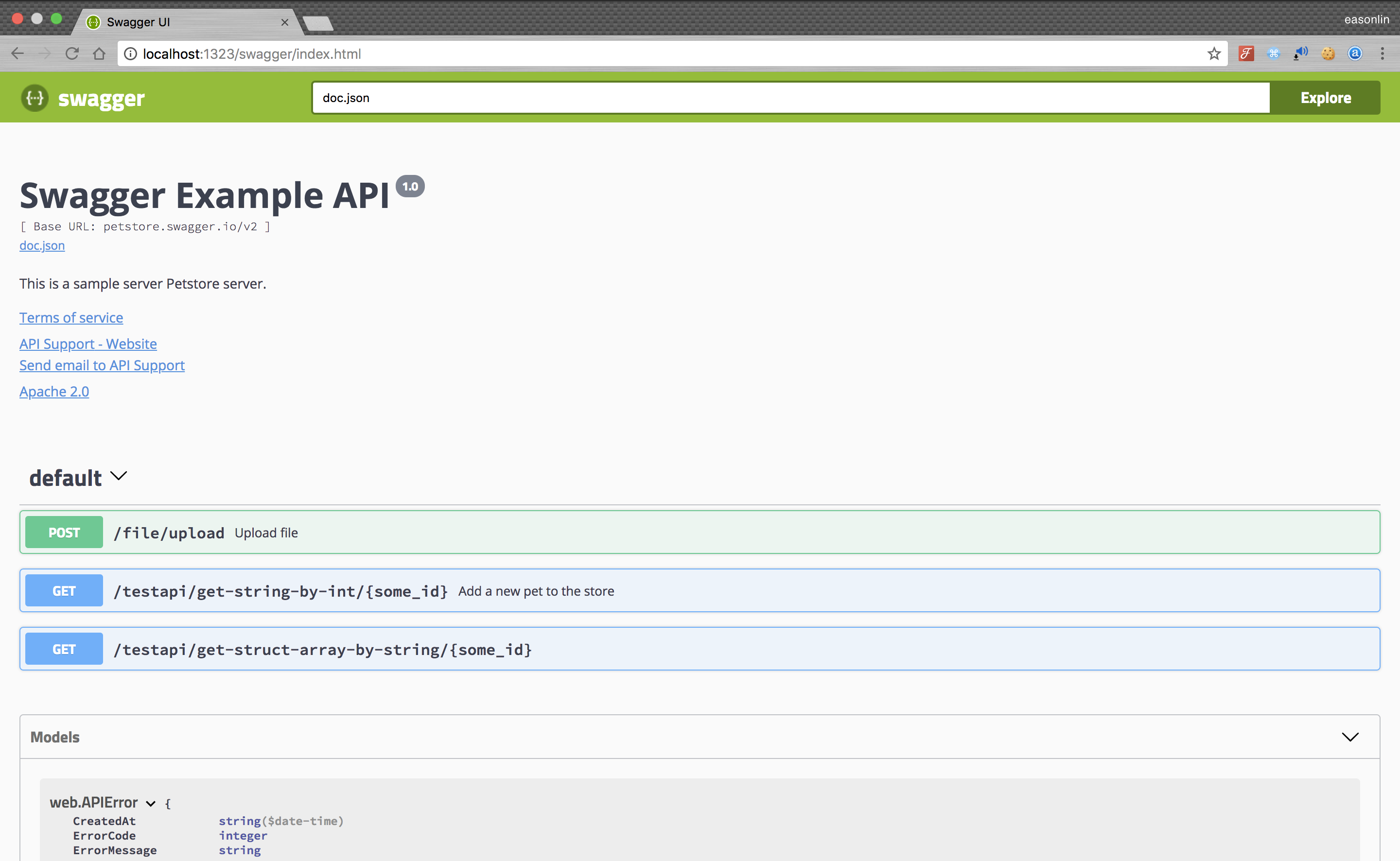
Note: If you are using Gzip middleware you should add the swagger endpoint to skipper
Example
e.Use(middleware.GzipWithConfig(middleware.GzipConfig{
	Skipper: func(c echo.Context) bool {
		if strings.Contains(c.Request().URL.Path, "swagger") {
			return true
		}
		return false
	},
}))
 Documentation

Documentation

Index 
- Variables
- func DeepLinking(deepLinking bool) func(*Config)
- func DefaultModelsExpandDepth(depth int) func(*Config)
- func DocExpansion(docExpansion string) func(*Config)
- func DomID(domID string) func(*Config)
- func EchoWrapHandler(options ...func(*Config)) echo.HandlerFunc
- func EchoWrapHandlerV3(options ...func(*Config)) echo.HandlerFunc
- func InstanceName(instanceName string) func(*Config)
- func OAuth(config *OAuthConfig) func(*Config)
- func PersistAuthorization(persistAuthorization bool) func(*Config)
- func SyntaxHighlight(syntaxHighlight bool) func(*Config)
- func TryItOutEnabled(enable bool) func(*Config)
- func URL(url string) func(*Config)
- type Config
- type OAuthConfig
Constants 
This section is empty.
Variables 
var (
	WrapHandler   = EchoWrapHandler()
	WrapHandlerV3 = EchoWrapHandlerV3()
)
WrapHandler wraps swaggerFiles.Handler and returns echo.HandlerFunc
Functions 
func DefaultModelsExpandDepth 
DefaultModelsExpandDepth expansion depth for models (set -1 to completely hide the models). Defaults to 1
func DocExpansion 
DocExpansion list, full, none.
func EchoWrapHandler 
func EchoWrapHandler(options ...func(*Config)) echo.HandlerFunc
EchoWrapHandler wraps `http.Handler` into `echo.HandlerFunc`.
func EchoWrapHandlerV3 
func EchoWrapHandlerV3(options ...func(*Config)) echo.HandlerFunc
EchoWrapHandler wraps `http.Handler` into `echo.HandlerFunc`.
func InstanceName 
InstanceName specified swag instance name.
func OAuth 
func OAuth(config *OAuthConfig) func(*Config)
func PersistAuthorization 
PersistAuthorization Persist authorization information over browser close/refresh. Defaults to false.
func SyntaxHighlight 
SyntaxHighlight true, false.
func TryItOutEnabled 
TryItOutEnabled controls whether the "Try it out" section should be enabled by default. Defaults to true
Types 
type Config 
type Config struct {
	OAuth                    *OAuthConfig // The information for OAuth2 integration, if any.
	DocExpansion             string
	DomID                    string
	InstanceName             string
	URLs                     []string // The url pointing to API definition (normally swagger.json or swagger.yaml). Default is `mockedSwag.json`.
	DeepLinking              bool
	PersistAuthorization     bool
	SyntaxHighlight          bool
	TryItOutEnabled          bool
	DefaultModelsExpandDepth int
}
Config stores echoSwagger configuration variables.
type OAuthConfig 
type OAuthConfig struct {
	// The ID of the client sent to the OAuth2 IAM provider.
	ClientId string

	// The OAuth2 realm that the client should operate in. If not applicable, use empty string.
	Realm string

	// The name to display for the application in the authentication popup.
	AppName string
}
OAuthConfig stores configuration for Swagger UI OAuth2 integration. See https://swagger.io/docs/open-source-tools/swagger-ui/usage/oauth2/ for further details.
 Source Files