

 README

README

winsgo
winsgo is a pure-Go implementation of the Winston Wave Server (WWS) protocol. It supports Winston protocol version 3 and separates protocol handling from waveform storage by exposing a pluggable Provider for channel metadata and a Consumer for waveform data.
Preview
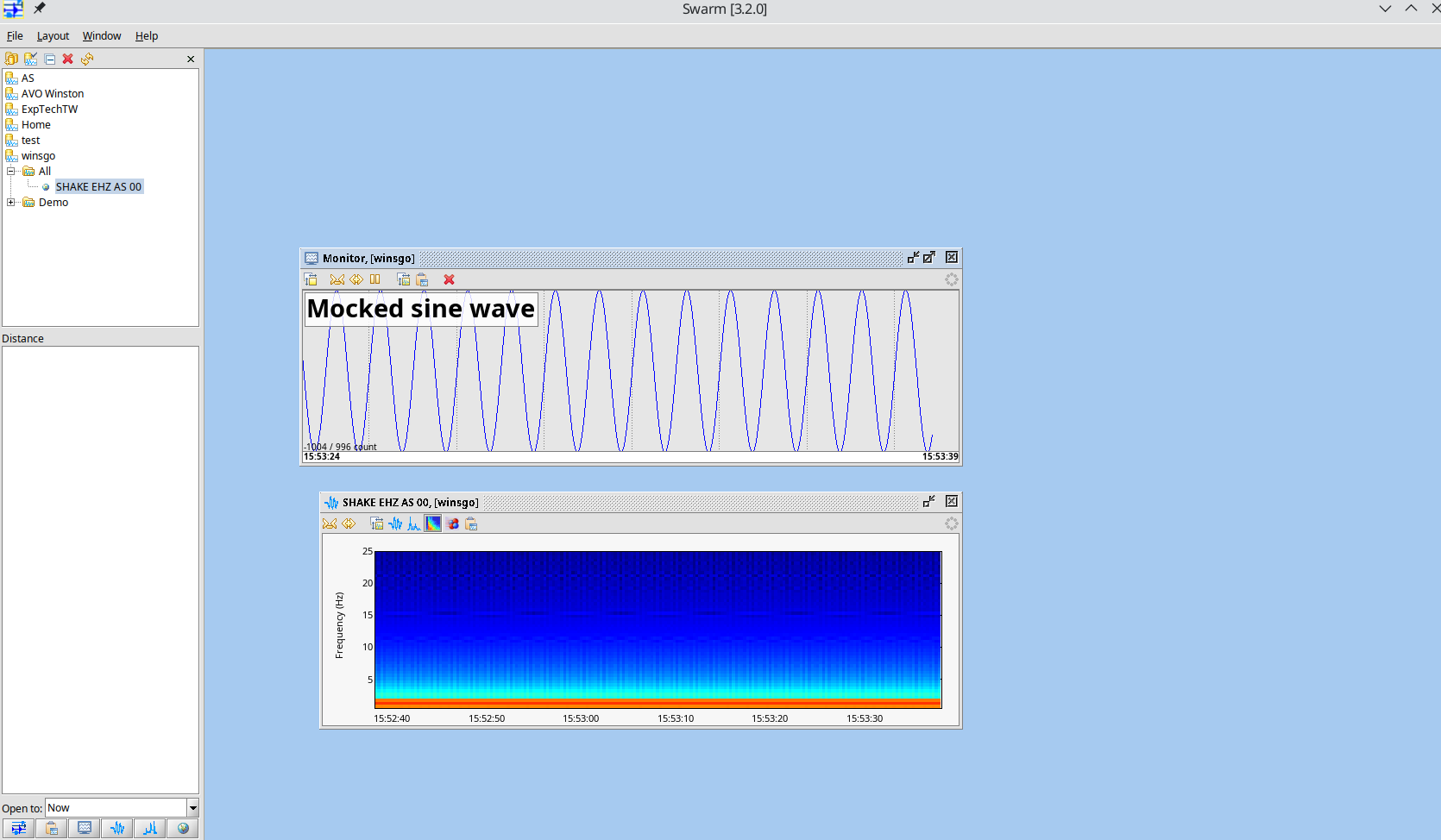
Features
- Winston Wave Server protocol v3 support
- MENU, GETCHANNELS, GETMETADATA, GETWAVERAW, GETSCN/GETSCNL, GETSCNRAW/GETSCNLRAW, GETSCNLHELIRAW, GETSCNLRSAMRAW, and STATUS commands
- Pure Go implementation with no external dependencies beyond the standard library
- Pluggable
ProviderandConsumerinterfaces for custom metadata and waveform sources - Optional hooks for connection, command, data, error, and close events
- Built-in support for compressed GETWAVERAW and Swarm-compatible product payloads
Installation
Install the package for use in your Go module:
$ go get github.com/bclswl0827/winsgo
Or install the command directly if you expose a main package from the repo:
$ go install github.com/bclswl0827/winsgo@latest
Quick Usage
Implement a Provider for channel metadata and a Consumer for waveform data,
then start the server with winsgo.New.
package main

import (
    "context"
    "log"
    "os"
    "os/signal"
    "syscall"

    "github.com/bclswl0827/winsgo"
)

func main() {
    server := winsgo.New(&provider{}, &consumer{}, &hooks{})
    ctx, stop := signal.NotifyContext(context.Background(), os.Interrupt, syscall.SIGTERM)
    defer stop()

    log.Println("starting Winston server on 0.0.0.0:16022")
    if err := server.Start(ctx, "0.0.0.0", 16022); err != nil {
        log.Fatal(err)
    }
}
Example implementations are available in the example/ directory.
Project layout
go.mod— Go module definitionserver.go— core server loop, connection handling, and command parsingprotocol.go— Winston command handling and response generationtypes.go— protocol data types, provider/consumer interfaces, and hookswaveform.go— waveform encoding and ZiLib compression utilitiesexample/— sample provider, consumer, hooks, and server launcherpreview/— project preview assets
Contributing
Contributions, issues, and feature requests are welcome. Please open an issue or pull request on the upstream repository.
License
This project is licensed under the MIT License.
 Documentation

Documentation

Index 
- Constants
- Variables
- func EncodeWaveform(wave Waveform) ([]byte, error)
- func J2KSeconds(t time.Time) float64
- func TimeFromJ2K(seconds float64) time.Time
- type Channel
- type Client
- type Command
- type Consumer
- type ErrorHooks
- type Hooks
- type Instrument
- type Product
- type ProductConsumer
- type ProductRequest
- type Provider
- type SCNL
- type Server
- type TraceBuf
- type TraceBufConsumer
- type Waveform
- type WaveformHandler
- type WaveformRequest
Constants 
const J2KEpoch = 946728000000
epoch used by Winston: 2000-01-01 12:00:00 UTC.
Variables 
var ErrNoData = errors.New("winsgo: no data")
Functions 
func EncodeWaveform 
EncodeWaveform produces the big-endian binary representation used in a Winston GETWAVERAW response and by volcano-core's Wave.toBinary().
func J2KSeconds 
J2KSeconds converts a time to decimal seconds since J2KEpoch.
func TimeFromJ2K 
TimeFromJ2K converts decimal J2K seconds to a UTC time.
Types 
type Channel 
type Channel struct {
	ID         int
	SCNL       SCNL
	StartTime  time.Time
	EndTime    time.Time
	Instrument Instrument
	Alias      string
	Unit       string
	LinearA    float64
	LinearB    float64
	Groups     []string
	Metadata   map[string]string
}
Channel describes one channel advertised by MENU and GETCHANNELS.
type Consumer 
type Consumer interface {
	Consume(context.Context, WaveformRequest, WaveformHandler) error
}
Consumer fulfills waveform requests. It may return ErrNoData without invoking the handler when no waveform overlaps the requested interval.
type ErrorHooks 
ErrorHooks may be implemented in addition to Hooks to observe the reason a connection handler is closing.
type Hooks 
type Hooks interface {
	OnConnection(*Client)
	OnCommand(*Client, Command)
	OnData(*Client, []byte)
	OnClose(*Client)
}
Hooks observes server activity. Hook methods must return quickly and must not retain or modify byte slices passed to OnData.
type Instrument 
type Instrument struct {
	ID          int
	Name        string
	Description string
	Longitude   float64
	Latitude    float64
	Height      float64
	TimeZone    string
	Metadata    map[string]string
}
Instrument contains the station metadata returned by GETMETADATA.
type Product 
type Product int
Product identifies an optional Winston binary derived-data response.
type ProductConsumer 
type ProductConsumer interface {
	ConsumeProduct(context.Context, ProductRequest, func([]byte) error) error
}
ProductConsumer optionally overrides server-side derivation of Winston binary products. The callback accepts the uncompressed, Winston-compatible representation.
type ProductRequest 
type ProductRequest struct {
	WaveformRequest
	Product Product
	Period  int
}
ProductRequest describes GETSCNLHELIRAW and GETSCNLRSAMRAW requests.
type Provider 
Provider supplies the channel catalog. It is deliberately separate from the waveform Consumer so metadata and waveform data may come from different systems.
type SCNL 
SCNL identifies a seismic channel by station, channel, network, and location.
type Server 
type Server struct {
	Provider Provider
	Consumer Consumer

	MaxCommandSize int
	// DisableHelicorder disables the GETSCNLHELIRAW command. Clients that send
	// GETSCNLHELIRAW will receive an unsupported-command error.
	DisableHelicorder bool
	// contains filtered or unexported fields
}
Server implements Winston Wave Server protocol version 3.
type TraceBufConsumer 
type TraceBufConsumer interface {
	ConsumeTraceBuf(context.Context, WaveformRequest, func(TraceBuf) error) error
}
TraceBufConsumer optionally enables GETSCNRAW and GETSCNLRAW. Raw records are not synthesized from Waveform because Winston promises to return their original form.
type Waveform 
type Waveform struct {
	StartTime          time.Time
	SampleRate         float64
	RegistrationOffset float64
	Samples            []int32
	// DataType defaults to "s4", the Earthworm signed 32-bit sample type.
	DataType string
}
Waveform is Winston's regularly sampled, signed 32-bit waveform type.
type WaveformHandler 
WaveformHandler delivers a waveform to the server. A Consumer must call the handler at most once and must not call it after Consume returns.
 Source Files
 Directories