

 README

README

Passphrase
Better passwords by combining random words.
Passphrase is a Go library, command-line interface, Google App Engine application and AWS Lambda function to generate a random sequence of words.
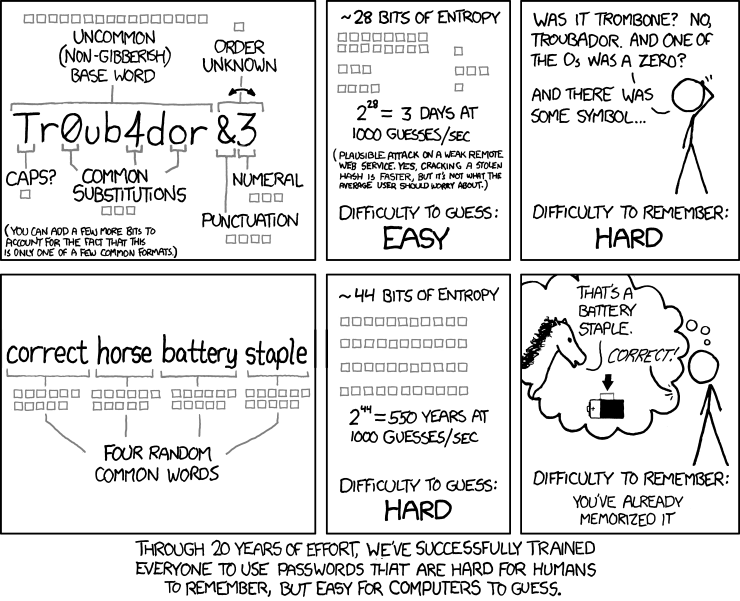
It is inspired by Randall Munroe's xkcd webcomic #936 with the title "Password Strength":
Installation
The passphrase command-line interface can be installed via
go get:
go get github.com/blueimp/passphrase/passphrase
Usage
By default, passphrase prints four space-separated words, but also accepts
an argument for the number of words to generate:
passphrase [number]
The concurrency limit for random number generation (default: 128) can be
adjusted with the environment variable PASSPHRASE_MAX_WORKER_COUNT:
PASSPHRASE_MAX_WORKER_COUNT=1000 passphrase 1000
Import
The passphrase library can be imported and used with any type
implementing the io.Writer interface, e.g.
os.Stdout:
package main

import (
	"fmt"
	"os"

	"github.com/blueimp/passphrase"
)

var exit = os.Exit

func main() {
	_, err := passphrase.Write(os.Stdout, 4)
	if err != nil {
		fmt.Fprintln(os.Stderr, err)
		exit(1)
	}
	fmt.Println()
}
Or alternatively with a simple string return value:
package main

import (
	"fmt"
	"os"

	"github.com/blueimp/passphrase"
)

var exit = os.Exit

func main() {
	pass, err := passphrase.String(4)
	if err != nil {
		fmt.Fprintln(os.Stderr, err)
		exit(1)
	}
	fmt.Println(pass)
}
Word list
This repository includes the word list google-10000-english-usa-no-swears.txt
from Josh Kaufman's repository
google-10000-english,
but passphrase can also be compiled with another list of newline separated
words.
The words module can be generated the following way:
WORD_LIST_URL=words.txt MIN_WORD_LENGTH=3 make words
The WORD_LIST_URL variable can point to a URL or a local file path and falls
back to words.txt.
Words shorter than MIN_WORD_LENGTH (defaults to a minimum word length of 3
characters) are filtered out.
The updated word list module can then be used in a new build.
Build
First, clone the project and then switch into its source directory:
git clone https://github.com/blueimp/passphrase.git
cd passphrase
Please note:
This project relies on Go modules
for automatic dependency resolution.
To build the CLI binary, run Make in the repository:
make
The locally built binary can be installed at $GOPATH/bin/passphrase with the
following command:
make install
The uninstall command removes the binary from $GOPATH/bin/passphrase:
make uninstall
To clean up all build artifacts, run the following:
make clean
Test
All components come with unit tests, which can be executed the following way:
make test
Google App Engine
Passphrase can be deployed as Google App Engine application.
The application accepts a query parameter n to define the number of words to
generate, but limits the sequence to 100 words, e.g.:
https://PROJECT.appspot.com/?n=100
Requirements
App engine development and deployment requires the
Google Cloud SDK
with the app-engine-go component.
On MacOS, google-cloud-sdk can be installed via
Homebrew Cask.
brew cask install google-cloud-sdk
gcloud components install app-engine-go
To make dev_appserver.py available in the PATH, a symlink has to be added:
ln -s /usr/local/Caskroom/google-cloud-sdk/latest/google-cloud-sdk/bin/dev_* \
	/usr/local/bin/
The local watch task requires entr to be installed, which is available in the repositories of popular Linux distributions and can be installed on MacOS via Homebrew:
brew install entr
Environment variables
The following variables have to be set, e.g. by adding them to a .env file,
which gets included in the provided Makefile:
# The App Engine project:
PROJECT=passphrasebot
# The App Engine project version:
VERSION=1
Deploy
To deploy the application, execute the following:
make deploy
To open the URL of the application in a browser tab, run the following:
make browse
Local development
To start a local App Engine server, run the following:
make start
On MacOS, to also automatically reload the active Chrome/Safari/Firefox tab, run the following:
[BROWSER=chrome|safari|firefox] make watch
AWS Lambda
Passphrase can be deployed as AWS lambda function with an API Gateway triggger.
The function accepts a query parameter n to define the number of words to
generate, but limits the sequence to 100 words, e.g.:
https://API_GW_ID.execute-api.REGION.amazonaws.com/Prod?n=100
Requirements
Deployment requires the AWS CLI as well as
aws-vault for secure credentials
access.
Alternatively, it's also possible to reset the wrapped aws CLI command by
exporting AWS_CLI=aws as environment variable.
Local invocations require AWS SAM Local.
The local watch task requires entr to be installed, which is available in the repositories of popular Linux distributions and can be installed on MacOS via Homebrew:
brew install entr
Environment variables
The following variables have to be set, e.g. by adding them to a .env file,
which gets included in the provided Makefile:
# Platform to use for local development and deployment (appengine or lambda):
PLATFORM=lambda
# The AWS profile to use for aws-vault:
AWS_PROFILE=default
# The S3 bucket where the lambda package can be uploaded:
DEPLOYMENT_BUCKET=example-bucket
# The S3 object prefix for the lambda package:
DEPLOYMENT_PREFIX=passphrase
# The CloudFormation stack name:
STACK_NAME=passphrase
# The name of an existing IAM role for AWS Lambda with
# AWSLambdaBasicExecutionRole attached:
LAMBDA_ROLE=arn:aws:iam::000000000000:role/aws-lambda-basic-execution-role
# The AWS service region, required to construct the API Gateway URL:
AWS_REGION=eu-west-1
Build
To build the AWS Lambda function binary, run the following:
make lambda
Deploy
To package and deploy the function, execute the following:
make deploy
After the deployment succeeds, the API Gateway URL is printed.
This URL can also be retrieved later with the following command:
make url
To remove the AWS Lambda function and API Gateway configuration, execute the following:
make destroy
Local development
Using AWS SAM Local, the function can also be invoked and served locally.
A sample API Gateway event can be generated the following way:
make event
To invoke the function locally, execute the following:
make invoke
To start the local API Gateway along with a watch process for source file changes, run the following:
[BROWSER=chrome|safari|firefox] make watch
The watch task recompiles the lambda binary on changes.
On MacOS, it also automatically reloads the active Chrome/Safari/Firefox tab.
License
Released under the MIT license.
 Documentation

Documentation

Overview 
Code generated by go generate; DO NOT EDIT. This file was auto-generated at 2018-11-17 22:46:09.610588 +0100 CET m=+0.002312625 using data from words.txt.
Index 
Constants 
This section is empty.
Variables 
var MaxWorkerCount = 128
MaxWorkerCount sets the concurrency limit for random number generation.
var MinWordLength = 3
MinWordLength defines the minimum length for the individual passphrase words.
var Words = [...]string{}/* 9467 elements not displayed */
Words is the list of strings used for the random passphrase generation.
Functions 
Types 
This section is empty.
 Source Files
 Directories