

 README

README




[!NOTE] Portions of this project were developed with the assistance of AI tools.
[!WARNING] g0efilter is in active development and its configuration may change often.
g0efilter is a lightweight container that filters outbound (egress) traffic from attached container workloads. Run it alongside your workloads, attach them with network_mode: "service:g0efilter", and enforce an IP and domain policy without terminating TLS.
Features
- Egress filtering by IP/CIDR and domain, default-deny with an allowlist
- Flexible domain patterns: exact names, wildcards anywhere (
*.example.com,bucket.*.r2.example.com), and regex (/^cache-[0-9]+\.example\.com$/) - Three filter modes:
https(SNI/Host inspection),dns(resolution filtering),dns-strict(resolution filtering plus kernel connection-time enforcement) - Default-allow (denylist) mode: allow everything except listed domains/IPs
- Learning mode: observe without blocking and auto-build the allowlist
- Audit mode: dry-run a policy; would-be blocks are logged, nothing breaks
- Process attribution: flow logs can carry the owning PID/command (opt-in)
- Live policy reloading, real-time dashboard, remote unblock, Gotify notifications
Quick start
See examples for ready-to-run compose files and policies.
How it works
Attached containers share g0efilter's network namespace. Traffic to allowlisted IPs/CIDRs passes through directly; everything else is handled by the selected FILTER_MODE:
https mode (default): TLS SNI / HTTP Host inspection
Outbound traffic on ports 80/443 is redirected by nftables to local proxy services inside g0efilter. The proxies read the HTTP Host header (port 80) or the TLS SNI from the ClientHello (port 443, without terminating TLS) and check it against the policy. Allowed connections are spliced through to the original destination at kernel speed; blocked connections are reset. Traffic on other ports is dropped unless the destination IP is allowlisted.
Start
|
+- Destination IP in allowlist? -- Yes -> ALLOW (no redirect)
|
+- Connection already established? -- Yes -> ALLOW
|
+- Destination port 80/443? -- No -> BLOCK
|
+- Redirect to local proxy, extract Host header / SNI
|
+- Domain matches policy? -- Yes -> FORWARD to original destination
|                          -- No  -> DROP (connection reset)
|
+- LOG decision -> dashboard (if enabled)
Strengths: precise per-connection domain checks, works with CDNs and changing IPs. Limits: domain filtering applies to ports 80/443 only; a client that sends no SNI is blocked (default-deny).
dns mode: resolution filtering
All DNS (UDP/TCP port 53) is redirected to an internal DNS proxy. Allowed domains resolve normally through the upstream resolver; non-allowlisted A/AAAA queries are sinkholed to 0.0.0.0/:: and other blocked query types get NXDOMAIN.
Start
|
+- DNS query to port 53? -- No -> PASS (no domain check)
|
+- Redirect to local DNS proxy
|
+- Domain matches policy? -- Yes -> FORWARD to upstream resolver
|                          -- No  -> SINKHOLE A/AAAA or NXDOMAIN
|
+- LOG decision -> dashboard (if enabled)
Strengths: covers every protocol and port, cheapest data path (no proxying of the traffic itself).
Limits: enforcement happens at resolution only. A process that connects to a hardcoded IP, uses DNS-over-HTTPS, or replays a cached answer bypasses filtering entirely. Use dns-strict to close that gap.
dns-strict mode: resolution filtering plus connection-time enforcement
Everything dns mode does, plus: when an allowed domain resolves, the proxy pushes the answer's A/AAAA addresses into a kernel nftables set with a TTL-bounded timeout (60s floor, 24h cap), before the client sees the answer. The filter chain is default-drop, so connections to any IP that was never resolved through the proxy (hardcoded IPs, DoH, cached answers) are dropped.
Start
|
+- Destination IP in allowlist/resolved set? -- Yes -> ALLOW
|
+- DNS query to port 53? -- Yes -> Redirect to DNS proxy
|      |
|      +- Domain matches policy? -- Yes -> Resolve, add answer IPs, return answer
|      |                          -- No  -> SINKHOLE A/AAAA or NXDOMAIN
|
+- Connection already established? -- Yes -> ALLOW
|
+- BLOCK
|
+- LOG decision -> dashboard (if enabled)
- Enforcement covers all ports and both IPv4/IPv6, entirely in the kernel
- Entries expire with the DNS TTL; established connections survive expiry via conntrack
- Resolved entries are flushed on policy reload and repopulate on the next resolution
- Requires
default_action: deny; under default-allow or learning mode it degrades to plain dns mode with a warning
[!NOTE] Attached containers must not bind to ports used by g0efilter:
HTTP_PORT(8080),HTTPS_PORT(8443), andDNS_PORT(53) in dns modes.
Policy
allowlist:
  ips:
    - "1.1.1.1"
    - "192.168.0.0/16"
  domains:
    - "github.com"                                 # exact
    - "*.alpinelinux.org"                          # wildcard, any subdomain level
    - "bucket.*.r2.cloudflarestorage.com"          # wildcard works mid-name too
    - '/^cache-[0-9]+\.example\.com$/'             # regex (single-quote it in YAML)
Each * matches one or more characters including dots. Regex entries are slash-delimited, matched case-insensitively against the whole hostname (anchoring is automatic), and compiled with Go's linear-time RE2 engine. Ready-made example policies live in examples/policy/.
The policy file live-reloads: edits apply without restarting the container. Mount the policy directory, not the single file, or editors that use atomic save will silently break reloads:
volumes:
  - ./policy/:/app/policy/   # correct
# NOT: - ./policy.yaml:/app/policy.yaml
Environment variables (ALLOWLIST_IPS, ALLOWLIST_DOMAINS, ...) can replace the policy file and take precedence when set.
Default-allow (denylist) mode
Set default_action: allow in the policy file to invert the model: traffic passes unless it matches the denylist. Useful for containers that need broad internet access but should be kept away from analytics/telemetry endpoints or the LAN. An explicit allowlist match always overrides the denylist.
default_action: allow
allowlist:
  domains:
    - "api.github.com"        # explicitly allow this host even though *.github.com is denylisted
denylist:
  ips:
    - "192.168.0.0/16"        # block LAN access
  domains:
    - "*.github.com"          # deny broad GitHub subdomains
    - "*.doubleclick.net"
    - "telemetry.example.com"
Because default_action lives in the policy file, flipping it is a live-reload edit. When it is deny (the default), the denylist is ignored.
Learning mode
LEARNING_MODE=true runs g0efilter observe-only: nothing is blocked and every domain (or destination IP when no SNI/Host is present) not already covered is appended to the policy file. Run it for a representative period, prune the result, then switch back to enforcement.
Audit mode
ENFORCE=audit is a dry run for an existing policy: would-be-blocked traffic is allowed through and logged with the AUDIT action (visible in the dashboard), so you can preview a policy's impact before enforcing it. Unlike learning mode, nothing is written to the policy file.
Process attribution
PROCESS_INFO=true enriches flow logs with the owning process (pid, process_name, cmdline, executable), resolved via /proc and cached per flow. This requires g0efilter to share a PID namespace with the client processes (host deploy, pid: host, or shareProcessNamespace: true); in a plain network-only sidecar the fields degrade to process_name=unknown.
GitHub Actions (CI egress filtering)
g0efilter can filter egress from GitHub Actions runners. The action starts the g0efilter container with host networking, so all traffic from the job (and later steps) is inspected, and adds a report of blocked/audited connections to the job summary.
jobs:
  build:
    runs-on: ubuntu-latest
    steps:
      - name: Filter egress
        uses: g0lab/g0efilter@v0
        with:
          egress-policy: block   # or 'audit' to log without blocking
          allowed-domains: |
            *.npmjs.org
            registry.npmjs.org

      - uses: actions/checkout@v7
      # ... the rest of the job runs behind the filter
| Input | Description | Default |
|---|---|---|
allowed-domains |
Newline-separated domains (wildcards and regex supported) | |
allowed-ips |
Newline-separated IPs/CIDRs | |
egress-policy |
block or audit |
block |
mode |
https (SNI/Host inspection) or dns |
https |
log-level |
g0efilter log level | INFO |
image |
Container image to run | matches the action's release tag, or :latest for branch refs |
GitHub's documented runner communication domains (github.com, api.github.com, *.actions.githubusercontent.com, codeload.github.com, artifact/log storage, release downloads) and the runner's DNS resolvers are always allowed so the workflow itself keeps working. Package registries are not in the baseline - if a step pulls containers or packages, add the registry (ghcr.io, *.pkg.github.com, registry.npmjs.org, ...) to allowed-domains.
[!NOTE] Limitations: GitHub-hosted Ubuntu runners only. Traffic from Docker containers started by later steps is filtered only when they use
--network host; jobs that run inside a container (container:) are not supported.egress-policy: auditrequires a g0efilter release with audit mode (newer than v0.5.13) - on older images it enforcesblock.
Dashboard
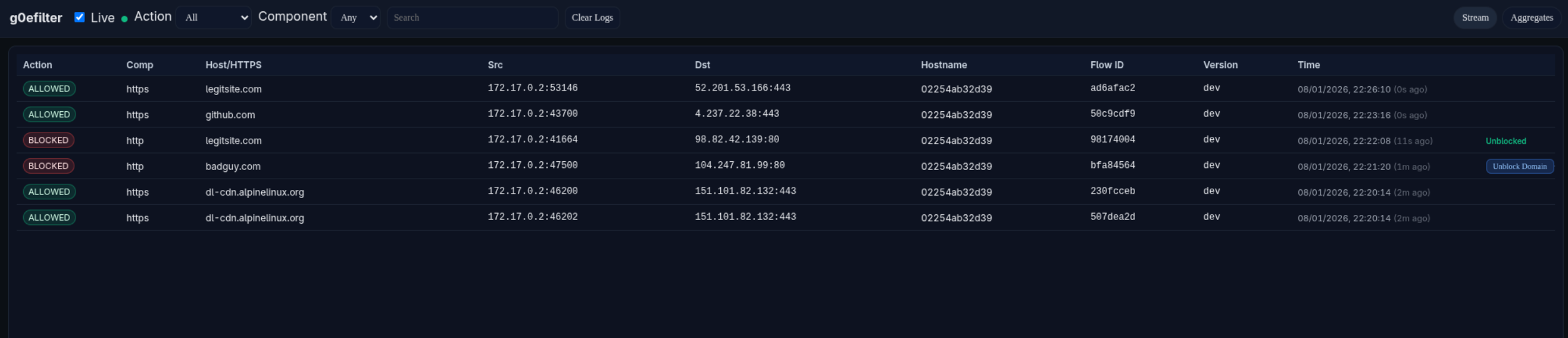
The optional g0efilter-dashboard container serves a web UI on port 8081. Set DASHBOARD_HOST and DASHBOARD_API_KEY on g0efilter to ship logs to it.
Environment variables
g0efilter
| Variable | Description | Default |
|---|---|---|
FILTER_MODE |
https, dns, or dns-strict |
https |
POLICY_PATH |
Path to policy file inside container. When unset, /app/policy.yaml is used if present, then /app/policy/policy.yaml (the directory-mount convention). The file is never auto-created. |
/app/policy.yaml |
DEFAULT_ACTION |
deny (allowlist) or allow (denylist). Policy file default_action wins when set |
deny |
ENFORCE |
block or audit (dry-run: log would-be blocks, allow traffic) |
block |
LEARNING_MODE |
true to observe without blocking and auto-append seen domains/IPs to the policy |
false |
PROCESS_INFO |
true to add pid/process fields to flow logs (needs shared PID namespace) |
false |
ALLOWLIST_IPS |
Comma-separated allowed IPs/CIDRs (takes precedence over policy file) | unset |
ALLOWLIST_DOMAINS |
Comma-separated allowed domains (exact/wildcard/regex) | unset |
DENYLIST_IPS |
Comma-separated denied IPs/CIDRs (with DEFAULT_ACTION=allow) |
unset |
DENYLIST_DOMAINS |
Comma-separated denied domains (with DEFAULT_ACTION=allow) |
unset |
HTTP_PORT |
Local HTTP proxy port | 8080 |
HTTPS_PORT |
Local HTTPS proxy port | 8443 |
DNS_PORT |
DNS listen port | 53 |
DNS_UPSTREAMS |
Upstream DNS servers (comma-separated) | 127.0.0.11:53 |
DNS_HARDENING |
Anti-exfil checks in the DNS proxy: qname/label length caps, NULL and bulky-TXT answer rejection, per-source rate limiting | true |
DNS_RATE_QPS |
Hardening rate limiter: sustained queries/sec per source. All local traffic shares one source behind the NAT redirect, so this bounds the whole host | 50 |
DNS_RATE_BURST |
Hardening rate limiter: burst allowance per source | 100 |
LOG_LEVEL |
TRACE, DEBUG, INFO, WARN, ERROR | INFO |
LOG_FILE |
Optional path for a persistent log file | unset |
HOSTNAME |
Identifies this instance in shipped logs | unset |
DASHBOARD_HOST |
Dashboard URL for log shipping | unset |
DASHBOARD_API_KEY |
Must match API_KEY on the dashboard |
unset |
DASHBOARD_QUEUE_SIZE |
Log buffer before shipping; drops when full | 1024 |
DASHBOARD_START_DELAY |
Delay before log shipping starts (5s, 1m, ...) |
5s |
ENABLE_REMOTE_UNBLOCK |
Poll dashboard for remote unblock requests | false |
UNBLOCK_POLL_INTERVAL |
Unblock poll interval | 10s |
NOTIFICATION_HOST |
Gotify server URL for blocked-traffic alerts | unset |
NOTIFICATION_KEY |
Gotify application key | unset |
NOTIFICATION_BACKOFF_SECONDS |
Duplicate-alert backoff | 60 |
NOTIFICATION_IGNORE_DOMAINS |
Domains to skip for notifications (wildcards ok) | unset |
NFLOG_BUFSIZE |
Netfilter log buffer size | 96 |
NFLOG_QTHRESH |
Netfilter log queue threshold | 50 |
[!NOTE] Most hosts need no DNS source-port tuning. In DNS modes, upstream UDP forwards bind to
61000-64999to avoid conntrack collisions with redirected client queries. If you widennet.ipv4.ip_local_port_rangepast60999, reserve that window withnet.ipv4.ip_local_reserved_ports.
g0efilter-dashboard
| Variable | Description | Default |
|---|---|---|
PORT |
Listen address/port for UI and API | :8081 |
API_KEY |
Authenticates log ingestion from g0efilter | unset |
LOG_LEVEL |
TRACE, DEBUG, INFO, WARN, ERROR | INFO |
BUFFER_SIZE |
In-memory event buffer; oldest dropped when full | 5000 |
READ_LIMIT |
Max events per API request | 5000 |
SSE_RETRY_MS |
SSE client retry interval (ms) | 2000 |
WRITE_TIMEOUT |
HTTP write timeout in seconds (0 = none, recommended for SSE) | 0 |
RATE_RPS |
Rate limit, requests per second | 50 |
RATE_BURST |
Rate limit burst | 100 |
Remote unblock
Administrators can unblock domains/IPs from the dashboard UI; g0efilter instances poll for pending requests and update their policy files.
[!WARNING] Disabled by default. Only enable behind authentication middleware:
POST /api/v1/unblocksmust be protected (Authelia, Authentik, PocketID, ...) or anyone reaching the dashboard can modify your allowlist.
API endpoints and example Traefik configuration
| Endpoint | Auth | Description |
|---|---|---|
GET /health |
None | Health check |
POST /api/v1/logs |
API Key | Log ingestion from g0efilter |
GET /api/v1/unblocks?hostname=X |
API Key | Poll pending unblocks (g0efilter) |
POST /api/v1/unblocks/ack |
API Key | Acknowledge processed unblock (g0efilter) |
GET / |
Middleware | Dashboard web UI |
GET /api/v1/config |
Middleware | Server configuration for UI |
GET /api/v1/logs |
Middleware | Read logs |
GET /api/v1/events |
Middleware | Server-Sent Events stream |
DELETE /api/v1/logs |
Middleware | Clear logs |
POST /api/v1/unblocks |
Middleware | Create unblock request (UI) |
GET /api/v1/unblocks/status |
Middleware | Poll unblock status (UI) |
Two Traefik routers handle the different auth requirements: an ingest router (API-key endpoints, no SSO) and a dashboard router (everything else behind your auth middleware).
http:
  routers:
    g0efilter-ingest-router:
      entryPoints:
        - websecure
      rule: "Host(`g0efilter.example.com`) && ((PathPrefix(`/api/v1/logs`) && Method(`POST`)) || PathPrefix(`/health`) || (Path(`/api/v1/unblocks`) && Method(`GET`) && QueryRegexp(`hostname`, `^.+$`)) || (Path(`/api/v1/unblocks/ack`) && Method(`POST`)))"
      service: g0efilter-dash-service
      middlewares:
        - security-headers
        - ratelimit
      tls:
        certResolver: letsencrypt

    g0efilter-dash-router:
      entryPoints:
        - websecure
      rule: "Host(`g0efilter.example.com`)"
      service: g0efilter-dash-service
      middlewares:
        - security-headers
        - ratelimit
        - auth-oidc  # your auth middleware
      tls:
        certResolver: letsencrypt

  services:
    g0efilter-dash-service:
      loadBalancer:
        servers:
          - url: "http://g0efilter-dashboard:8081"
Example docker-compose.yaml
services:
  g0efilter:
    image: docker.io/g0lab/g0efilter:latest
    container_name: g0efilter
    volumes:
      - ./policy/:/app/policy/   # directory mount, see Policy section
    cap_drop:
      - ALL
    cap_add:
      - NET_ADMIN                # required for nftables
    security_opt:
      - no-new-privileges
    ports:
      - 8081:8081                # dashboard (runs in the same netns)
    read_only: true
    restart: always
    env_file:
      - .env

  g0efilter-dashboard:
    image: docker.io/g0lab/g0efilter-dashboard:latest
    container_name: g0efilter-dashboard
    cap_drop:
      - ALL
    security_opt:
      - no-new-privileges
    read_only: true
    env_file:
      - .env.dashboard
    network_mode: "service:g0efilter"
    restart: always

  example-container:
    image: docker.io/alpine/curl:latest
    command: sh -c "sleep infinity"
    network_mode: "service:g0efilter"
Verifying container signatures
Images are signed with Cosign keyless signing:
cosign verify g0lab/g0efilter:latest \
  --certificate-identity-regexp=https://github.com/g0lab/g0efilter \
  --certificate-oidc-issuer=https://token.actions.githubusercontent.com \
  -o text
(Repeat with g0lab/g0efilter-dashboard:latest for the dashboard image.)
License
MIT, see LICENSE.
 Directories

Directories

| Path | Synopsis |
|---|---|
|
cmd
|
|
|
g0efilter
command
Package main is the entrypoint for g0efilter.
|
Package main is the entrypoint for g0efilter. |
|
g0efilter-dashboard
command
Package main is the entrypoint for g0efilter-dashboard.
|
Package main is the entrypoint for g0efilter-dashboard. |
|
internal
|
|
|
actions
Package actions defines shared action and filter mode constants used across multiple internal packages without introducing import cycles.
|
Package actions defines shared action and filter mode constants used across multiple internal packages without introducing import cycles. |
|
alerting
Package alerting provides notification capabilities for security events.
|
Package alerting provides notification capabilities for security events. |
|
dashboard
Package dashboard provides the web UI and HTTP API server.
|
Package dashboard provides the web UI and HTTP API server. |
|
filter
Package filter provides network filtering utilities.
|
Package filter provides network filtering utilities. |
|
g0efilter
Package g0efilter contains the g0efilter application wiring and run loop.
|
Package g0efilter contains the g0efilter application wiring and run loop. |
|
logging
Package logging provides logging helpers.
|
Package logging provides logging helpers. |
|
netutil
Package netutil provides the SO_MARK dialer that lets g0efilter's own outbound traffic (proxy upstreams, dashboard shipping, notifications) bypass its nftables rules.
|
Package netutil provides the SO_MARK dialer that lets g0efilter's own outbound traffic (proxy upstreams, dashboard shipping, notifications) bypass its nftables rules. |
|
nftables
Package nftables provides nftables integration.
|
Package nftables provides nftables integration. |
|
policy
Package policy parses and validates the allowlist policy file.
|
Package policy parses and validates the allowlist policy file. |
|
procinfo
Package procinfo resolves the process that owns a local socket by walking /proc, for log enrichment.
|
Package procinfo resolves the process that owns a local socket by walking /proc, for log enrichment. |
|
safeio
Package safeio provides helpers to safely drain and close readers.
|
Package safeio provides helpers to safely drain and close readers. |