

 README

README

DelayQueue



DelayQueue is a message queue supporting delayed/scheduled delivery based on redis.
Core Advantages:
- Support ACK/Retry mechanism, it will re-deliver message after a while as long as no confirmation is received. As long as Redis doesn't crash, consumer crashes won't cause message loss.
- Works safely in a distributed environment, you could deliver message to same queue or consume message from same queue at multiple machines.
- A message will be consumed by one and only one consumer.
- Consumers control the flow of messages, NO NEED FOR ANY OTHER MIDDLEWARES except redis.
Install
DelayQueue requires a Go version with modules support. Run following command line in your project with go.mod:
go get github.com/hdt3213/delayqueue
if you are using github.com/go-redis/redis/v8 please use
go get github.com/hdt3213/delayqueue@v8
Get Started
package main

import (
	"github.com/redis/go-redis/v9"
	"github.com/hdt3213/delayqueue"
	"strconv"
	"time"
)

func main() {
	redisCli := redis.NewClient(&redis.Options{
		Addr: "127.0.0.1:6379",
	})
	queue := delayqueue.NewQueue("example", redisCli, func(payload string) bool {
		// callback returns true to confirm successful consumption.
		// If callback returns false or not return within maxConsumeDuration, DelayQueue will re-deliver this message
		return true
	}).WithConcurrent(4) // set the number of concurrent consumers
	// send delay message
	for i := 0; i < 10; i++ {
		err := queue.SendDelayMsg(strconv.Itoa(i), time.Hour, delayqueue.WithRetryCount(3))
		if err != nil {
			panic(err)
		}
	}
	// send schedule message
	for i := 0; i < 10; i++ {
		err := queue.SendScheduleMsg(strconv.Itoa(i), time.Now().Add(time.Hour))
		if err != nil {
			panic(err)
		}
	}
	// start consume
	done := queue.StartConsume()
	<-done
}
Options
WithLogger(logger *log.Logger)
WithLogger customizes logger for queue
WithConcurrent(c uint)
WithConcurrent sets the number of concurrent consumers
WithFetchInterval(d time.Duration)
WithFetchInterval customizes the interval at which consumer fetch message from redis
WithMaxConsumeDuration(d time.Duration)
WithMaxConsumeDuration customizes max consume duration
If no acknowledge received within WithMaxConsumeDuration after message delivery, DelayQueue will try to deliver this message again
WithFetchLimit(limit uint)
WithFetchLimit limits the max number of unack (processing) messages
UseHashTagKey()
UseHashTagKey add hashtags to redis keys to ensure all keys of this queue are allocated in the same hash slot.
If you are using Codis/AliyunRedisCluster/TencentCloudRedisCluster, you should add this option to NewQueue: NewQueue("test", redisCli, cb, UseHashTagKey()). This Option cannot be changed after DelayQueue has been created.
WARNING! CHANGING(add or remove) this option will cause DelayQueue failing to read existed data in redis
see more: https://redis.io/docs/reference/cluster-spec/#hash-tags
WithDefaultRetryCount(count uint)
WithDefaultRetryCount customizes the max number of retry, it effects of messages in this queue
use WithRetryCount during DelayQueue.SendScheduleMsg or DelayQueue.SendDelayMsg to specific retry count of particular message
More Details
Here is the complete flowchart:
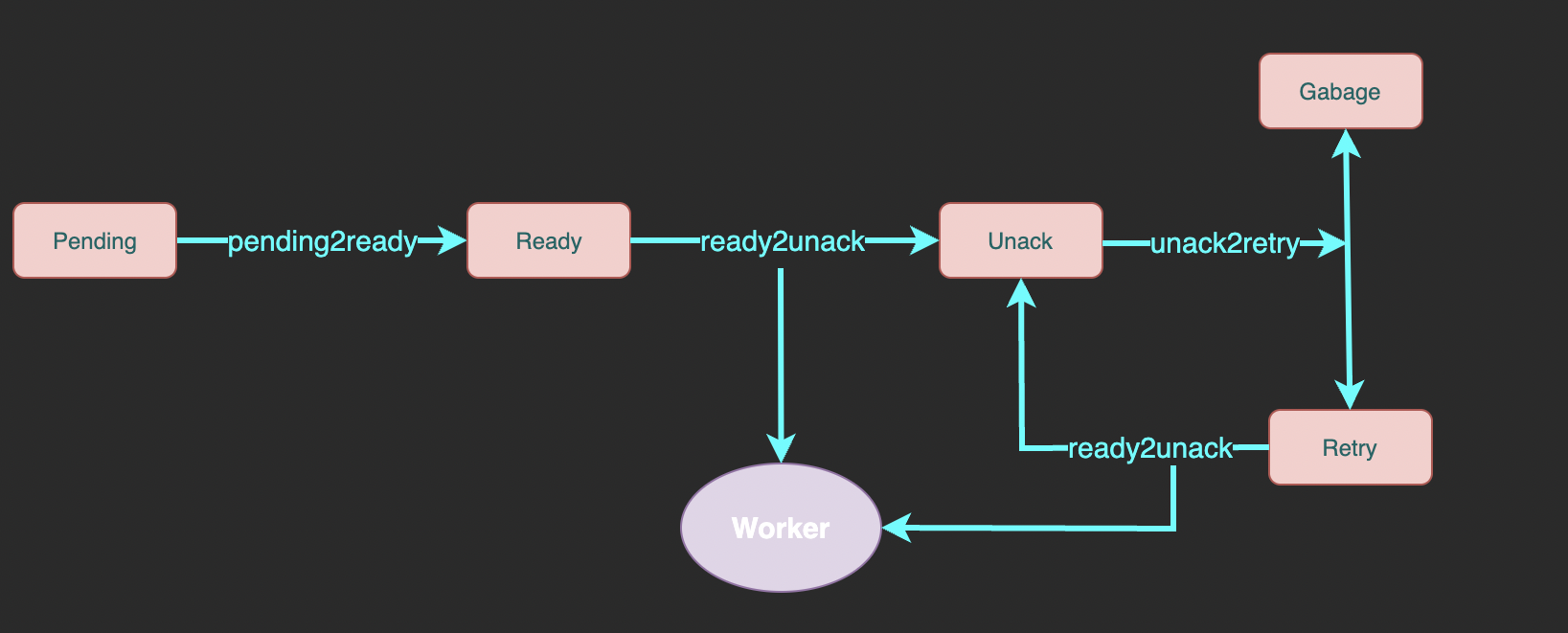
- pending: A sorted set of messages pending for delivery.
memberis message id,scoreis delivery unix timestamp. - ready: A list of messages ready to deliver. Workers fetch messages from here.
- unack: A sorted set of messages waiting for ack (successfully consumed confirmation) which means the messages here is being processing.
memberis message id,scoreis the unix timestamp of processing deadline. - retry: A list of messages which processing exceeded deadline and waits for retry
- garbage: A list of messages reaching max retry count and waits for cleaning
 Documentation

Documentation

Index 
- func UseHashTagKey() interface{}
- func WithMsgTTL(d time.Duration) interface{}
- func WithRetryCount(count int) interface{}
- type DelayQueue
- func (q *DelayQueue) SendDelayMsg(payload string, duration time.Duration, opts ...interface{}) error
- func (q *DelayQueue) SendScheduleMsg(payload string, t time.Time, opts ...interface{}) error
- func (q *DelayQueue) StartConsume() (done <-chan struct{})
- func (q *DelayQueue) StopConsume()
- func (q *DelayQueue) WithConcurrent(c uint) *DelayQueue
- func (q *DelayQueue) WithDefaultRetryCount(count uint) *DelayQueue
- func (q *DelayQueue) WithFetchInterval(d time.Duration) *DelayQueue
- func (q *DelayQueue) WithFetchLimit(limit uint) *DelayQueue
- func (q *DelayQueue) WithLogger(logger *log.Logger) *DelayQueue
- func (q *DelayQueue) WithMaxConsumeDuration(d time.Duration) *DelayQueue
Constants 
This section is empty.
Variables 
This section is empty.
Functions 
func UseHashTagKey ¶ added in v1.0.3
func UseHashTagKey() interface{}
UseHashTagKey add hashtags to redis keys to ensure all keys of this queue are allocated in the same hash slot. If you are using Codis/AliyunRedisCluster/TencentCloudRedisCluster, add this option to NewQueue WARNING! Changing (add or remove) this option will cause DelayQueue failing to read existed data in redis see more: https://redis.io/docs/reference/cluster-spec/#hash-tags
func WithMsgTTL ¶ added in v1.0.2
WithMsgTTL set ttl for a msg example: queue.SendDelayMsg(payload, duration, delayqueue.WithMsgTTL(Hour))
func WithRetryCount 
func WithRetryCount(count int) interface{}
WithRetryCount set retry count for a msg example: queue.SendDelayMsg(payload, duration, delayqueue.WithRetryCount(3))
Types 
type DelayQueue 
type DelayQueue struct {
	// contains filtered or unexported fields
}
DelayQueue is a message queue supporting delayed/scheduled delivery based on redis
func NewQueue 
func NewQueue(name string, cli *redis.Client, callback func(string) bool, opts ...interface{}) *DelayQueue
NewQueue creates a new queue, use DelayQueue.StartConsume to consume or DelayQueue.SendScheduleMsg to publish message callback returns true to confirm successful consumption. If callback returns false or not return within maxConsumeDuration, DelayQueue will re-deliver this message
func (*DelayQueue) SendDelayMsg 
func (q *DelayQueue) SendDelayMsg(payload string, duration time.Duration, opts ...interface{}) error
SendDelayMsg submits a message delivered after given duration
func (*DelayQueue) SendScheduleMsg 
func (q *DelayQueue) SendScheduleMsg(payload string, t time.Time, opts ...interface{}) error
SendScheduleMsg submits a message delivered at given time
func (*DelayQueue) StartConsume 
func (q *DelayQueue) StartConsume() (done <-chan struct{})
StartConsume creates a goroutine to consume message from DelayQueue use `<-done` to wait consumer stopping
func (*DelayQueue) StopConsume 
func (q *DelayQueue) StopConsume()
StopConsume stops consumer goroutine
func (*DelayQueue) WithConcurrent ¶ added in v1.0.1
func (q *DelayQueue) WithConcurrent(c uint) *DelayQueue
WithConcurrent sets the number of concurrent consumers
func (*DelayQueue) WithDefaultRetryCount ¶ added in v1.0.1
func (q *DelayQueue) WithDefaultRetryCount(count uint) *DelayQueue
WithDefaultRetryCount customizes the max number of retry, it effects of messages in this queue use WithRetryCount during DelayQueue.SendScheduleMsg or DelayQueue.SendDelayMsg to specific retry count of particular message
func (*DelayQueue) WithFetchInterval 
func (q *DelayQueue) WithFetchInterval(d time.Duration) *DelayQueue
WithFetchInterval customizes the interval at which consumer fetch message from redis
func (*DelayQueue) WithFetchLimit 
func (q *DelayQueue) WithFetchLimit(limit uint) *DelayQueue
WithFetchLimit limits the max number of unack (processing) messages
func (*DelayQueue) WithLogger 
func (q *DelayQueue) WithLogger(logger *log.Logger) *DelayQueue
WithLogger customizes logger for queue
func (*DelayQueue) WithMaxConsumeDuration 
func (q *DelayQueue) WithMaxConsumeDuration(d time.Duration) *DelayQueue
WithMaxConsumeDuration customizes max consume duration If no acknowledge received within WithMaxConsumeDuration after message delivery, DelayQueue will try to deliver this message again
 Source Files
 Directories