

 README

README

cidranger
Fast IP to CIDR block(s) lookup using trie in Golang, inspired by IPv4 route lookup linux. Possible use cases include detecting if a IP address is from published cloud provider CIDR blocks (e.g. 52.95.110.1 is contained in published AWS Route53 CIDR 52.95.110.0/24), IP routing rules, etc.



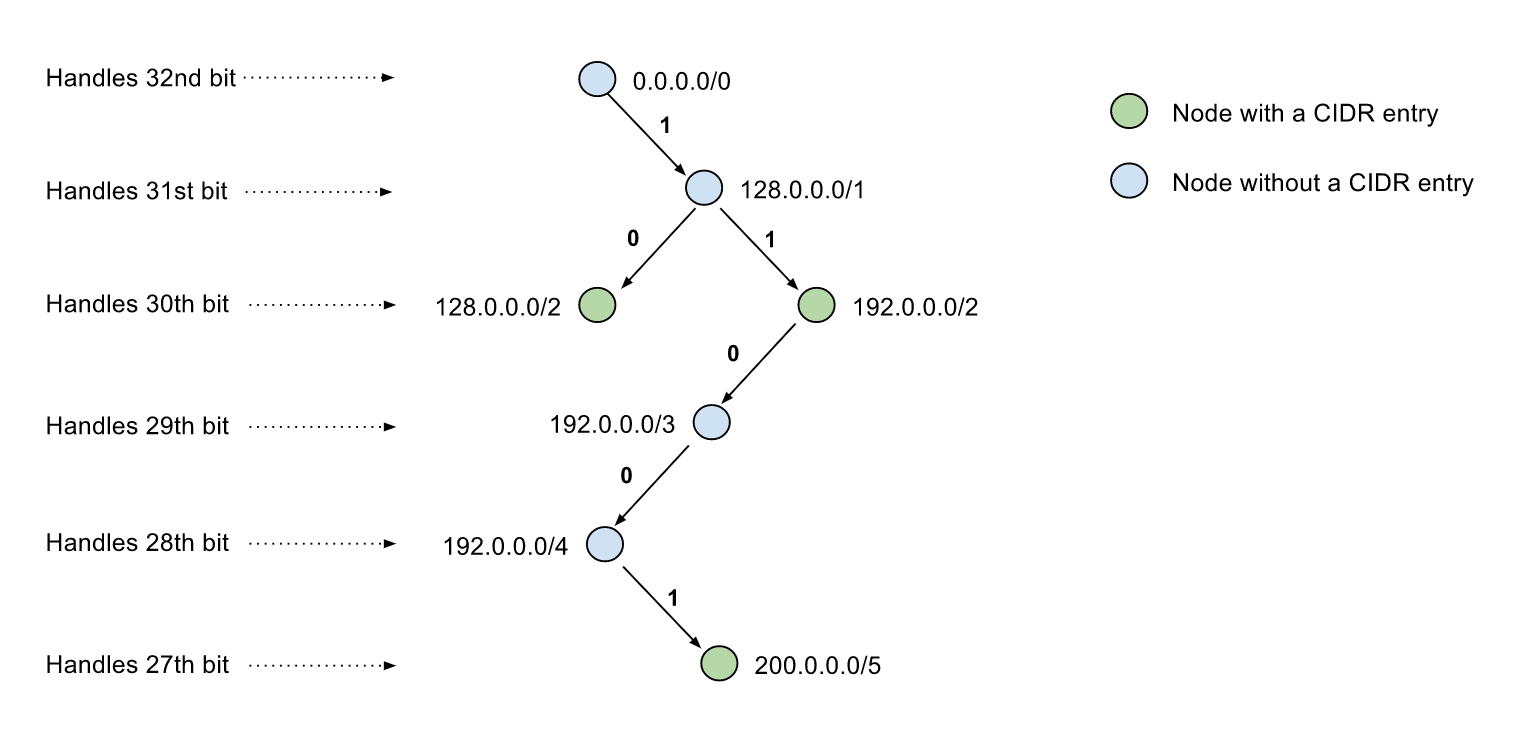
This is visualization of a trie storing CIDR blocks 128.0.0.0/2 192.0.0.0/2 200.0.0.0/5 without path compression, the 0/1 number on the path indicates the bit value of the IP address at specified bit position, hence the path from root node to a child node represents a CIDR block that contains all IP ranges of its children, and children's children.
Visualization of trie storing same CIDR blocks with path compression, improving both lookup speed and memory footprint.

Getting Started
Configure imports.
import (
  "net"

  "github.com/yl2chen/cidranger"
)
Create a new ranger implemented using Path-Compressed prefix trie.
ranger := NewPCTrieRanger()
Inserts CIDR blocks.
_, network1, _ := net.ParseCIDR("192.168.1.0/24")
_, network2, _ := net.ParseCIDR("128.168.1.0/24")
ranger.Insert(NewBasicRangerEntry(*network1))
ranger.Insert(NewBasicRangerEntry(*network2))
To attach any additional value(s) to the entry, simply create custom struct storing the desired value(s) that implements the RangerEntry interface:
type RangerEntry interface {
	Network() net.IPNet
}
The prefix trie can be visualized as:
0.0.0.0/0 (target_pos:31:has_entry:false)
| 1--> 128.0.0.0/1 (target_pos:30:has_entry:false)
| | 0--> 128.168.1.0/24 (target_pos:7:has_entry:true)
| | 1--> 192.168.1.0/24 (target_pos:7:has_entry:true)
To test if given IP is contained in constructed ranger,
contains, err = ranger.Contains(net.ParseIP("128.168.1.0")) // returns true, nil
contains, err = ranger.Contains(net.ParseIP("192.168.2.0")) // returns false, nil
To get all the networks given is contained in,
containingNetworks, err = ranger.ContainingNetworks(net.ParseIP("128.168.1.0"))
To get all networks in ranger,
entries, err := ranger.CoveredNetworks(*AllIPv4) // for IPv4
entries, err := ranger.CoveredNetworks(*AllIPv6) // for IPv6
Benchmark
Compare hit/miss case for IPv4/IPv6 using PC trie vs brute force implementation, Ranger is initialized with published AWS ip ranges (889 IPv4 CIDR blocks and 360 IPv6)
// Ipv4 lookup hit scenario
BenchmarkPCTrieHitIPv4UsingAWSRanges-4         	 5000000	       353   ns/op
BenchmarkBruteRangerHitIPv4UsingAWSRanges-4    	  100000	     13719   ns/op

// Ipv6 lookup hit scenario, counter-intuitively faster then IPv4 due to less IPv6 CIDR
// blocks in the AWS dataset, hence the constructed trie has less path splits and depth.
BenchmarkPCTrieHitIPv6UsingAWSRanges-4         	10000000	       143   ns/op
BenchmarkBruteRangerHitIPv6UsingAWSRanges-4    	  300000	      5178   ns/op

// Ipv4 lookup miss scenario
BenchmarkPCTrieMissIPv4UsingAWSRanges-4        	20000000	        96.5 ns/op
BenchmarkBruteRangerMissIPv4UsingAWSRanges-4   	   50000	     24781   ns/op

// Ipv6 lookup miss scenario
BenchmarkPCTrieHMissIPv6UsingAWSRanges-4       	10000000	       115   ns/op
BenchmarkBruteRangerMissIPv6UsingAWSRanges-4   	  100000	     10824   ns/op
Example of IPv6 trie:
::/0 (target_pos:127:has_entry:false)
| 0--> 2400::/14 (target_pos:113:has_entry:false)
| | 0--> 2400:6400::/22 (target_pos:105:has_entry:false)
| | | 0--> 2400:6500::/32 (target_pos:95:has_entry:false)
| | | | 0--> 2400:6500::/39 (target_pos:88:has_entry:false)
| | | | | 0--> 2400:6500:0:7000::/53 (target_pos:74:has_entry:false)
| | | | | | 0--> 2400:6500:0:7000::/54 (target_pos:73:has_entry:false)
| | | | | | | 0--> 2400:6500:0:7000::/55 (target_pos:72:has_entry:false)
| | | | | | | | 0--> 2400:6500:0:7000::/56 (target_pos:71:has_entry:true)
| | | | | | | | 1--> 2400:6500:0:7100::/56 (target_pos:71:has_entry:true)
| | | | | | | 1--> 2400:6500:0:7200::/56 (target_pos:71:has_entry:true)
| | | | | | 1--> 2400:6500:0:7400::/55 (target_pos:72:has_entry:false)
| | | | | | | 0--> 2400:6500:0:7400::/56 (target_pos:71:has_entry:true)
| | | | | | | 1--> 2400:6500:0:7500::/56 (target_pos:71:has_entry:true)
| | | | | 1--> 2400:6500:100:7000::/54 (target_pos:73:has_entry:false)
| | | | | | 0--> 2400:6500:100:7100::/56 (target_pos:71:has_entry:true)
| | | | | | 1--> 2400:6500:100:7200::/56 (target_pos:71:has_entry:true)
| | | | 1--> 2400:6500:ff00::/64 (target_pos:63:has_entry:true)
| | | 1--> 2400:6700:ff00::/64 (target_pos:63:has_entry:true)
| | 1--> 2403:b300:ff00::/64 (target_pos:63:has_entry:true)
 Documentation

Documentation

Overview 
Package cidranger provides utility to store CIDR blocks and perform ip inclusion tests against it.
To create a new instance of the path-compressed trie:
ranger := NewPCTrieRanger()
To insert or remove an entry (any object that satisfies the RangerEntry interface):
_, network, _ := net.ParseCIDR("192.168.0.0/24")
ranger.Insert(NewBasicRangerEntry(*network))
ranger.Remove(network)
If you desire for any value to be attached to the entry, simply create custom struct that satisfies the RangerEntry interface:
type RangerEntry interface {
	Network() net.IPNet
}
To test whether an IP is contained in the constructed networks ranger:
// returns bool, error
containsBool, err := ranger.Contains(net.ParseIP("192.168.0.1"))
To get a list of CIDR blocks in constructed ranger that contains IP:
// returns []RangerEntry, error
entries, err := ranger.ContainingNetworks(net.ParseIP("192.168.0.1"))
To get a list of all IPv4/IPv6 rangers respectively:
// returns []RangerEntry, error
entries, err := ranger.CoveredNetworks(*AllIPv4)
entries, err := ranger.CoveredNetworks(*AllIPv6)
Index 
Constants 
This section is empty.
Variables 
var AllIPv4 = parseCIDRUnsafe("0.0.0.0/0")
AllIPv4 is a IPv4 CIDR that contains all networks
var AllIPv6 = parseCIDRUnsafe("0::0/0")
AllIPv6 is a IPv6 CIDR that contains all networks
var ErrInvalidNetworkInput = fmt.Errorf("Invalid network input")
ErrInvalidNetworkInput is returned upon invalid network input.
var ErrInvalidNetworkNumberInput = fmt.Errorf("Invalid network number input")
ErrInvalidNetworkNumberInput is returned upon invalid network input.
Functions 
This section is empty.
Types 
type Ranger 
type Ranger interface {
	Insert(entry RangerEntry) error
	Remove(network net.IPNet) (RangerEntry, error)
	Contains(ip net.IP) (bool, error)
	ContainingNetworks(ip net.IP) ([]RangerEntry, error)
	// returns the list of RangerEntry(s) covered by "network".
	// i.e. CoveredNetworks("1.1.1.0/24") would return "1.1.1.1/32" if it's in the cidranger list,
	// but CoveredNetworks("1.1.1.0/24") would never return "1.1.0.0/16".
	CoveredNetworks(network net.IPNet) ([]RangerEntry, error)
	// returns the list of RangerEntry(s) covering "network".
	// i.e. CoveringNetworks("1.1.1.0/24") would return "1.1.0.0/16" if it's in the cidranger list,
	// but CoveringNetworks("1.1.1.0/24") would never return "1.1.1.1/32".
	CoveringNetworks(network net.IPNet) ([]RangerEntry, error)
	// returns the list of RangerEntry(s) that are either covering "network" or covered by "network".
	// i.e. CoveringOrCoveredNetworks("1.1.1.0/24") would return "1.1.0.0/16" if it's in the cidranger list,
	// and CoveringOrCoveredNetworks("1.1.1.0/24") would return "1.1.1.1/32" if it's also in the cidranger list.
	CoveringOrCoveredNetworks(network net.IPNet) ([]RangerEntry, error)
	Len() int
}
Ranger is an interface for cidr block containment lookups.
func NewPCTrieRanger 
func NewPCTrieRanger() Ranger
NewPCTrieRanger returns a versionedRanger that supports both IPv4 and IPv6 using the path compressed trie implemention.
type RangerEntry 
RangerEntry is an interface for insertable entry into a Ranger.
func NewBasicRangerEntry 
func NewBasicRangerEntry(ipNet net.IPNet) RangerEntry
NewBasicRangerEntry returns a basic RangerEntry that only stores the network itself.
 Source Files
 Directories