

 README

README

rum



Package rum implements an HTTP server. The rum server is compatible with net/http and faster than net/http.
Features
- Fully compatible with the http.HandlerFunc interface.
- Support other router that implements the http.Handler interface.
- Epoll / Kqueue
- HTTP request
- HTTP response
- HTTP request multiplexer
- HTTP handler
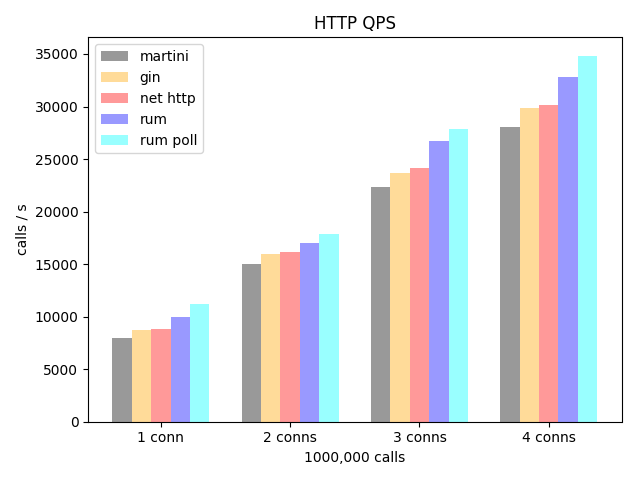
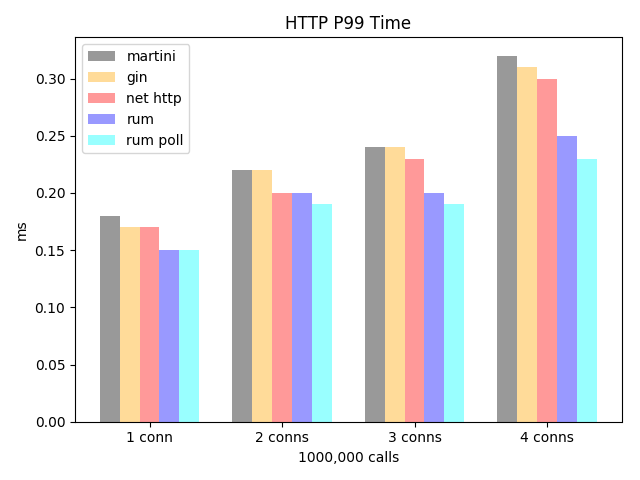
Benchmark
Get started
Install
go get github.com/hslam/rum
Import
import "github.com/hslam/rum"
Usage
Simple Example
package main

import (
	"github.com/hslam/rum"
	"net/http"
)

func main() {
	m := rum.New()
	m.HandleFunc("/", func(w http.ResponseWriter, r *http.Request) {
		w.Write([]byte("Hello World"))
	})
	m.Run(":8080")
}
Hello World
Example
package main

import (
	"github.com/hslam/rum"
	"net/http"
)

func main() {
	m := rum.New()
	m.SetPoll(true)
	m.Recovery(rum.Recovery)
	m.NotFound(func(w http.ResponseWriter, r *http.Request) {
		http.Error(w, "Not Found : "+r.URL.String(), http.StatusNotFound)
	})
	m.Use(func(w http.ResponseWriter, r *http.Request) {
		w.Header().Set("Access-Control-Allow-Origin", "*")
	})
	m.HandleFunc("/", func(w http.ResponseWriter, r *http.Request) {
		w.Write([]byte("Hello World"))
	})
	m.HandleFunc("/hello/:name", func(w http.ResponseWriter, r *http.Request) {
		params := m.Params(r)
		w.Write([]byte("Hello " + params["name"]))
	}).GET()
	m.Group("/group", func(m *rum.Mux) {
		m.HandleFunc("/foo/:id", func(w http.ResponseWriter, r *http.Request) {
			params := m.Params(r)
			w.Write([]byte("group/foo id:" + params["id"]))
		}).GET()
		m.HandleFunc("/bar/:id", func(w http.ResponseWriter, r *http.Request) {
			params := m.Params(r)
			w.Write([]byte("group/bar id:" + params["id"]))
		}).GET()
	})
	m.Run(":8080")
}
curl http://localhost:8080/hello/rum
Hello rum
curl http://localhost:8080/group/foo/1
group/foo id:1
curl http://localhost:8080/group/bar/2
group/bar id:2
Use Other Router Example
The router must implement the http.Handler interface, for example using the http.ServeMux.
package main

import (
	"github.com/hslam/rum"
	"net/http"
)

func main() {
	router := http.NewServeMux()
	router.HandleFunc("/", func(w http.ResponseWriter, r *http.Request) {
		w.Write([]byte("Hello World"))
	})
	server := rum.New()
	server.Handler = router
	server.Run(":8080")
}
License
This package is licensed under a MIT license (Copyright (c) 2020 Meng Huang)
Author
rum was written by Meng Huang.
 Documentation

Documentation

Overview 
Package rum implements an HTTP server.
Index 
- Variables
- func ListenAndServe(addr string, handler http.Handler) error
- func ListenAndServeTLS(addr, certFile, keyFile string, handler http.Handler) error
- func Recovery(w http.ResponseWriter, r *http.Request)
- type Entry
- func (entry *Entry) All()
- func (entry *Entry) CONNECT() *Entry
- func (entry *Entry) DELETE() *Entry
- func (entry *Entry) GET() *Entry
- func (entry *Entry) HEAD() *Entry
- func (entry *Entry) OPTIONS() *Entry
- func (entry *Entry) PATCH() *Entry
- func (entry *Entry) POST() *Entry
- func (entry *Entry) PUT() *Entry
- func (entry *Entry) TRACE() *Entry
- type Mux
- func (m *Mux) Group(group string, f func(m *Mux))
- func (m *Mux) Handle(pattern string, handler http.Handler) *Entry
- func (m *Mux) HandleFunc(pattern string, handler func(http.ResponseWriter, *http.Request)) *Entry
- func (m *Mux) NotFound(handler http.HandlerFunc)
- func (m *Mux) Params(r *http.Request) map[string]string
- func (m *Mux) Recovery(handler http.HandlerFunc)
- func (m *Mux) ServeHTTP(w http.ResponseWriter, r *http.Request)
- func (m *Mux) Use(handler http.HandlerFunc)
- type Rum
- func (m *Rum) Close() error
- func (m *Rum) Run(addr string) error
- func (m *Rum) RunTLS(addr string, certFile, keyFile string) error
- func (m *Rum) Serve(l net.Listener) error
- func (m *Rum) ServeTLS(l net.Listener, certFile, keyFile string) error
- func (m *Rum) SetFast(fast bool)
- func (m *Rum) SetPoll(poll bool)
Constants 
This section is empty.
Variables 
var DefaultServer = New()
DefaultServer is the default HTTP server.
var ErrGroupExisted = errors.New("Group Existed")
ErrGroupExisted is the error returned by Group when registers a existed group.
var ErrParamsKeyEmpty = errors.New("Params key must be not empty")
ErrParamsKeyEmpty is the error returned by HandleFunc when the params key is empty.
var RecoveryContextKey = &contextKey{"recovery"}
RecoveryContextKey is a context key.
Functions 
func ListenAndServe 
ListenAndServe listens on the TCP network address addr and then calls Serve with handler to handle requests on incoming connections. Accepted connections are configured to enable TCP keep-alives.
The handler is typically nil, in which case the DefaultServeMux is used.
ListenAndServe always returns a non-nil error.
func ListenAndServeTLS 
ListenAndServeTLS acts identically to ListenAndServe, except that it expects HTTPS connections. Additionally, files containing a certificate and matching private key for the server must be provided. If the certificate is signed by a certificate authority, the certFile should be the concatenation of the server's certificate, any intermediates, and the CA's certificate.
Types 
type Entry 
type Entry struct {
	// contains filtered or unexported fields
}
Entry represents an HTTP HandlerFunc entry.
type Mux 
type Mux struct {
	// contains filtered or unexported fields
}
Mux is an HTTP request multiplexer.
func (*Mux) HandleFunc 
HandleFunc registers a handler function with the given pattern to the Mux.
func (*Mux) NotFound 
func (m *Mux) NotFound(handler http.HandlerFunc)
NotFound registers a not found handler function to the Mux.
func (*Mux) Recovery ¶ added in v0.0.2
func (m *Mux) Recovery(handler http.HandlerFunc)
Recovery registers a recovery handler function to the Mux.
type Rum 
type Rum struct {
	*Mux
	Handler http.Handler
	// TLSConfig optionally provides a TLS configuration for use
	// by ServeTLS and ListenAndServeTLS. Note that this value is
	// cloned by ServeTLS and ListenAndServeTLS, so it's not
	// possible to modify the configuration with methods like
	// tls.Config.SetSessionTicketKeys. To use
	// SetSessionTicketKeys, use Server.Serve with a TLS Listener
	// instead.
	TLSConfig *tls.Config
	// contains filtered or unexported fields
}
Rum is an HTTP server.
func (*Rum) Run 
Run listens on the TCP network address addr and then calls Serve with m to handle requests on incoming connections. Accepted connections are configured to enable TCP keep-alives.
Run always returns a non-nil error.
func (*Rum) Serve 
Serve accepts incoming connections on the Listener l, creating a new service goroutine for each, or registering the conn fd to poll that will trigger the fd to read requests and then call handler to reply to them.
func (*Rum) ServeTLS 
ServeTLS accepts incoming connections on the Listener l, creating a new service goroutine for each. The service goroutines perform TLS setup and then read requests, calling srv.Handler to reply to them.
Files containing a certificate and matching private key for the server must be provided if neither the Server's TLSConfig.Certificates nor TLSConfig.GetCertificate are populated. If the certificate is signed by a certificate authority, the certFile should be the concatenation of the server's certificate, any intermediates, and the CA's certificate.
ServeTLS always returns a non-nil error. After Shutdown or Close, the returned error is ErrServerClosed.
 Source Files