


 README


MoniGo - Runtime Observability for Go Applications




MoniGo is a lightweight, embeddable observability library for Go services. It collects runtime metrics (CPU, memory, goroutines, disk/network I/O), traces function execution with pprof profiling, stores time-series data, and serves a real-time dashboard - all from a single go get.
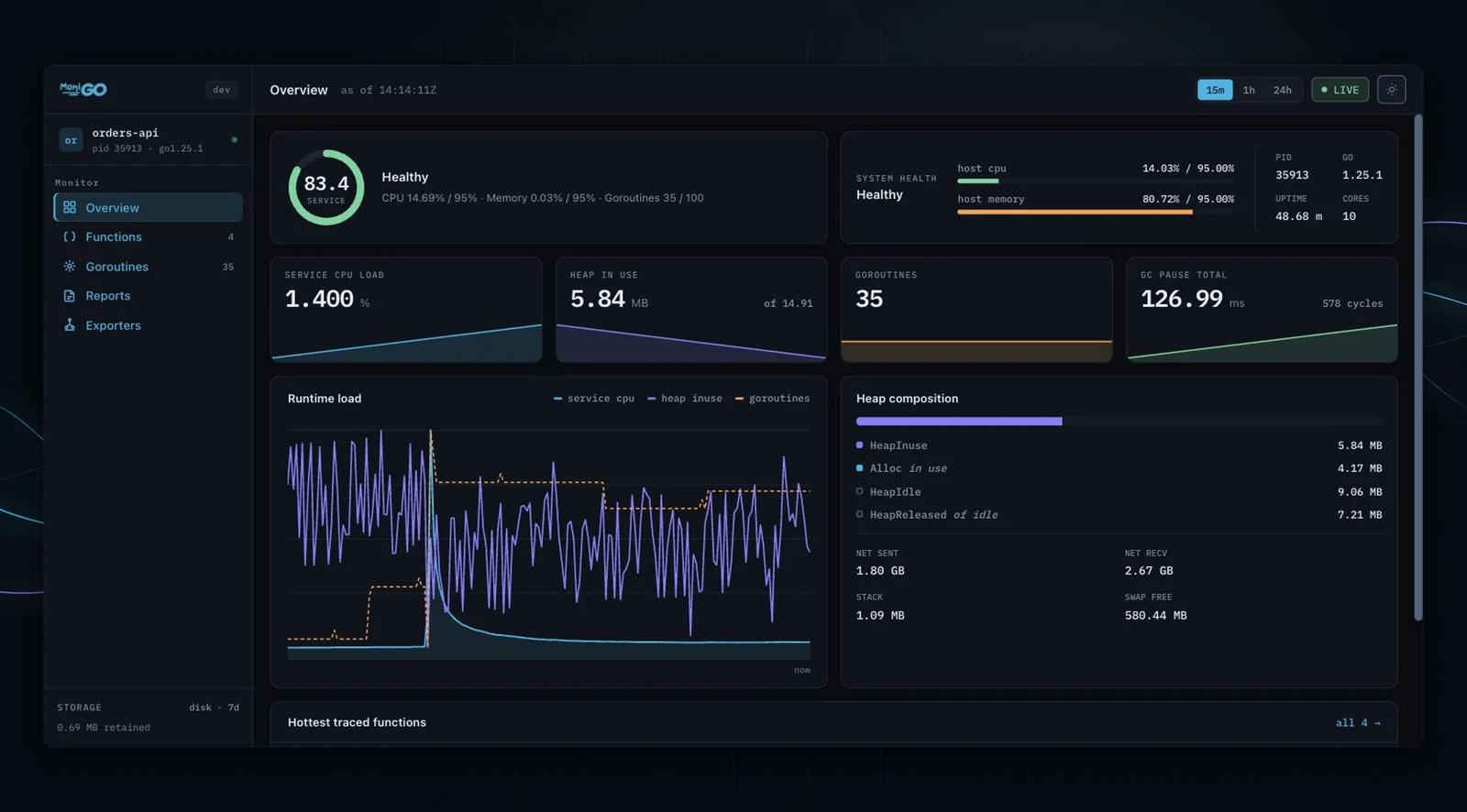
Features
- Function-Level Tracing - Profile any function with CPU/memory pprof, adaptive sampling, and reflection-based argument capture
- Pluggable Storage - Persistent disk (tstorage) or volatile in-memory backends
- Real-Time Dashboard - Embedded web UI with system metrics, health scoring, goroutine inspection, and downloadable reports
- Prometheus & OpenTelemetry - Built-in
/metricsendpoint and OTLP/gRPC export - Router Integration - Works with
net/http, Gin, Echo, Chi, Fiber, Gorilla Mux - Dashboard Security - Basic Auth, API Key, IP Whitelist, Rate Limiting middleware
- Headless Mode - Run as a background telemetry agent without the dashboard
- Builder API - Type-safe, chainable configuration with validation
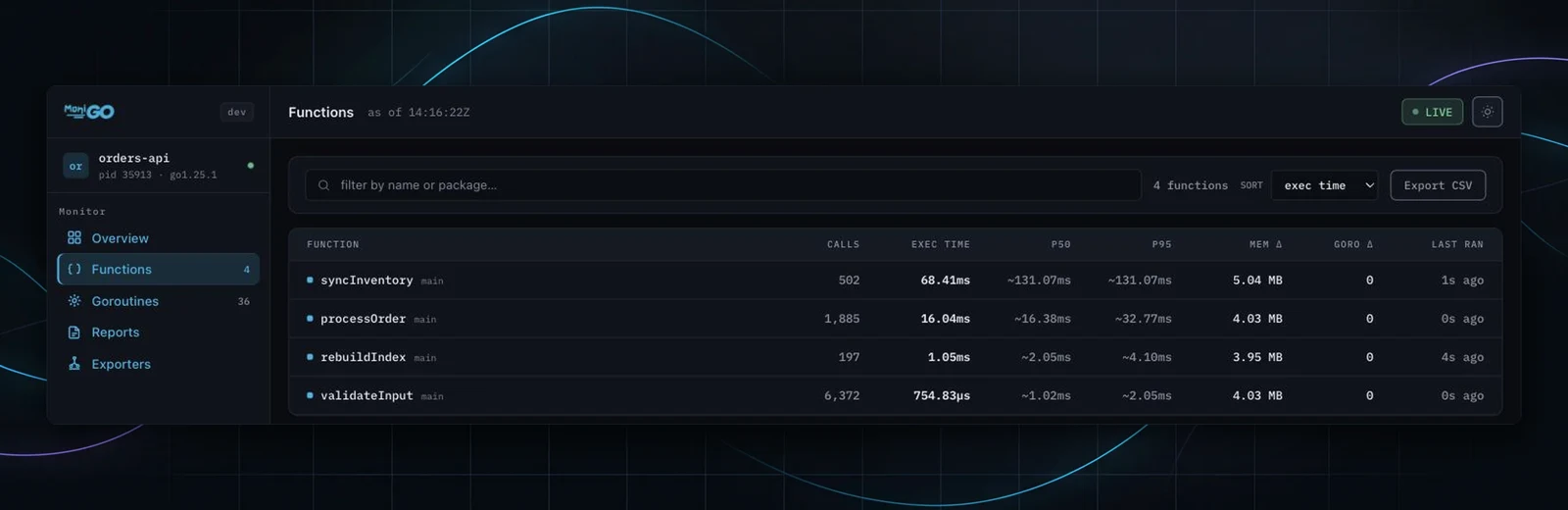
Per-function metrics
Call counts and approximate latency percentiles for every traced function, with
memory and goroutine deltas. Percentiles are bucket upper bounds, shown as ~4ms
meaning "at most 4ms", and read - below 20 calls rather than pretending three
samples make a p95.
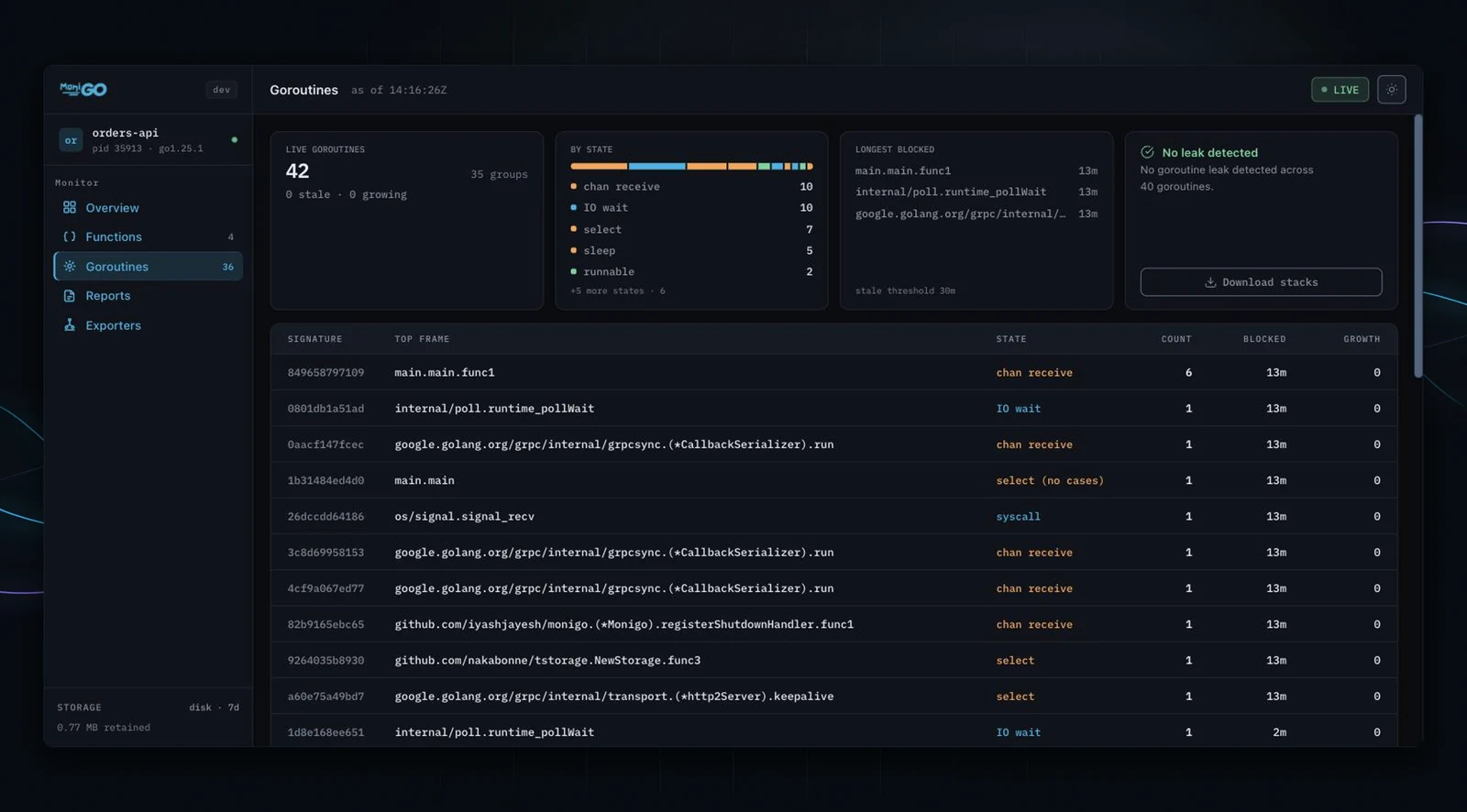
Goroutine inspection
Live goroutines grouped by stack signature, with state, how long each group has been blocked, and growth across snapshots -- so a leak shows up as a group that keeps growing rather than a number that keeps rising.
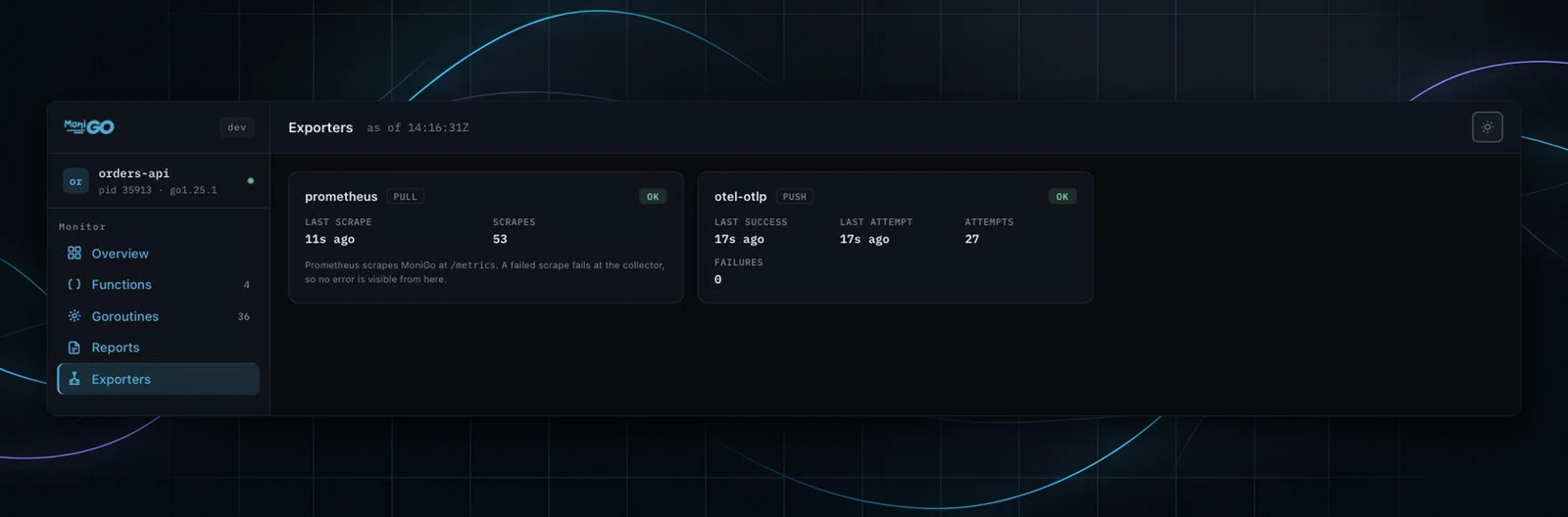
Exporter status
Prometheus and OpenTelemetry reported in their own terms. MoniGo is scraped by Prometheus and pushes to OTel, so the pull exporter shows when it was last scraped and carries no failure count -- a failed scrape fails at the collector, and the server never hears about it.
Installation
go get github.com/iyashjayesh/monigo@latest
Requires Go 1.22+.
Quick Start
package main

import (
    "log"
    "math"
    "net/http"

    "github.com/iyashjayesh/monigo"
)

func main() {
    m := monigo.NewBuilder().
        WithServiceName("my-api").
        WithPort(8080).
        WithStorageType("memory").
        WithSamplingRate(100).
        Build()

    go func() {
        if err := m.Start(); err != nil {
            log.Fatalf("monigo: %v", err)
        }
    }()

    http.HandleFunc("/compute", func(w http.ResponseWriter, r *http.Request) {
        monigo.TraceFunction(r.Context(), heavyWork)
        w.Write([]byte("done"))
    })

    log.Fatal(http.ListenAndServe(":9000", nil))
}

func heavyWork() {
    var sum float64
    for i := 0; i < 1e8; i++ {
        sum += math.Sqrt(float64(i))
    }
}
Dashboard: http://localhost:8080 - Your app: http://localhost:9000
Configuration
All configuration is done via the builder pattern:
m := monigo.NewBuilder().
    WithServiceName("order-service").       // Required
    WithPort(8080).                         // Dashboard port (default: 8080)
    WithStorageType("disk").                // "disk" or "memory" (default: "disk")
    WithRetentionPeriod("7d").              // Data retention (default: "7d")
    WithDataPointsSyncFrequency("5m").      // Metric flush interval (default: "5m")
    WithSamplingRate(100).                  // Trace 1 in N calls (default: 100)
    WithMaxCPUUsage(90).                    // Health threshold (default: 95%)
    WithMaxMemoryUsage(90).                 // Health threshold (default: 95%)
    WithMaxGoRoutines(500).                 // Health threshold (default: 100)
    WithAlertWebhook("https://...").        // Health breach webhook (default: off)
    WithStaleGoroutineThreshold(24*time.Hour). // Stale goroutine cutoff (default: 24h)
    WithHeadless(false).                    // true = no dashboard (default: false)
    WithTimeZone("UTC").                    // Timezone (default: "Local")
    WithLogLevel(slog.LevelInfo).           // Log level
    WithOTelEndpoint("localhost:4317").      // OTLP gRPC endpoint
    WithOTelHeaders(map[string]string{      // OTel auth headers
        "Authorization": "Bearer <token>",
    }).
    Build()
Health Breach Alerts
MoniGo computes a system and service health score on every collection cycle. Point
WithAlertWebhook at an HTTP endpoint to be notified when either score drops below
70. Left unset, MoniGo makes no outbound requests.
m := monigo.NewBuilder().
    WithServiceName("order-service").
    WithAlertWebhook("https://hooks.slack.com/services/...").
    Build()
Delivery is POST with Content-Type: application/json:
{
  "service_name": "order-service",
  "timestamp": "2026-08-28T11:59:20Z",
  "message": "Service Health Alert: Service usage exceeds allowed limits: CPU Usage 143.20% / 95.00%, ...",
  "health_score": 42.5
}
Alerts are dispatched off the metrics collection path, so a slow or unreachable endpoint never stalls metric collection. Requests time out after 10 seconds, and a minimum of 5 minutes separates deliveries so a flapping service cannot emit an alert on every tick. Delivery failures are logged and otherwise ignored.
Build() rejects a webhook URL that is not http:// or https://.
Goroutine Leak Detection
Every metrics collection cycle captures all goroutine stacks and evaluates them for
two independent leak signals. The verdict appears on the Go Routines Stats page and
in the go-routines-stats API response, and raises the alert webhook if one is
configured.
Stale goroutines. The Go runtime stamps a block duration into each goroutine's stack header once it has been parked for over a minute:
goroutine 21 [chan receive, 47 minutes]:
Any goroutine blocked at or beyond the threshold is reported as stale. The default
is 24h; WithStaleGoroutineThreshold takes any duration of 1m or more (below that
is not representable, since the runtime reports whole minutes only).
Growing call stacks. Goroutines are grouped by identical call stack, and the per-group counts are retained across the last 5 collection cycles. A group is flagged only if its count rose in every retained cycle. That rule is deliberately strict: a worker pool scaling up briefly, plateauing, or oscillating is not a leak, and a group absent from the oldest snapshot is treated as new rather than growing. Nothing is reported until the window is full, so a freshly started service cannot raise a false alarm from two data points.
m := monigo.NewBuilder().
    WithServiceName("order-service").
    WithStaleGoroutineThreshold(6 * time.Hour).
    WithAlertWebhook("https://hooks.slack.com/services/...").
    Build()
The report is carried on the goroutine stats response:
{
  "number_of_goroutines": 456,
  "leak_report": {
    "total_goroutines": 456,
    "stale_goroutines": 443,
    "growing_groups": 1,
    "leak_suspected": true,
    "snapshots_retained": 5,
    "snapshots_required": 5,
    "stale_threshold_minutes": 360,
    "message": "Possible goroutine leak: 443 goroutine(s) blocked for at least 6h; 1 call stack(s) growing across the last 5 snapshots (total goroutines: 456).",
    "suspicious_groups": [
      {
        "signature": "a3f19c2d4e5b",
        "state": "chan receive",
        "count": 440,
        "blocked_minutes": 421,
        "growth": 100,
        "stale": true,
        "growing": true,
        "call_stack": "main.worker()\n\t/app/main.go:31 +0x24\n..."
      }
    ]
  }
}
Detection is driven by the metrics collection cycle rather than by dashboard polling, so growth snapshots stay evenly spaced and a leak is caught whether or not anyone has a browser tab open.
Function Tracing
// Simple function
monigo.TraceFunction(ctx, myFunc)

// Function with arguments
monigo.TraceFunctionWithArgs(ctx, processOrder, orderID, userID)

// Function with single return
result := monigo.TraceFunctionWithReturn(ctx, calculateTotal, items).(float64)

// Function with multiple returns
results := monigo.TraceFunctionWithReturns(ctx, validateInput, data)
val := results[0].(string)
err := results[1].(error)
Each traced call captures: execution time, memory delta, goroutine delta, and (at sampling rate) CPU/memory pprof profiles.
Dashboard Security
mw, stop := monigo.RateLimitMiddleware(100, time.Minute)
defer stop()

m := monigo.NewBuilder().
    WithServiceName("secure-api").
    WithPort(8080).
    WithDashboardMiddleware(
        monigo.BasicAuthMiddleware("admin", "s3cret"),
        mw,
    ).
    WithAPIMiddleware(
        monigo.APIKeyMiddleware("my-api-key"),
    ).
    Build()
Router Integration
MoniGo integrates with any Go HTTP router:
// Standard net/http
mux := http.NewServeMux()
monigo.RegisterDashboardHandlers(mux)

// Fiber
app.All("/monigo/*", adaptor.HTTPHandler(monigo.GetUnifiedHandler()))

// Gin / Echo / Chi - use GetAPIHandlers() map
for path, handler := range monigo.GetAPIHandlers() {
    router.GET(path, gin.WrapF(handler))
}
See example/router-integration/ for complete examples.
API Endpoints
| Method | Path | Description |
|---|---|---|
| GET | /monigo/api/v1/metrics |
Current service statistics |
| GET | /monigo/api/v1/service-info |
Service metadata |
| POST | /monigo/api/v1/service-metrics |
Query time-series data |
| GET | /monigo/api/v1/go-routines-stats |
Goroutine stack analysis |
| GET | /monigo/api/v1/function |
Function trace summary |
| GET | /monigo/api/v1/function-details |
pprof reports for a function |
| POST | /monigo/api/v1/reports |
Aggregated report data |
| GET | /metrics |
Prometheus scrape endpoint |
Architecture
┌─────────────────────────────────────────────────┐
│                  Your Application                │
│                                                  │
│  monigo.TraceFunction(ctx, fn)                   │
│  monigo.Start() / monigo.Initialize()            │
└───────────┬─────────────────────┬────────────────┘
            │                     │
    ┌───────▼───────┐    ┌───────▼────────┐
    │   core/       │    │   monigo.go    │
    │  Metrics      │    │  Dashboard     │
    │  Collection   │    │  HTTP Server   │
    │  Health Score │    │  Middleware     │
    │  Profiling    │    │  Router Integ. │
    └───────┬───────┘    └───────┬────────┘
            │                     │
    ┌───────▼─────────────────────▼────────┐
    │           timeseries/                 │
    │  tstorage (disk) │ InMemoryStorage   │
    └───────┬──────────────────────────────┘
            │
    ┌───────▼───────────────────────────────┐
    │           exporters/                   │
    │  Prometheus Collector │ OTel Exporter  │
    └───────────────────────────────────────┘
            │
    ┌───────▼───────────────────────────────┐
    │           internal/                    │
    │  registry │ pipeline │ exporter │ log  │
    └───────────────────────────────────────┘
Package responsibilities:
| Package | Role |
|---|---|
monigo (root) |
Public API, dashboard server, middleware, builder |
core |
System metric collection, function tracing, health scoring |
common |
Utilities, unit conversion, process info |
timeseries |
Storage abstraction (disk + in-memory) |
exporters |
Prometheus collector, OTel OTLP exporter |
internal/registry |
Thread-safe metric registry |
internal/pipeline |
Async metric export pipeline |
internal/exporter |
Exporter interface + fan-out |
internal/logger |
Race-safe structured logger (slog) |
models |
Shared data structures |
api |
HTTP handlers for all endpoints |
What Works Well
- Zero-dependency embedding - Single
go get, no sidecar, no agent - Goroutine-safe metrics - Atomic sampling, mutex-protected maps,
sync.Oncesingletons - Adaptive profiling - Sampling prevents pprof overhead in hot paths
- Clean builder API - Validation at build time catches misconfiguration early
- Race-free logger -
atomic.Pointereliminates the commonslogdata race
Examples
| Example | Path |
|---|---|
| Basic usage | example/main.go |
| Function tracing | example/function-trace-example/ |
| Gin integration | example/router-integration/gin-integration/ |
| Echo integration | example/router-integration/echo-integration/ |
| Fiber integration | example/router-integration/fiber-integration/ |
| Standard mux | example/router-integration/standard-mux-integration/ |
| Gorilla mux | example/router-integration/gorilla-mux-integration/ |
| Basic auth | example/security-examples/basic-auth/ |
| API key auth | example/security-examples/api-key/ |
| IP whitelist | example/security-examples/ip-whitelist-example/ |
| Custom auth | example/security-examples/custom-auth/ |
Documentation
Full guides and API reference: iyashjayesh.github.io/monigo-website
| Topic | Link |
|---|---|
| Introduction & Features | Docs |
| Configuration (Builder API) | Docs |
| Function Tracing | Docs |
| Router Integration | Docs |
| Dashboard Security | Docs |
| Migration (v1 → v2) | Docs |
Contributing
We welcome contributions. Please see CONTRIBUTING.md for guidelines.
If you find MoniGo useful, consider giving it a star.
License
Apache 2.0 - see LICENSE.
Contact
For questions or feedback: open an issue or reach out at iyashjayesh@gmail.com / LinkedIn.
Star History
 Documentation

Index 
- Variables
- func APIKeyMiddleware(apiKey string) func(http.Handler) http.Handler
- func BasicAuthMiddleware(username, password string) func(http.Handler) http.Handler
- func GetAPIHandlers(customBaseAPIPath ...string) map[string]http.HandlerFunc
- func GetFiberHandler(customBaseAPIPath ...string) func(*fiber.Ctx) error
- func GetSecuredAPIHandlers(m *Monigo, customBaseAPIPath ...string) map[string]http.HandlerFunc
- func GetSecuredStaticHandler(m *Monigo) http.HandlerFunc
- func GetSecuredUnifiedHandler(m *Monigo, customBaseAPIPath ...string) http.HandlerFunc
- func GetStaticHandler() http.HandlerFunc
- func GetUnifiedHandler(customBaseAPIPath ...string) http.HandlerFunc
- func IPWhitelistMiddleware(allowedIPs []string) func(http.Handler) http.Handler
- func LoggingMiddleware() func(http.Handler) http.Handler
- func RateLimitMiddleware(requests int, window time.Duration) (mw func(http.Handler) http.Handler, stop func())
- func RegisterAPIHandlers(mux *http.ServeMux, customBaseAPIPath ...string)
- func RegisterDashboardHandlers(mux *http.ServeMux, customBaseAPIPath ...string)
- func RegisterSecuredAPIHandlers(mux *http.ServeMux, m *Monigo, customBaseAPIPath ...string)
- func RegisterSecuredDashboardHandlers(mux *http.ServeMux, m *Monigo, customBaseAPIPath ...string)
- func RegisterSecuredStaticHandlers(mux *http.ServeMux, m *Monigo)
- func RegisterStaticHandlers(mux *http.ServeMux)
- func SetSamplingRate(rate int)
- func StartDashboard(port int) error
- func StartDashboardWithCustomPath(port int, customBaseAPIPath string) error
- func StartSecuredDashboard(m *Monigo) error
- func TraceFunction(ctx context.Context, f func())
- func TraceFunctionWithArgs(ctx context.Context, f interface{}, args ...interface{})
- func TraceFunctionWithReturn(ctx context.Context, f interface{}, args ...interface{}) interface{}
- func TraceFunctionWithReturns(ctx context.Context, f interface{}, args ...interface{}) []interface{}
- type Cache
- type Monigo
- func (m *Monigo) GetGoRoutinesStats() models.GoRoutinesStatistic
- func (m *Monigo) GetRunningPort() int
- func (m *Monigo) Initialize() error
- func (m *Monigo) MonigoInstanceConstructor() error
- func (m *Monigo) MonigoInstanceConstructorWithoutPort()
- func (m *Monigo) Shutdown(ctx context.Context) error
- func (m *Monigo) Start() error
- type MonigoBuilder
- func (b *MonigoBuilder) Build() *Monigo
- func (b *MonigoBuilder) WithAPIMiddleware(middleware ...func(http.Handler) http.Handler) *MonigoBuilder
- func (b *MonigoBuilder) WithAlertWebhook(url string) *MonigoBuilder
- func (b *MonigoBuilder) WithAuthFunction(authFunc func(*http.Request) bool) *MonigoBuilder
- func (b *MonigoBuilder) WithCustomBaseAPIPath(path string) *MonigoBuilder
- func (b *MonigoBuilder) WithDashboardMiddleware(middleware ...func(http.Handler) http.Handler) *MonigoBuilder
- func (b *MonigoBuilder) WithDataPointsSyncFrequency(frequency string) *MonigoBuilder
- func (b *MonigoBuilder) WithHeadless(headless bool) *MonigoBuilder
- func (b *MonigoBuilder) WithLogLevel(level slog.Level) *MonigoBuilder
- func (b *MonigoBuilder) WithLogger(l *slog.Logger) *MonigoBuilder
- func (b *MonigoBuilder) WithMaxCPUUsage(usage float64) *MonigoBuilder
- func (b *MonigoBuilder) WithMaxGoRoutines(routines int) *MonigoBuilder
- func (b *MonigoBuilder) WithMaxMemoryUsage(usage float64) *MonigoBuilder
- func (b *MonigoBuilder) WithOTelEndpoint(endpoint string) *MonigoBuilder
- func (b *MonigoBuilder) WithOTelHeaders(headers map[string]string) *MonigoBuilder
- func (b *MonigoBuilder) WithPort(port int) *MonigoBuilder
- func (b *MonigoBuilder) WithRetentionPeriod(period string) *MonigoBuilder
- func (b *MonigoBuilder) WithSamplingRate(rate int) *MonigoBuilder
- func (b *MonigoBuilder) WithServiceName(serviceName string) *MonigoBuilder
- func (b *MonigoBuilder) WithStaleGoroutineThreshold(d time.Duration) *MonigoBuilder
- func (b *MonigoBuilder) WithStorageType(storageType string) *MonigoBuilder
- func (b *MonigoBuilder) WithTimeZone(timeZone string) *MonigoBuilder
- type MonigoInt
Constants 
This section is empty.
Variables 
var (
	BasePath string
)
Functions 
func APIKeyMiddleware ¶ added in v1.1.0
APIKeyMiddleware creates an API key authentication middleware
func BasicAuthMiddleware ¶ added in v1.1.0
BasicAuthMiddleware creates a basic authentication middleware
func GetAPIHandlers ¶ added in v1.1.0
func GetAPIHandlers(customBaseAPIPath ...string) map[string]http.HandlerFunc
GetAPIHandlers returns a map of API handlers for any HTTP router
func GetFiberHandler ¶ added in v1.1.0
GetFiberHandler returns a Fiber-compatible handler
func GetSecuredAPIHandlers ¶ added in v1.1.0
func GetSecuredAPIHandlers(m *Monigo, customBaseAPIPath ...string) map[string]http.HandlerFunc
GetSecuredAPIHandlers returns secured API handlers
func GetSecuredStaticHandler ¶ added in v1.1.0
func GetSecuredStaticHandler(m *Monigo) http.HandlerFunc
GetSecuredStaticHandler returns the static file handler with middleware
func GetSecuredUnifiedHandler ¶ added in v1.1.0
func GetSecuredUnifiedHandler(m *Monigo, customBaseAPIPath ...string) http.HandlerFunc
GetSecuredUnifiedHandler returns a unified handler with middleware
func GetStaticHandler ¶ added in v1.1.0
func GetStaticHandler() http.HandlerFunc
GetStaticHandler returns the static file handler function
func GetUnifiedHandler ¶ added in v1.1.0
func GetUnifiedHandler(customBaseAPIPath ...string) http.HandlerFunc
GetUnifiedHandler returns a unified handler that handles both API and static files
func IPWhitelistMiddleware ¶ added in v1.1.0
IPWhitelistMiddleware creates an IP whitelist middleware
func LoggingMiddleware ¶ added in v1.1.0
LoggingMiddleware creates a request logging middleware
func RateLimitMiddleware ¶ added in v1.1.0
func RateLimitMiddleware(requests int, window time.Duration) (mw func(http.Handler) http.Handler, stop func())
RateLimitMiddleware creates a simple rate limiting middleware. The returned stop function should be called during shutdown to release the cleanup goroutine.
func RegisterAPIHandlers ¶ added in v1.1.0
RegisterAPIHandlers registers only the API handlers
func RegisterDashboardHandlers ¶ added in v1.1.0
RegisterDashboardHandlers registers all dashboard handlers to the provided HTTP mux
func RegisterSecuredAPIHandlers ¶ added in v1.1.0
RegisterSecuredAPIHandlers registers only the API handlers with middleware support
func RegisterSecuredDashboardHandlers ¶ added in v1.1.0
RegisterSecuredDashboardHandlers registers all dashboard handlers with middleware support
func RegisterSecuredStaticHandlers ¶ added in v1.1.0
RegisterSecuredStaticHandlers registers only the static file handlers with middleware
func RegisterStaticHandlers ¶ added in v1.1.0
RegisterStaticHandlers registers only the static file handlers
func SetSamplingRate ¶ added in v1.3.0
func SetSamplingRate(rate int)
SetSamplingRate sets the sampling rate for function tracing
func StartDashboard 
StartDashboard starts the dashboard on the specified port
func StartDashboardWithCustomPath ¶ added in v1.1.0
StartDashboardWithCustomPath starts the dashboard on the specified port with a custom API path
func StartSecuredDashboard ¶ added in v1.1.0
StartSecuredDashboard starts the dashboard with middleware support
func TraceFunction ¶ added in v0.0.2
TraceFunction traces the function
func TraceFunctionWithArgs ¶ added in v1.1.0
TraceFunctionWithArgs traces a function with parameters and captures the metrics
func TraceFunctionWithReturn ¶ added in v1.1.0
TraceFunctionWithReturn traces a function with parameters and return values
func TraceFunctionWithReturns ¶ added in v1.1.0
func TraceFunctionWithReturns(ctx context.Context, f interface{}, args ...interface{}) []interface{}
TraceFunctionWithReturns traces a function with parameters and returns all results
Types 
type Monigo 
type Monigo struct {
	ServiceName             string    `json:"service_name"`
	DashboardPort           int       `json:"dashboard_port"`
	DataPointsSyncFrequency string    `json:"db_sync_frequency"`
	DataRetentionPeriod     string    `json:"retention_period"`
	TimeZone                string    `json:"time_zone"`
	GoVersion               string    `json:"go_version"`
	ServiceStartTime        time.Time `json:"service_start_time"`
	ProcessId               int32     `json:"process_id"`
	MaxCPUUsage             float64   `json:"max_cpu_usage"`
	MaxMemoryUsage          float64   `json:"max_memory_usage"`
	MaxGoRoutines           int       `json:"max_go_routines"`
	CustomBaseAPIPath       string    `json:"custom_base_api_path"`
	Headless                bool      `json:"headless"`
	SamplingRate            int       `json:"sampling_rate"`
	StorageType             string    `json:"storage_type"`
	AlertWebhookURL         string    `json:"alert_webhook_url,omitempty"`
	// StaleGoroutineThreshold is how long a goroutine must stay blocked before
	// leak detection reports it as stale. Zero means the 24h default.
	StaleGoroutineThreshold time.Duration `json:"stale_goroutine_threshold,omitempty"`

	// OpenTelemetry Configuration
	OTelEndpoint string            `json:"otel_endpoint,omitempty"`
	OTelHeaders  map[string]string `json:"-"`

	// Security and Middleware Configuration
	DashboardMiddleware []func(http.Handler) http.Handler `json:"-"`
	APIMiddleware       []func(http.Handler) http.Handler `json:"-"`
	AuthFunction        func(*http.Request) bool          `json:"-"`
	// contains filtered or unexported fields
}
Monigo is the main struct to start the monigo service
func (*Monigo) GetGoRoutinesStats ¶ added in v0.0.2
func (m *Monigo) GetGoRoutinesStats() models.GoRoutinesStatistic
GetGoRoutinesStats returns Go routines statistics.
func (*Monigo) GetRunningPort ¶ added in v1.3.0
GetRunningPort returns the running port
func (*Monigo) Initialize ¶ added in v1.1.0
Initialize initializes the monigo service without starting the dashboard
func (*Monigo) MonigoInstanceConstructor ¶ added in v0.0.2
MonigoInstanceConstructor validates the port then initialises common fields.
func (*Monigo) MonigoInstanceConstructorWithoutPort ¶ added in v1.1.0
func (m *Monigo) MonigoInstanceConstructorWithoutPort()
MonigoInstanceConstructorWithoutPort initialises common fields without port binding.
type MonigoBuilder ¶ added in v1.2.0
type MonigoBuilder struct {
	// contains filtered or unexported fields
}
MonigoBuilder is the builder for the Monigo struct
func NewBuilder ¶ added in v1.2.0
func NewBuilder() *MonigoBuilder
NewBuilder creates a new instance of the MonigoBuilder
func (*MonigoBuilder) Build ¶ added in v1.2.0
func (b *MonigoBuilder) Build() *Monigo
Build validates the configuration and returns the Monigo struct. Panics if ServiceName is empty since it is a required field.
func (*MonigoBuilder) WithAPIMiddleware ¶ added in v1.2.0
func (b *MonigoBuilder) WithAPIMiddleware(middleware ...func(http.Handler) http.Handler) *MonigoBuilder
WithAPIMiddleware sets the API middleware
func (*MonigoBuilder) WithAlertWebhook ¶ added in v1.3.0
func (b *MonigoBuilder) WithAlertWebhook(url string) *MonigoBuilder
WithAlertWebhook sets the health breach alert webhook URL
func (*MonigoBuilder) WithAuthFunction ¶ added in v1.2.0
func (b *MonigoBuilder) WithAuthFunction(authFunc func(*http.Request) bool) *MonigoBuilder
WithAuthFunction sets the custom authentication function
func (*MonigoBuilder) WithCustomBaseAPIPath ¶ added in v1.2.0
func (b *MonigoBuilder) WithCustomBaseAPIPath(path string) *MonigoBuilder
WithCustomBaseAPIPath sets the custom base API path
func (*MonigoBuilder) WithDashboardMiddleware ¶ added in v1.2.0
func (b *MonigoBuilder) WithDashboardMiddleware(middleware ...func(http.Handler) http.Handler) *MonigoBuilder
WithDashboardMiddleware sets the dashboard middleware
func (*MonigoBuilder) WithDataPointsSyncFrequency ¶ added in v1.2.0
func (b *MonigoBuilder) WithDataPointsSyncFrequency(frequency string) *MonigoBuilder
WithDataPointsSyncFrequency sets the data points sync frequency
func (*MonigoBuilder) WithHeadless ¶ added in v1.3.0
func (b *MonigoBuilder) WithHeadless(headless bool) *MonigoBuilder
WithHeadless sets whether the dashboard should be started
func (*MonigoBuilder) WithLogLevel ¶ added in v1.3.0
func (b *MonigoBuilder) WithLogLevel(level slog.Level) *MonigoBuilder
WithLogLevel sets the log level for monigo's structured logger
func (*MonigoBuilder) WithLogger ¶ added in v1.3.0
func (b *MonigoBuilder) WithLogger(l *slog.Logger) *MonigoBuilder
WithLogger sets a custom slog.Logger for monigo
func (*MonigoBuilder) WithMaxCPUUsage ¶ added in v1.2.0
func (b *MonigoBuilder) WithMaxCPUUsage(usage float64) *MonigoBuilder
WithMaxCPUUsage sets the max CPU usage
func (*MonigoBuilder) WithMaxGoRoutines ¶ added in v1.2.0
func (b *MonigoBuilder) WithMaxGoRoutines(routines int) *MonigoBuilder
WithMaxGoRoutines sets the max Go routines
func (*MonigoBuilder) WithMaxMemoryUsage ¶ added in v1.2.0
func (b *MonigoBuilder) WithMaxMemoryUsage(usage float64) *MonigoBuilder
WithMaxMemoryUsage sets the max memory usage
func (*MonigoBuilder) WithOTelEndpoint ¶ added in v1.3.0
func (b *MonigoBuilder) WithOTelEndpoint(endpoint string) *MonigoBuilder
WithOTelEndpoint sets the OTLP gRPC endpoint for OpenTelemetry export (e.g. "localhost:4317")
func (*MonigoBuilder) WithOTelHeaders ¶ added in v1.3.0
func (b *MonigoBuilder) WithOTelHeaders(headers map[string]string) *MonigoBuilder
WithOTelHeaders sets optional headers for the OTel exporter
func (*MonigoBuilder) WithPort ¶ added in v1.2.0
func (b *MonigoBuilder) WithPort(port int) *MonigoBuilder
WithPort sets the dashboard port
func (*MonigoBuilder) WithRetentionPeriod ¶ added in v1.2.0
func (b *MonigoBuilder) WithRetentionPeriod(period string) *MonigoBuilder
WithRetentionPeriod sets the data retention period
func (*MonigoBuilder) WithSamplingRate ¶ added in v1.3.0
func (b *MonigoBuilder) WithSamplingRate(rate int) *MonigoBuilder
WithSamplingRate sets the sampling rate for function tracing: one call in every `rate` is profiled. The default is 100.
The sampled call pays a roughly constant ~200ms, independent of how long the function itself runs, because pprof.StopCPUProfile blocks on the runtime's buffer flush -- and because the CPU profiler samples at 100Hz, a call shorter than ~10ms usually captures nothing for that cost. See core.SetSamplingRate for the measurements and what to do about it.
func (*MonigoBuilder) WithServiceName ¶ added in v1.2.0
func (b *MonigoBuilder) WithServiceName(serviceName string) *MonigoBuilder
WithServiceName sets the service name
func (*MonigoBuilder) WithStaleGoroutineThreshold ¶ added in v1.3.0
func (b *MonigoBuilder) WithStaleGoroutineThreshold(d time.Duration) *MonigoBuilder
WithStaleGoroutineThreshold sets how long a goroutine must stay blocked before leak detection reports it as stale. Defaults to 24h when unset.
The Go runtime reports block duration in whole minutes, so a threshold below one minute cannot be represented and is rejected by Build().
func (*MonigoBuilder) WithStorageType ¶ added in v1.3.0
func (b *MonigoBuilder) WithStorageType(storageType string) *MonigoBuilder
WithStorageType sets the storage type ("disk" or "memory")
func (*MonigoBuilder) WithTimeZone ¶ added in v1.2.0
func (b *MonigoBuilder) WithTimeZone(timeZone string) *MonigoBuilder
WithTimeZone sets the time zone
 Source Files
 Directories