

 README


Miabi
The open-source, self-hosted PaaS for shipping apps, not infrastructure.
Docker Compose isn't enough. Kubernetes is overkill. Miabi is the middle.
Quick Start · Live Demo · Features · Comparison · Architecture · Docs . Examples





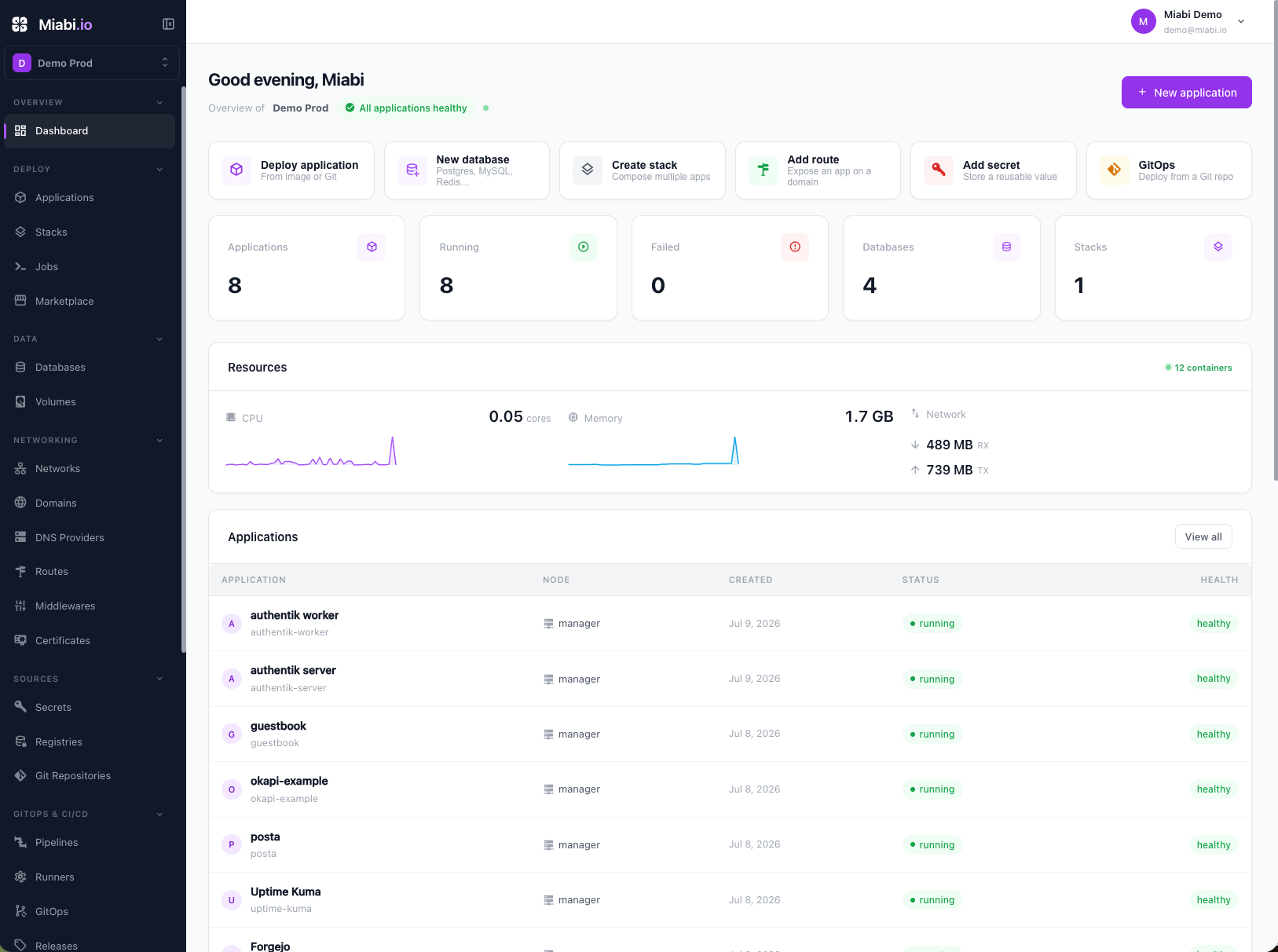
Miabi is a developer-first PaaS for deploying and operating containerized applications on your own infrastructure. Push an app — from a Git repo, a Docker image, or a marketplace template — and Miabi handles build, deploy, domains, TLS, databases, scaling, backups, monitoring, and analytics. One web console, one binary, no Docker commands and no Kubernetes cluster.
It runs wherever you already have a server — a VPS, a dedicated server, bare metal, a homelab, or a cloud VM — and everything stays there: the control plane, the data, and the runtime are yours to own, move, and inspect. There is no managed service in the middle and no vendor to leave.
The name. Miabi is Tshiluba (Kasai, DR Congo 🇨🇩) for the muabi trees, traditionally associated with blessing and growth. It joins the same family as its siblings Goma Gateway and Posta.
Contents
- Quick Start
- Why Miabi
- Features
- Screenshots
- How Miabi compares
- Architecture
- Live Demo
- Development
- Ecosystem
- Support & contributing
- License
Quick Start
Requirements: a Linux host with a reachable Docker socket, a domain pointing at it, and ports 80/443 free. PostgreSQL and Redis are brought up as part of the stack.
curl -fsSL https://get.miabi.io | sudo MIABI_DOMAIN=miabi.example.com \
  MIABI_ADMIN_EMAIL=you@example.com bash
The script installs Docker if missing, installs the miabi CLI, brings up the stack, and prints the admin password. From there:
sudo miabi system status
sudo miabi system restart
sudo miabi upgrade
sudo miabi system uninstall
Other install paths — CLI, no root, Docker Compose
Install the CLI and run the same converge yourself:
sudo miabi setup --domain miabi.example.com --admin-email you@example.com
Or use no binary at all. The Miabi image is an installer too, which is the path to take when you don't have root:
docker run --rm -it \
  -v /var/run/docker.sock:/var/run/docker.sock \
  -v /etc/miabi:/etc/miabi \
  miabi/miabi:latest install --domain miabi.example.com --admin-email you@example.com
install, upgrade, restart, status, and uninstall on the image are the same commands as miabi setup / miabi upgrade / miabi system … — one implementation, two front-ends, so neither can drift from the other. Either way the converge is idempotent: re-run it and only what changed is recreated.
Prefer to drive Compose yourself? examples/compose/ brings up the same stack.
Full options, the /etc/miabi/miabi.yaml manifest, the built-in registry, and custom gateway config are in the installation docs.
Why Miabi
Docker Compose isn't enough for production: no rolling updates, no rollback, no TLS, no multi-tenancy. Kubernetes is overkill: a service mesh just for canary, Argo CD or Flux just for GitOps, and a platform team to keep it running.
Miabi sits in the middle — production deployment strategies on plain Docker, with the pieces you actually need built in rather than assembled.
Three things set it apart from other self-hosted PaaS options:
Multi-tenancy from day one. Most self-hosted PaaS tools assume one operator and one set of apps. Miabi is built around workspaces: every app, database, domain, volume, registry image, secret, backup, and deployment belongs to one. That makes it workable for shared hosting providers, agencies running client apps, SaaS platforms, internal developer platforms, and universities — not just single-tenant homelabs.
Deployment strategies without a mesh. Rolling and canary deployments with weighted traffic splitting, rollbacks, and zero-downtime updates, on Docker, because routing already flows through Goma Gateway.
Analytics with zero instrumentation. Every request already passes through the gateway, so every app gets HTTP traffic, latency, and privacy-first web analytics with no JS snippet, no SDK, and no code change.
Everything in the console is also in the REST API, the CLI, and the Terraform provider. Run it on a VPS, dedicated server, bare metal, homelab, or cloud. No vendor lock-in, no managed control plane.
Features
Applications & deployments
- Deploy from a Git repo (build), a Docker image (pull), or a marketplace template
- Buildpack builds with no Dockerfile required, with configurable memory and time limits
- Releases with one-click rollback and full deployment history
- Zero-downtime updates, canary aliases, and weighted traffic splitting
- Env vars, a workspace secret vault, and per-app resource limits
- Jobs — one-off commands in an app's runtime context
- Stacks (compose-style app groups) and Environments (dev → staging → prod)
- Per-app timeline of lifecycle events
- Built-in container registry, multi-tenant and namespaced per workspace, with local or S3/MinIO storage and an optional garbage collector:
docker login <registry> -u <workspace-name> -p <api-token>
Domains, networking & TLS
- Domains with DNS-verified ownership, routed through Goma Gateway with workspace-owned middlewares
- Automatic TLS — HTTP-01 ACME by default, managed wildcard / DNS-01 certs via a connected DNS provider (auto-renewed), and uploaded custom certs (encrypted)
- Workspace-isolated Docker networks carved from a managed address pool, so a busy multi-tenant host never exhausts Docker's small default pool
- Configurable CIDR for the shared proxy network, per-node edge gateways, and on-demand port forwarding to managed databases
Data, storage & backups
- Databases — PostgreSQL, MySQL, MariaDB, Redis, libSQL, and MongoDB, with managed credentials and in-place version upgrades
- Volumes — workspace-owned Docker volumes, node-local by default, or shared (RWX) storage a replicated app can mount across nodes: NFS, CIFS/SMB, or a host-path bind to operator-managed storage under
/mnt/*(privileged workspaces) - Backups — scheduled and manual database backup/restore plus volume archives, to local, MinIO, or S3
Multi-node & clustering
- Nodes — add remote Docker hosts; the node agent dials the control plane over an outbound WebSocket tunnel, so it works behind NAT and firewalls
- Cluster mode — optional, auto-detected Docker Swarm with encrypted overlay networks
- Replicated service apps — in cluster mode apps deploy as replicated Swarm services by default (opt out per app); stateful apps with node-local storage stay pinned automatically
- Multiple clusters & locations — one control plane drives many clusters: the default cluster, standalone nodes connected over their agent tunnel, and remote Docker Swarms in other regions. Workspaces pick a location, and apps, databases and volumes are placed inside it
- Cluster ingress — each cluster is served by its own gateway (the central gateway, a node's own edge gateway, or a remote swarm's ingress node) with DNS pointing at it; traffic reaches a clustered app's tasks wherever the scheduler placed them, and the app detail view shows the real nodes replicas run on
- Node pools — group nodes by tier; Enterprise plan placement keeps each plan's workspaces on its locations and pool
- Image distribution — built images are pushed to the internal registry so any node can pull them, making multi-node deploys and rollbacks of Git-built apps work across the cluster
- Housekeeping to reconcile drift and reclaim disk, and Docker import to adopt pre-existing containers, volumes, and networks
CI/CD & GitOps
- Pipelines — pipeline-as-code CI/CD
- Build runners — dedicated build machines that keep build load off app-hosting nodes; a co-located runner ships for single-node and homelab use, and an optional "builds require a runner" guarantee keeps builds off production nodes entirely
- GitOps — declarative, pull-based reconciliation from
miabi.io/v1manifests, plus an imperative one-shot apply with dry-run, diff, and prune. No separate controller to run: no Argo CD, no Flux - Git push deploy, stored Git and registry credentials, signed webhooks, and notifications
- Examples — complete CI/CD and GitOps for Node.js, Go, Python, PHP, Laravel, Java and Spring Boot apps: tests, Dockerfiles, pipelines, and manifests that deploy as-is
- REST + OpenAPI everywhere, plus a CLI and an official Terraform / OpenTofu provider
Identity, teams & access
- Auth — registration, login with email or username, password reset, JWT sessions with Redis-backed revocation, API tokens, and 2FA (TOTP)
- SSO & directory — OAuth 2.0 / OIDC (GitHub, Google, generic OIDC), attachable to an organization so a customer's people land in the customer's realm. Enterprise adds SAML 2.0, SCIM provisioning, and LDAP / Active Directory sign-in on the normal login form, with directory groups mapped onto platform-admin and per-workspace roles
- Workspaces & teams — members and invitations; each workspace has a unique name handle (its URL and
docker loginnamespace) plus a display name, and each user a unique username - Organizations — tenant realms that own workspaces and the accounts in them, each with an owner, a workspace cap, its own SSO provider (accounts registered through it land in that realm), and optionally its own dedicated locations: nodes nobody else can place on.
- RBAC — Owner · Admin · Developer · Viewer, enforced in middleware and by
workspace_idscoping. Enterprise adds custom roles and per-resource policies (a role on a single app, domain, or database) - Container security profiles — an optional non-root "restricted" profile runs app and job containers as a platform UID with
no-new-privileges; outbound webhooks are SSRF-guarded - Plans & quotas, per-workspace encryption keys (keyring/DEK), key rotation, and crypto-shred on delete
Monitoring, analytics & operations
- Container CPU/memory/disk metrics and workspace health with retained history, Prometheus integration, and health endpoints
- Analytics — requests/sec, status mix, bandwidth, top routes; p50/p95/p99 latency with a gateway-vs-upstream split ("is my app slow, or the gateway?"), error rate, and Apdex; unique visitors, top pages, referrers, countries, and device families. Cookieless, no consent banner, IPs never stored, unique visitors via HyperLogLog sketches rather than per-person rows
- Log storage — deployment, pipeline, job, and backup logs externalized from Postgres to a shared filesystem store with a bounded DB tail, retention, size caps, and full-log download; live tailing unchanged
- Append-only audit log of every mutating action, with optional SIEM streaming over syslog or webhook (Enterprise)
- Admin platform — nodes and clusters, organizations, users, plans, settings, OAuth providers, SSO, license, and SIEM
Marketplace
Official, versioned templates: WordPress, Ghost, Nextcloud, n8n, Gitea, Forgejo, Umami, NGINX, pgAdmin, phpMyAdmin, mongo-express, libSQL, Posta, PostgreSQL, MySQL, Redis, and MongoDB.
Screenshots
Deploy an application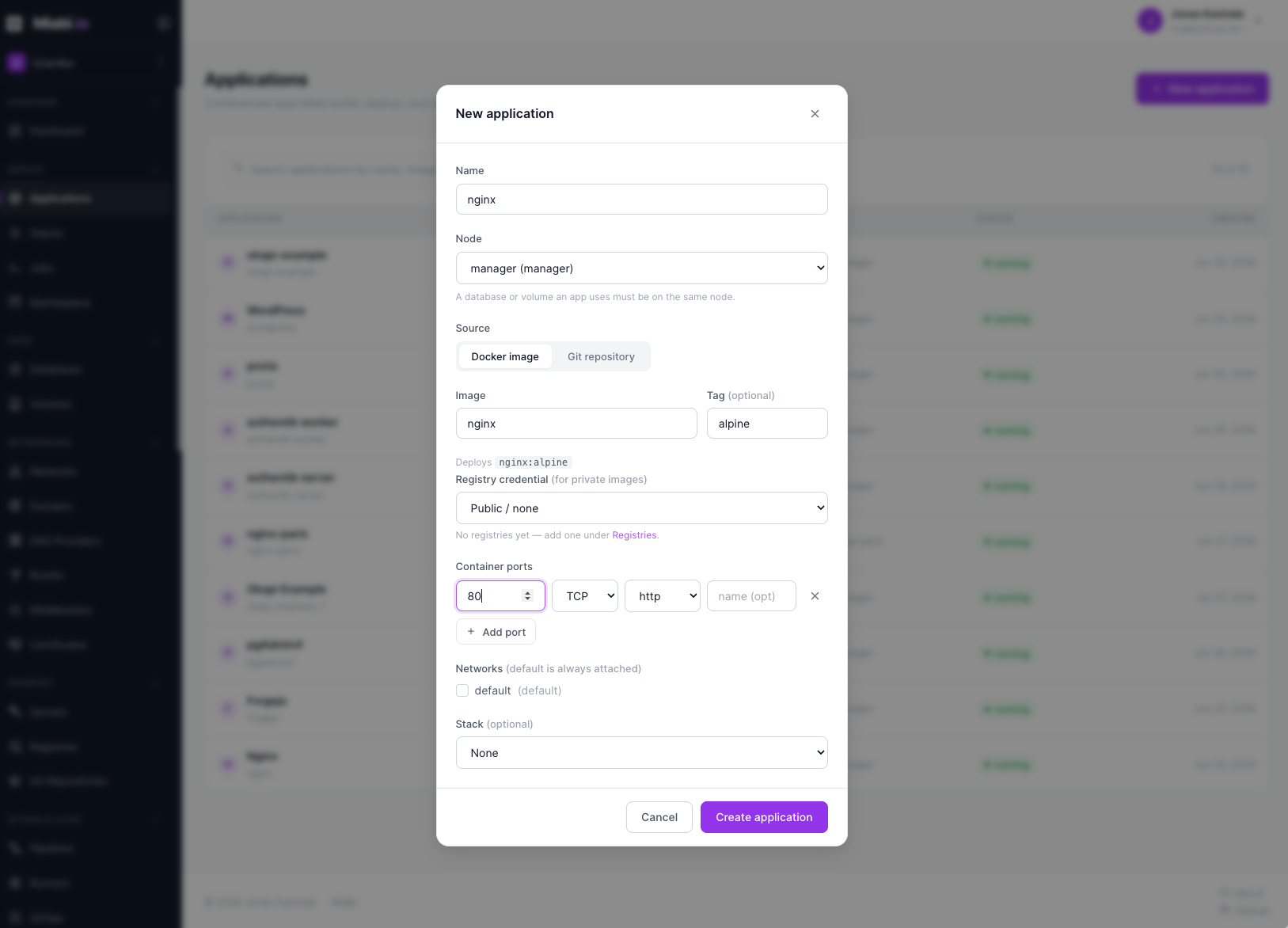 |
Canary deployment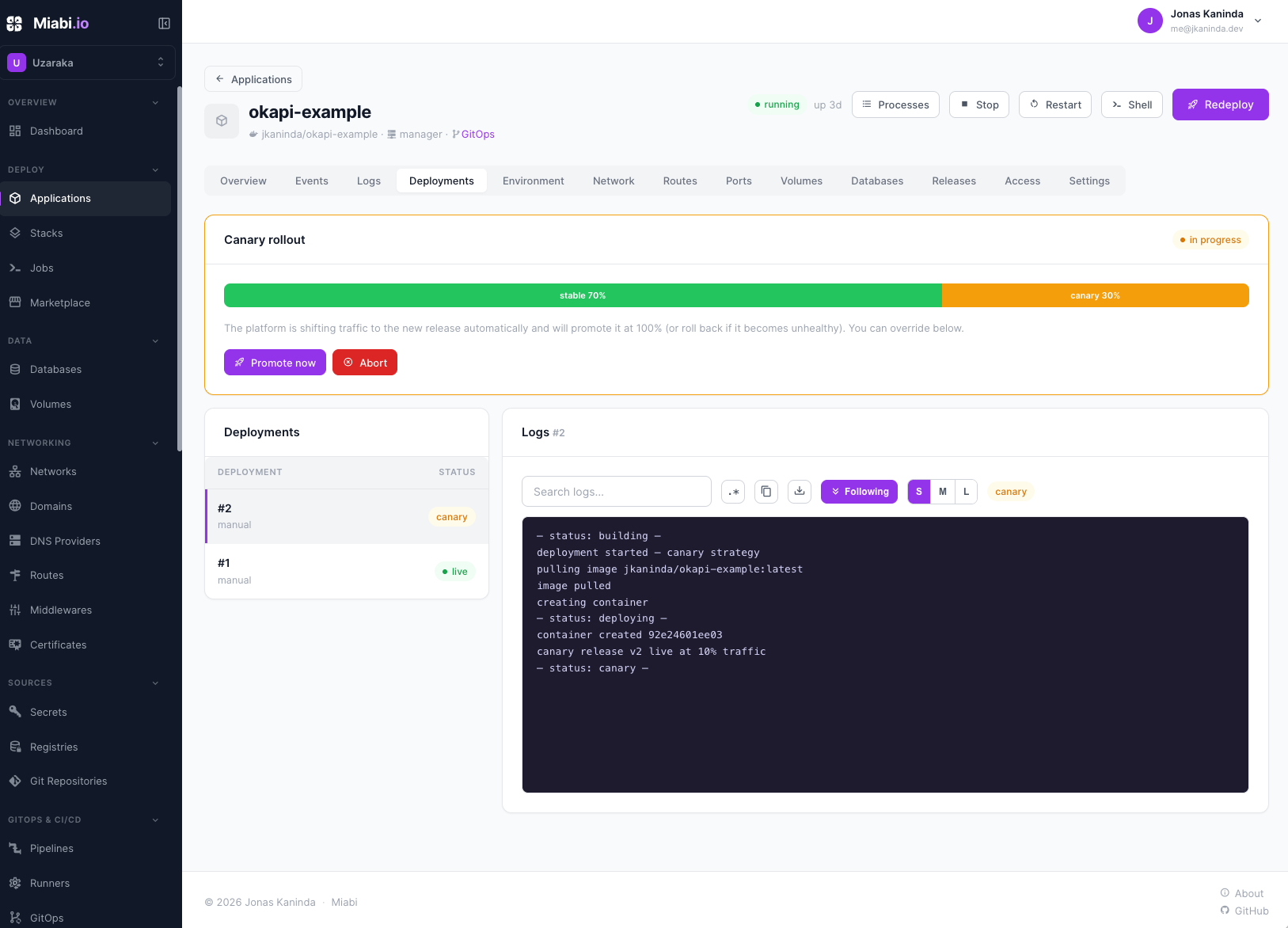 |
GitOps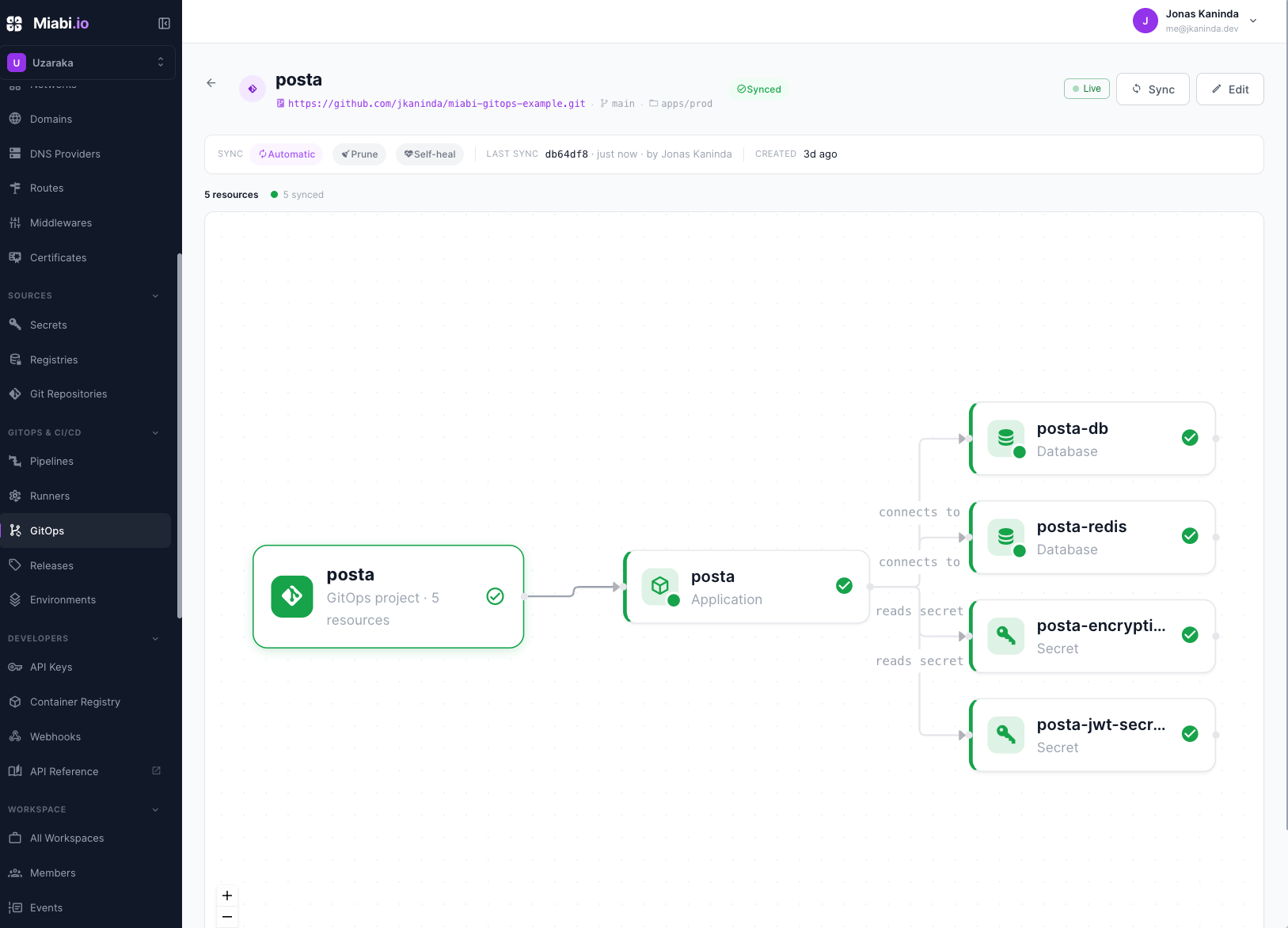 |
Analytics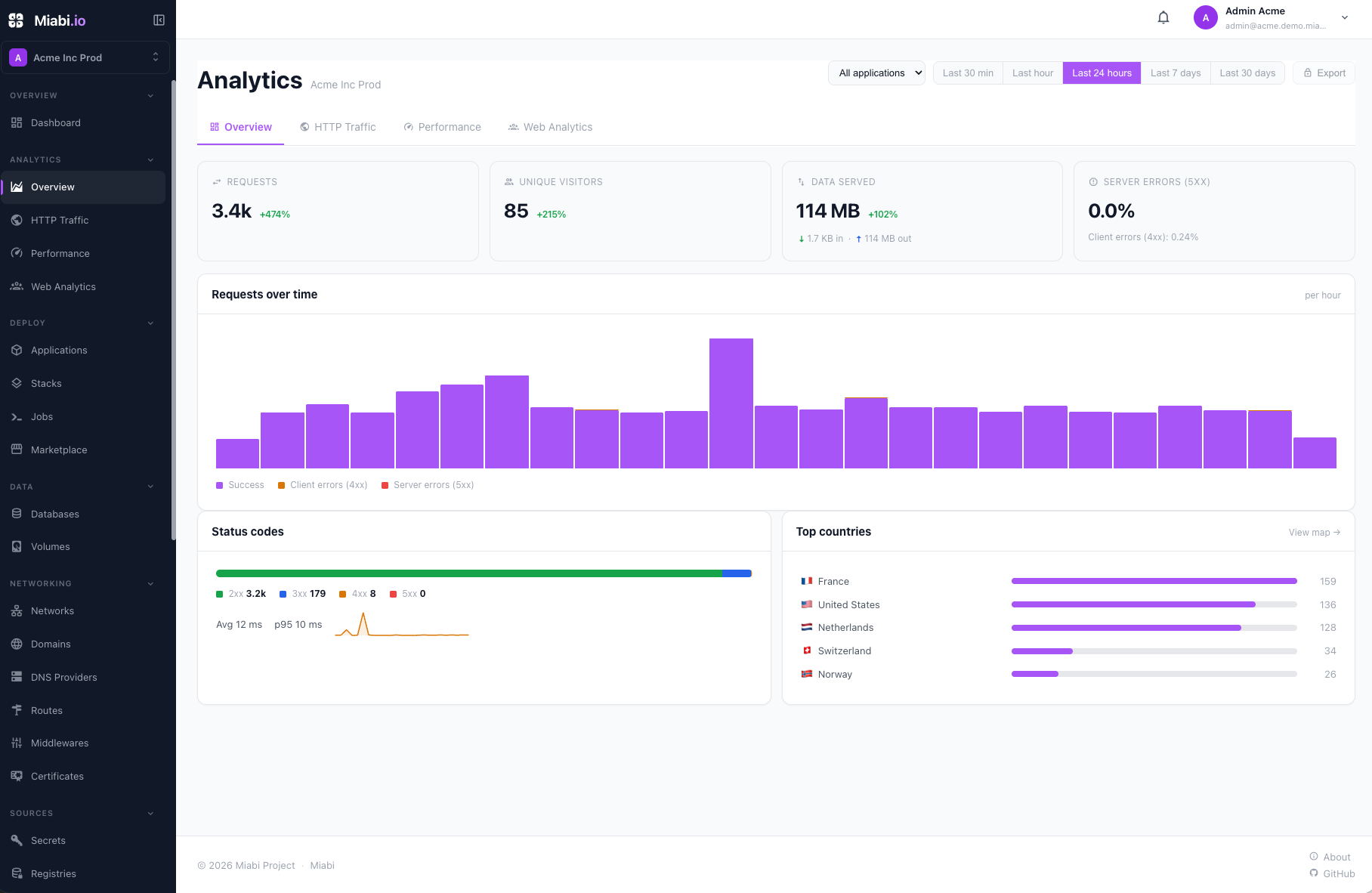 |
Nodes & cluster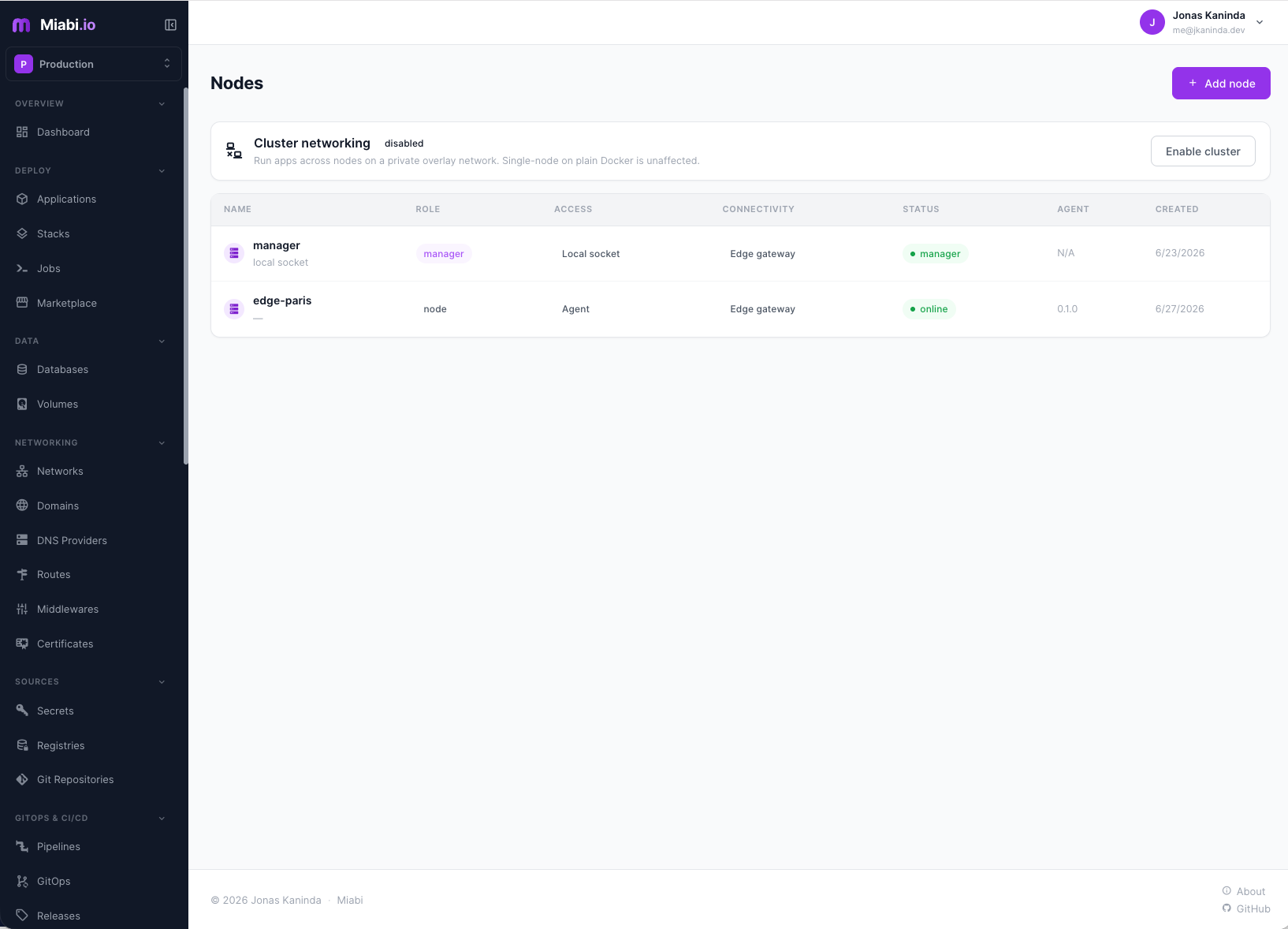 |
Managed databases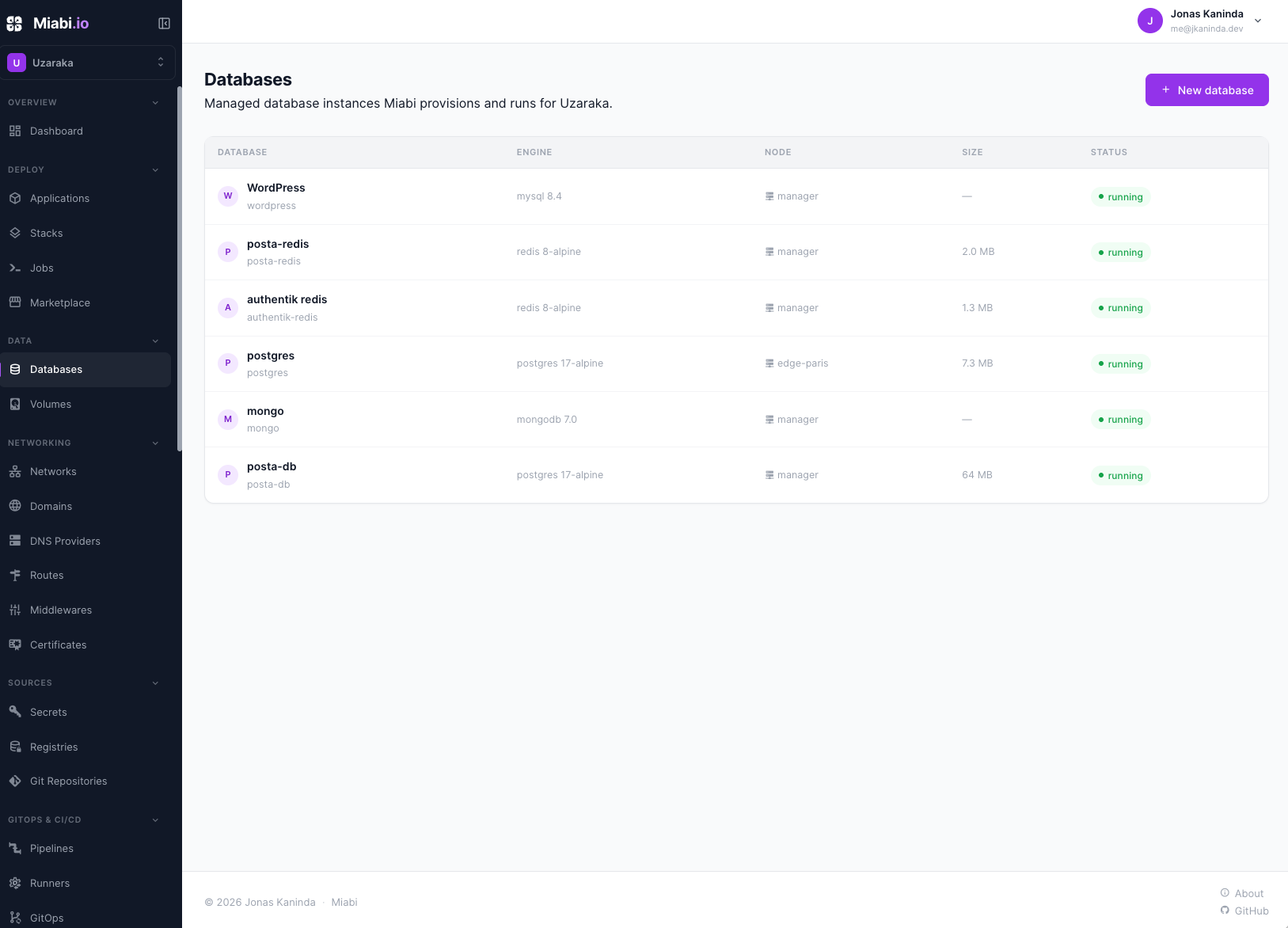 |
More screenshots — pipelines, domains, backups, monitoring, marketplace, admin
CI/CD pipelines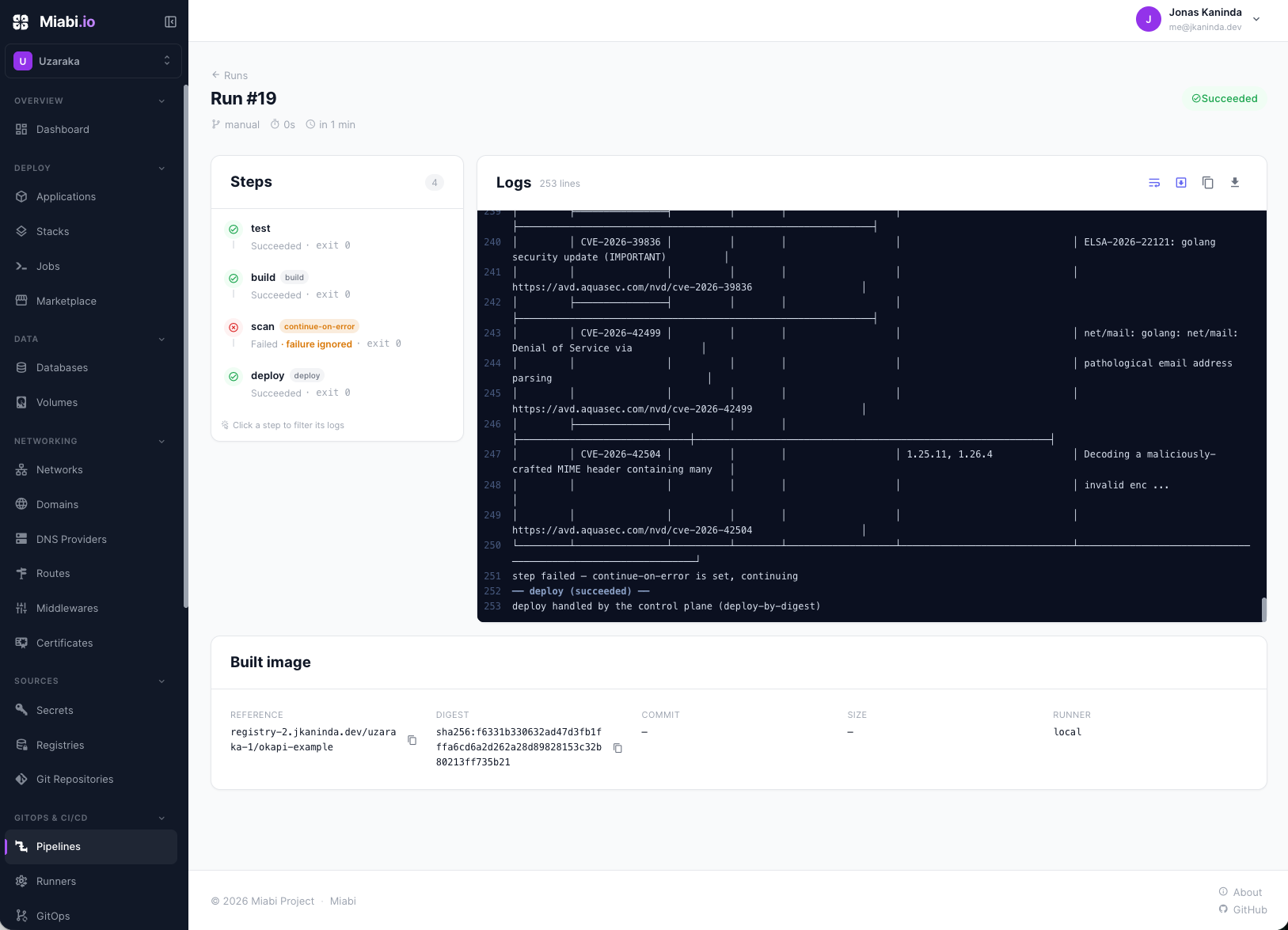 |
Domains, routes & TLS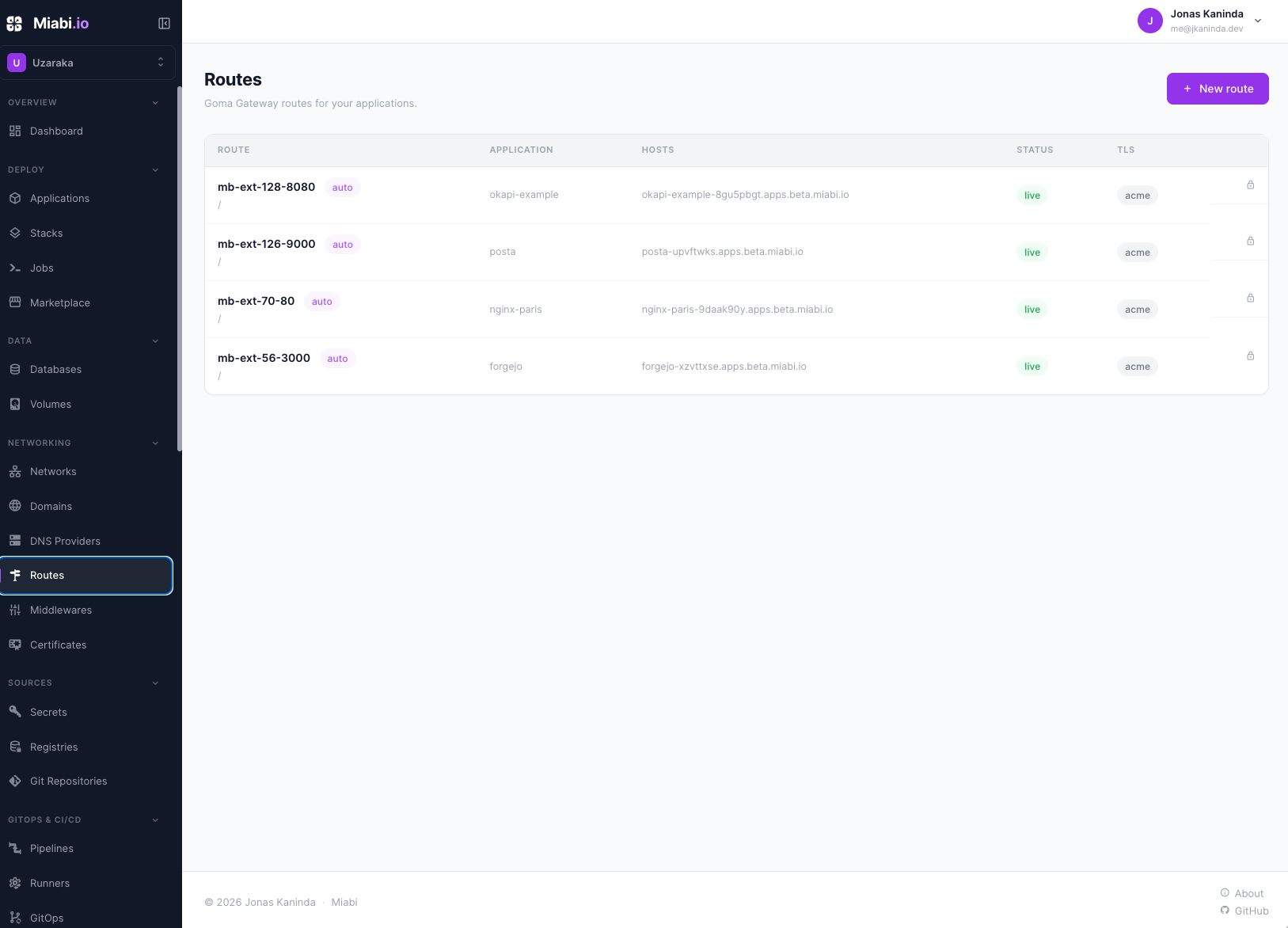 |
Backups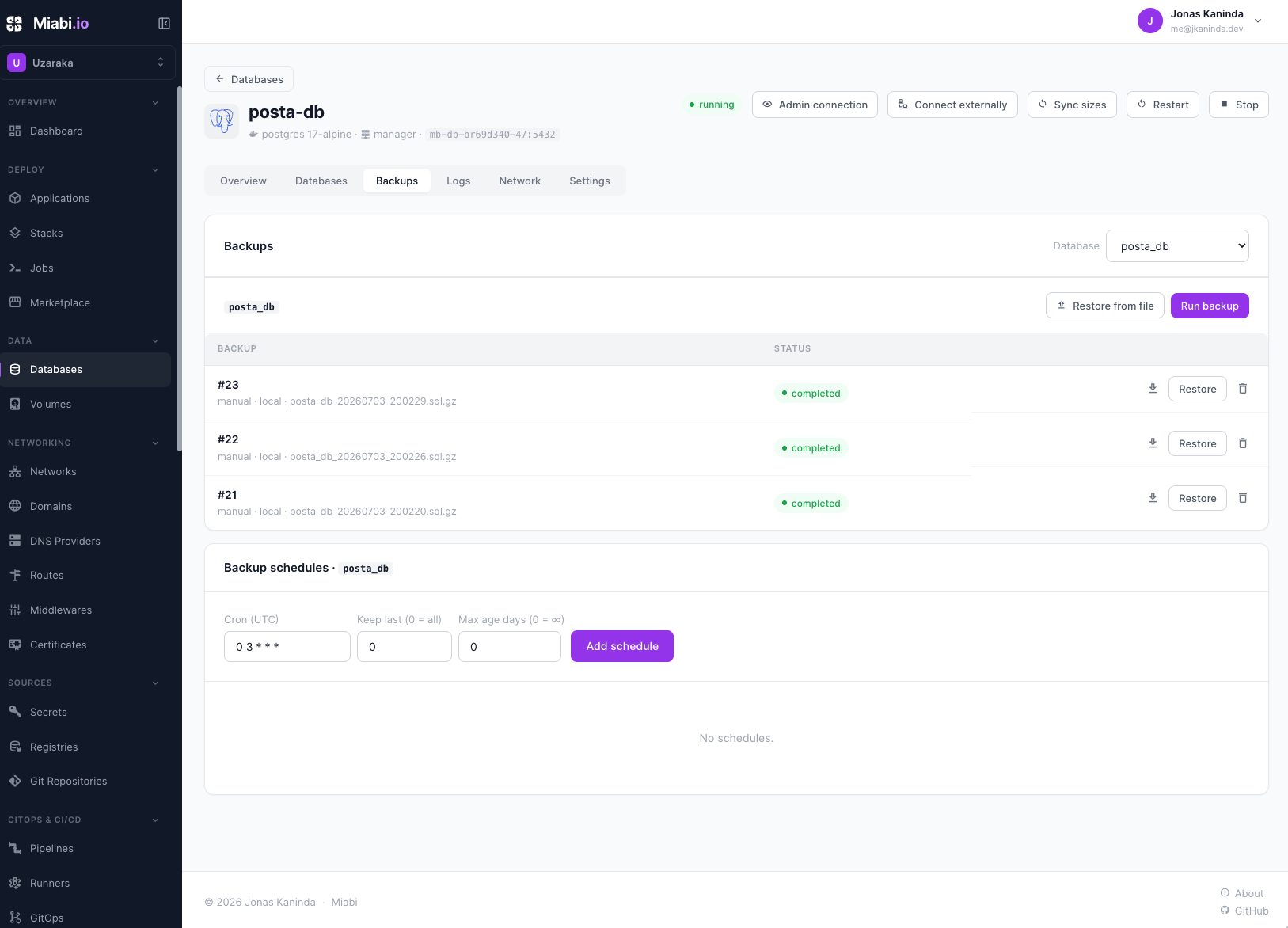 |
Monitoring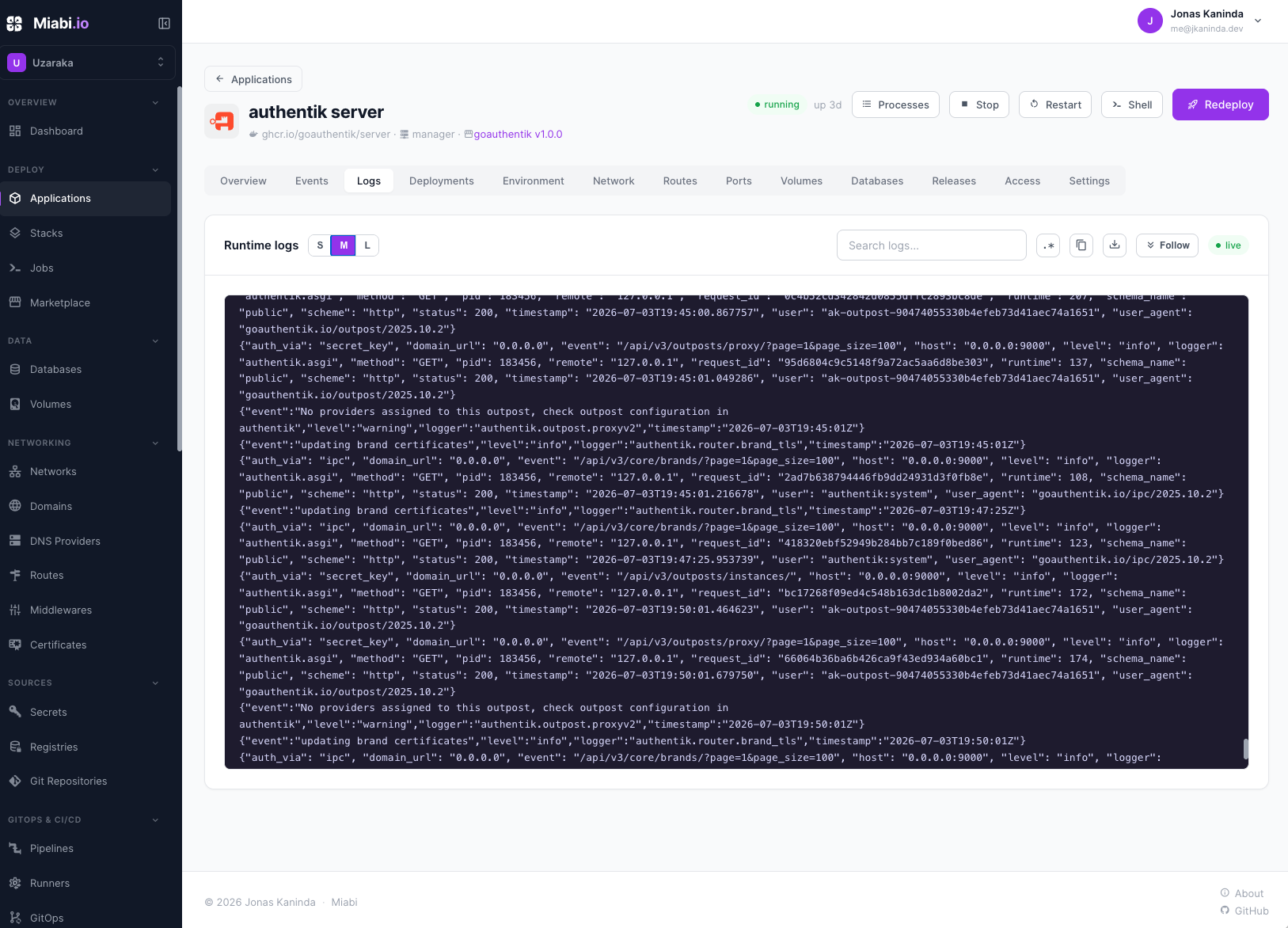 |
Marketplace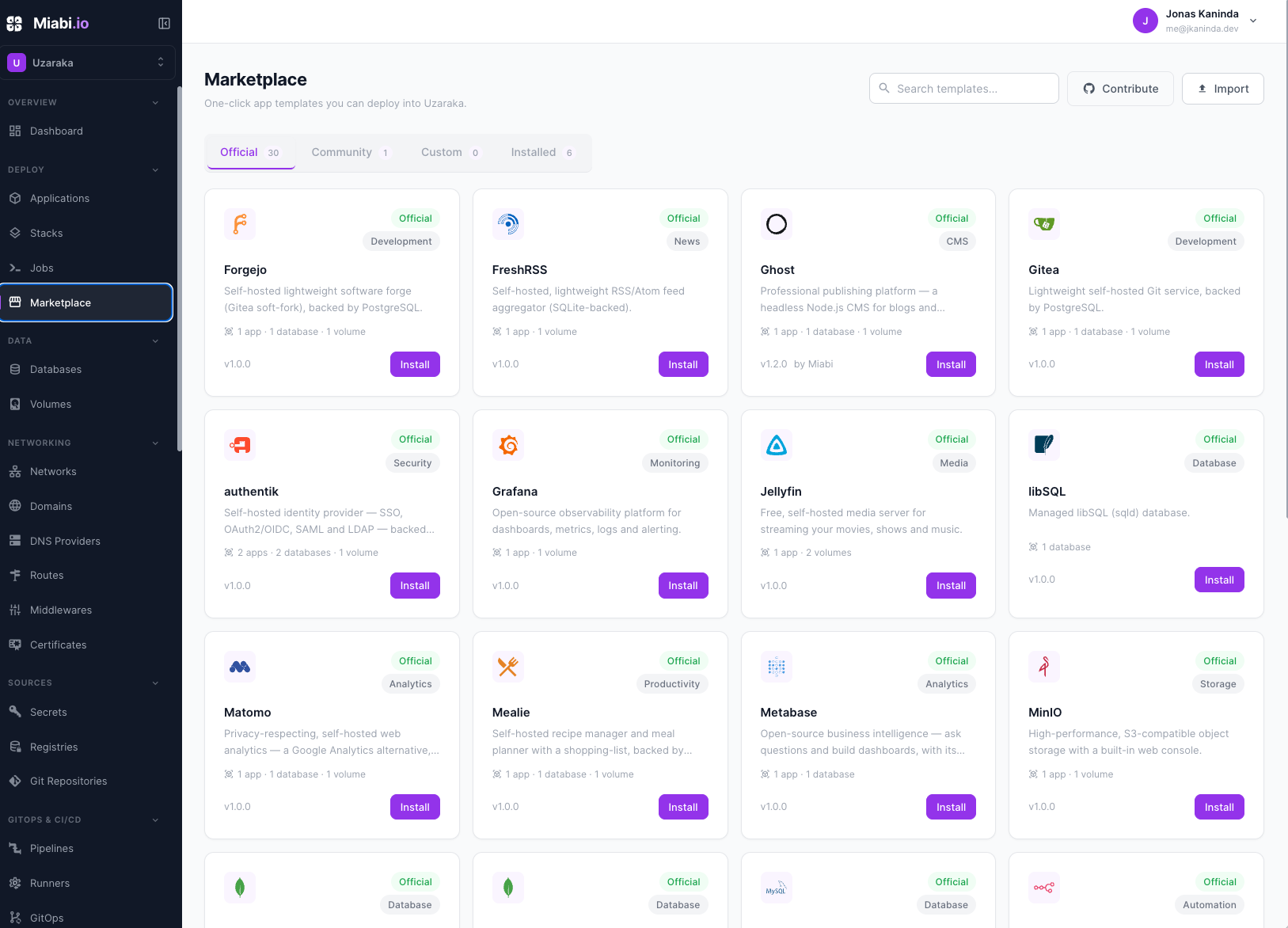 |
Platform admin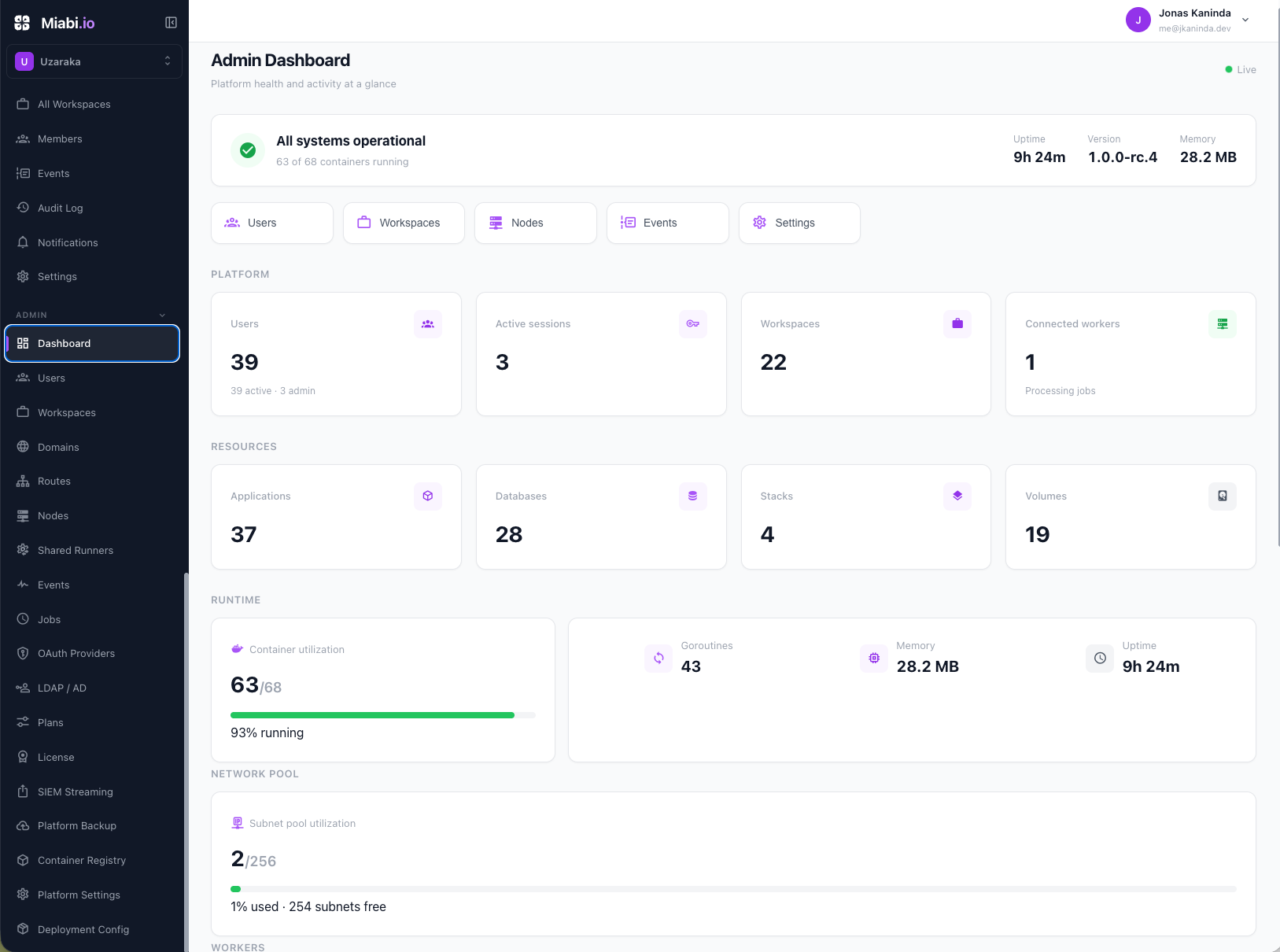 |
Application overview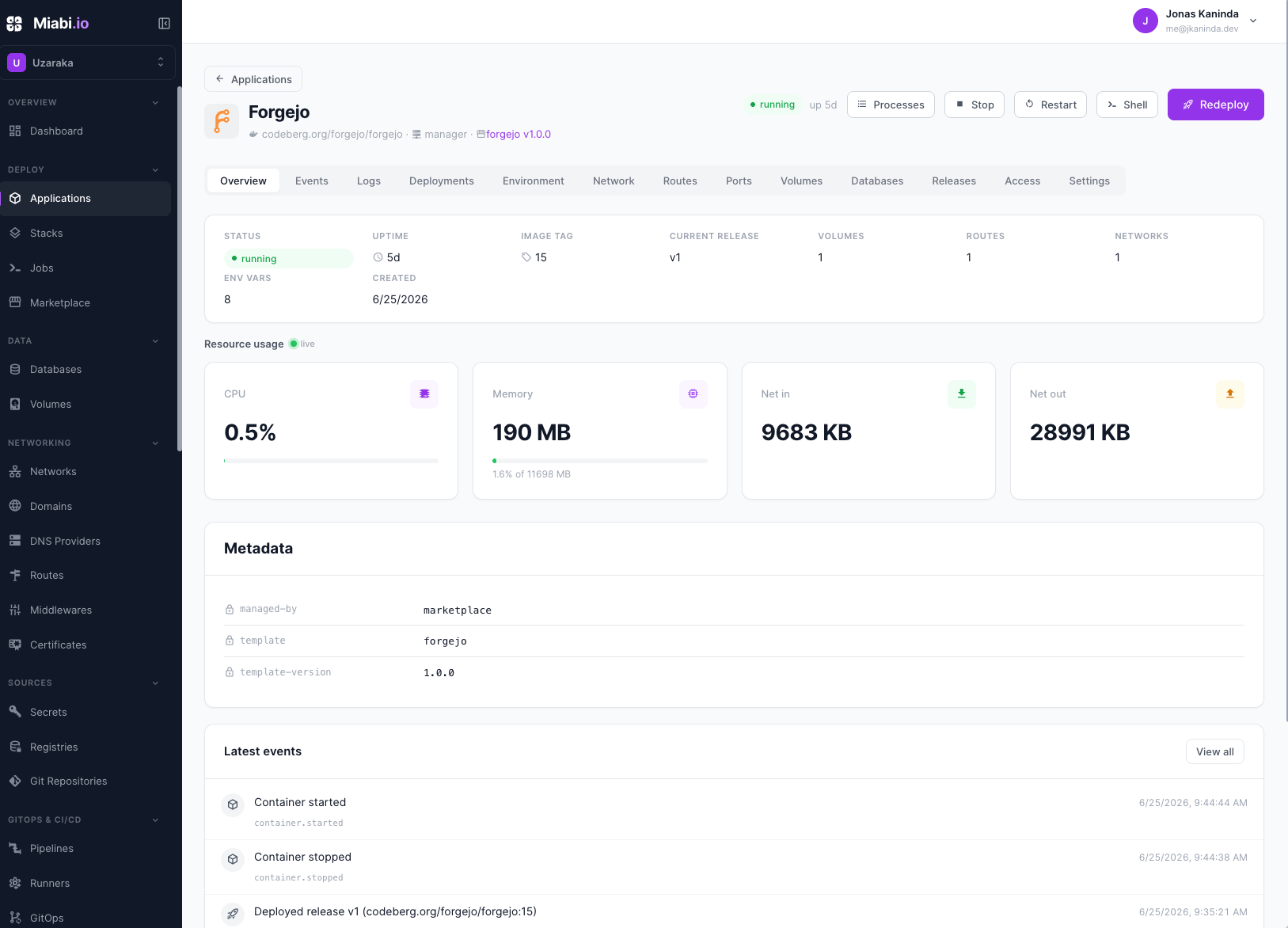 |
HTTP traffic analytics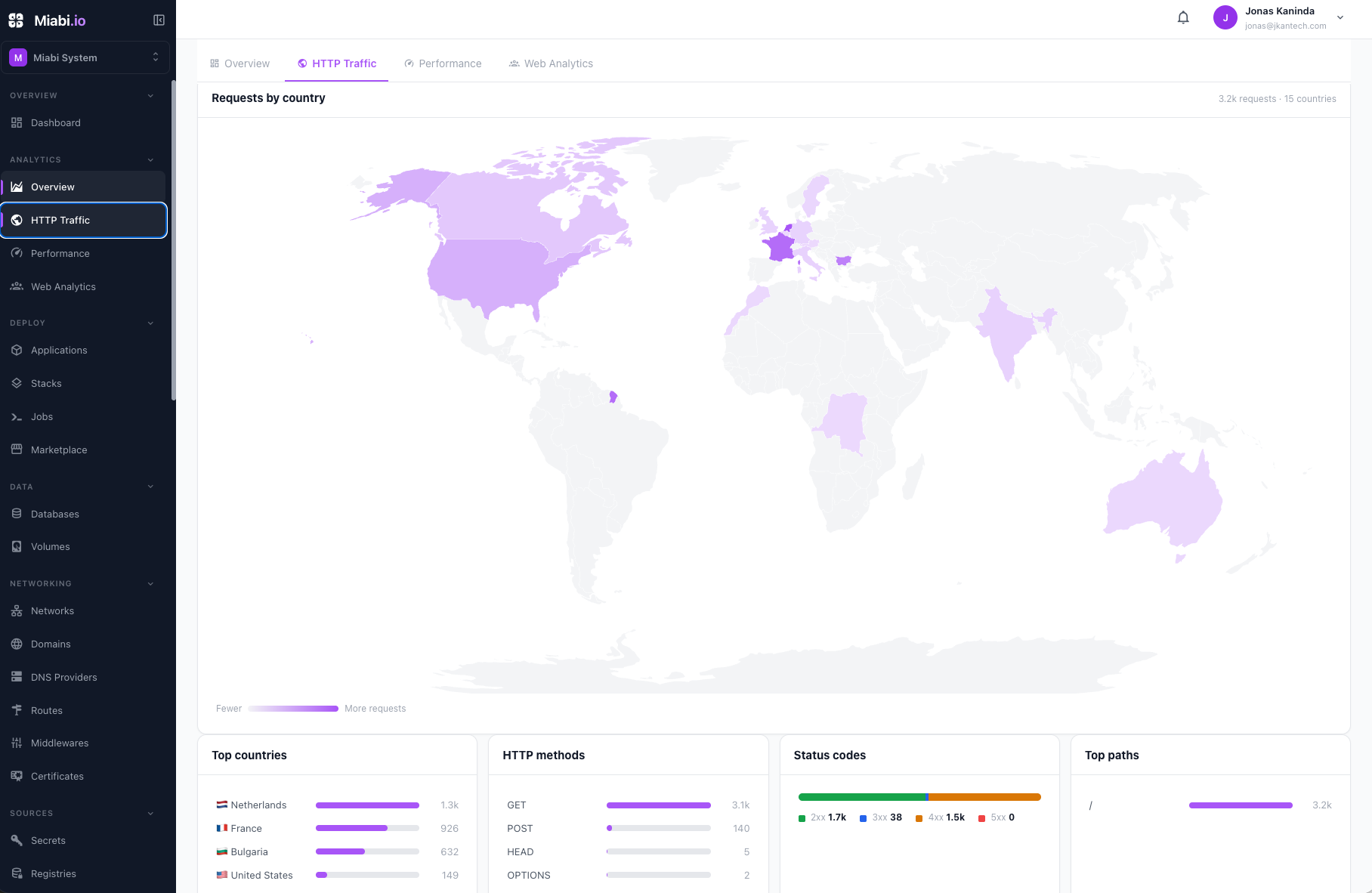 |
How Miabi compares
All four projects are self-hosted, open source, and deploy from Git or a Docker image with automatic HTTPS. The table covers only where they differ.
| Feature | Miabi | Coolify | Dokploy | CapRover |
|---|---|---|---|---|
| Multi-tenancy & workspace isolation | ✅ | ❌ | ❌ | ❌ |
| Organizations, teams & RBAC | ✅ | Limited | ❌ | ❌ |
| Shared hosting | ✅ | ❌ | ❌ | ❌ |
| Canary deployments | ✅ | ❌ | ❌ | ❌ |
| Zero-downtime deployments | ✅ | Limited | Limited | Limited |
| Built-in CI/CD pipelines | ✅ | ❌ | ❌ | ❌ |
| GitOps (no extra controller) | ✅ | ❌ | ❌ | ❌ |
Declarative manifests (miabi apply) |
✅ | ❌ | ❌ | ❌ |
| Built-in container registry | ✅ | ❌ | ❌ | ❌ |
| Secret vault (references, rotation redeploys apps) | ✅ | Partial | Partial | ❌ |
| Sealed secrets (encrypted, safe to commit to Git) | ✅ | ❌ | ❌ | ❌ |
| Built-in analytics (privacy-first) | ✅ | ❌ | ❌ | ❌ |
| Audit logs | ✅ | ❌ | ❌ | ❌ |
| OpenAPI-documented REST API | ✅ | ❌ | Partial | Limited |
| Official CLI | ✅ | ❌ | ❌ | ❌ |
| Terraform provider | ✅ | ❌ | ❌ | ❌ |
| Multi-node deployments | ✅ | Partial | Partial | Partial |
| Multiple clusters & regions | ✅ | ❌ | ❌ | ❌ |
| Live migration between locations (app, volumes & databases, near-zero downtime) | ✅ (Enterprise) | ❌ | ❌ | ❌ |
| Docker import (adopt existing containers) | ✅ | ❌ | ❌ | ❌ |
| Scheduled backups | ✅ | Partial | Partial | ❌ |
| Portable workspace backups (whole workspace, encrypted, restore anywhere) | ✅ | ❌ | ❌ | ❌ |
| Workspace migration to another install, with data | ✅ | ❌ | ❌ | ❌ |
| SAML / LDAP | ✅ (Enterprise) | ❌ | ❌ | ❌ |
Compiled from each project's public documentation. These projects move fast — if something here is out of date, please open a PR and we'll correct it.
Architecture
Browser / CLI / API clients
        │
        ▼
Goma Gateway (routing, TLS/ACME)
        │
        ▼
Miabi control plane (single Go binary: REST API + embedded Vue console)
        │
        ├─ asynq worker ── deploys, provisioning, backups
        ├─ PostgreSQL (GORM) · Redis (cache/queue)
        │
        ▼
Clusters (Docker Engine, optional Swarm per cluster)
        ├─ default cluster ── local socket, plus its Swarm members
        ├─ standalone nodes ── outbound agent tunnel, own edge gateway
        └─ remote Swarm clusters ── managers via agent tunnel, own ingress gateway
| Layer | Technology |
|---|---|
| Backend | Go 1.25+, Okapi framework, REST + OpenAPI |
| Frontend | Vue 3 + Pinia + Vite, built and statically served by the binary |
| Database | PostgreSQL (GORM) |
| Queue / cache | Redis + Asynq |
| Runtime | Docker Engine 25+ via the Moby SDK for Go (moby/moby/client), optional Swarm |
| Reverse proxy / TLS | Goma Gateway |
| Metrics | Prometheus |
The console source lives in web/ and is embedded into the Go binary, so a deployment is a single image. The node agent is a separate module, github.com/miabi-io/agent: a thin Docker proxy that needs only an outbound connection and the local Docker socket.
Live Demo
Try Miabi without installing anything at https://demo.miabi.io (password for all accounts: MiabiDemo2026).
The demo is seeded with two independent customers across three workspaces, so the core idea is visible immediately: shared hosting on Docker with true workspace isolation and role-based access. Every app, database, domain, volume, and secret belongs to a workspace; one tenant can never see or reach another's resources; a member only sees what their role grants.
| Sign in as | Workspaces | Role | Represents |
|---|---|---|---|
admin@acme.demo.miabi.io |
Acme Inc Prod · Acme Inc Dev | Owner | one org running prod and dev in separate, isolated workspaces |
dev@acme.demo.miabi.io |
Acme Inc Dev | Developer | a teammate scoped to a single workspace — can't see Acme Inc Prod |
admin@startup.demo.miabi.io |
Startup Prod | Owner | a different tenant — invisible to Acme |
Switch workspaces from the picker to watch the console re-scope, then sign in as the other customer to confirm the isolation boundary.
[!IMPORTANT] These are workspace accounts, not the platform admin. They can't reach the admin platform (nodes/cluster, users, plans, settings, licensing). To explore platform-admin features, install Miabi — the first account you seed is the platform admin.
[!NOTE] Demo apps run under a restricted (non-root) security profile: each container runs as a dedicated unprivileged user. If you deploy an app, make sure its image can run as non-root, or it will fail to start.
Development
Building from source needs Go 1.25+, Node (for the console), a PostgreSQL and a Redis instance, and a reachable Docker socket.
git clone https://github.com/miabi-io/miabi.git
cd miabi

make run        # API server on :9000, worker embedded
make worker     # standalone background worker (optional)
make build-ui   # build the Vue console into the embedded assets
make test       # unit + integration tests
The OpenAPI spec is generated from code annotations in internal/routes/ and served at /docs and /openapi.json on any running instance.
Ecosystem
Miabi is part of a family of self-hosting tools by the same author:
| Project | What it is |
|---|---|
| Okapi | The Go web framework Miabi is built on |
| Goma Gateway | Reverse proxy with TLS/ACME |
| cli | The official CLI |
| terraform-provider-miabi | Terraform / OpenTofu provider |
| agent | Outbound node agent for multi-node |
| runner | Dedicated build and pipeline runner |
| marketplace | Official app template catalog |
| examples | Example apps with complete CI/CD pipelines and GitOps manifests |
| Posta | Self-hosted email delivery and inbound |
| pg-bkup / mysql-bkup | Database backup tools |
Support & contributing
- Docs — https://docs.miabi.io
- Questions & ideas — GitHub Discussions
- Bugs & features — open an issue. External pull requests are not accepted at the moment; see CONTRIBUTING.md
- Security — report vulnerabilities privately to security@miabi.io. Please don't file public issues for security problems
If Miabi is useful to you, starring the repo genuinely helps other people find it.
License
| Path | License |
|---|---|
| Core | AGPL-3.0-or-later — LICENSE, NOTICE |
pkg/ |
Apache-2.0 — pkg/LICENSE |
internal/enterprise/ |
Miabi Enterprise License — LICENSE.md |
The reusable packages under pkg/ are the importable half of the project (pkg/stack is the host installer and lifecycle engine the CLI drives), so embedding them carries no AGPL obligation — nothing under pkg/ depends on AGPL-licensed code.
Enterprise features are built with the enterprise tag and require a valid commercial license. LICENSING.md has the full breakdown.
Miabi's code is open source. Its name is not. The Miabi name and logos are not covered by these licenses.
Copyright © 2026 Jonas Kaninda
 Directories

| Path | Synopsis |
|---|---|
|
cmd
|
|
|
healthprobe
command
Command healthprobe is the HTTP healthcheck copied into app containers, for images without a shell, curl or wget.
|
Command healthprobe is the HTTP healthcheck copied into app containers, for images without a shell, curl or wget. |
|
miabi
command
|
|
|
mwdocsgen
command
Command mwdocsgen generates the middleware reference docs from the catalog; a test asserts they match.
|
Command mwdocsgen generates the middleware reference docs from the catalog; a test asserts they match. |
|
schemagen
command
Command schemagen generates the miabi.io/v1 JSON Schema from the manifest parser's types so they cannot drift.
|
Command schemagen generates the miabi.io/v1 JSON Schema from the manifest parser's types so they cannot drift. |
|
internal
|
|
|
acme
Package acme issues TLS certificates via ACME DNS-01 using caller-supplied solver funcs.
|
Package acme issues TLS certificates via ACME DNS-01 using caller-supplied solver funcs. |
|
components
Package components lists the independently versioned parts of Miabi for the About page.
|
Package components lists the independently versioned parts of Miabi for the About page. |
|
cron
Package cron is a recurring-task scheduler keyed by "kind:id" strings so sources share one loop without collisions.
|
Package cron is a recurring-task scheduler keyed by "kind:id" strings so sources share one loop without collisions. |
|
datavolume
Package datavolume refuses to start a workload whose volume is gone, since Docker would silently create an empty one.
|
Package datavolume refuses to start a workload whose volume is gone, since Docker would silently create an empty one. |
|
dbenvelope
Package dbenvelope seals per-set data keys under the backup passphrase so the passphrase is cheaply rotatable.
|
Package dbenvelope seals per-set data keys under the backup passphrase so the passphrase is cheaply rotatable. |
|
declarative
Package declarative is the miabi.io/v1 resource model shared by apply, GitOps, Terraform and marketplace templates.
|
Package declarative is the miabi.io/v1 resource model shared by apply, GitOps, Terraform and marketplace templates. |
|
dns
Package dns wraps libdns behind one Provider interface; Miabi only manages the records it owns.
|
Package dns wraps libdns behind one Provider interface; Miabi only manages the records it owns. |
|
dnscatalog
Package dnscatalog is the single source of truth for supported DNS hosts: validation, secrets, API enum and UI form.
|
Package dnscatalog is the single source of truth for supported DNS hosts: validation, secrets, API enum and UI form. |
|
dnscatalog/gen
command
Command gen prints the docs' supported-providers table so it cannot drift from the catalog.
|
Command gen prints the docs' supported-providers table so it cannot drift from the catalog. |
|
docker
Package docker is the sole adapter over the Docker SDK, keeping SDK types out of the rest of the codebase.
|
Package docker is the sole adapter over the Docker SDK, keeping SDK types out of the rest of the codebase. |
|
dr
Package dr holds disaster-recovery primitives and depends on nothing else in Miabi: restore runs on a bare host.
|
Package dr holds disaster-recovery primitives and depends on nothing else in Miabi: restore runs on a bare host. |
|
drift
Package drift is the shared vocabulary for divergence between Miabi's records and what Docker runs.
|
Package drift is the shared vocabulary for divergence between Miabi's records and what Docker runs. |
|
healthprobe
Package healthprobe embeds the probe binary; without bin/ (make build-probe) builds fall back to a shell probe.
|
Package healthprobe embeds the probe binary; without bin/ (make build-probe) builds fall back to a shell probe. |
|
hostmount
Package hostmount defines the allow-listed host bind mounts; sources are server-owned, never client-supplied.
|
Package hostmount defines the allow-listed host bind mounts; sources are server-owned, never client-supplied. |
|
hoststats
Package hoststats re-exports pkg/hoststats and adds the control-plane-only helper-container sampler.
|
Package hoststats re-exports pkg/hoststats and adds the control-plane-only helper-container sampler. |
|
leader
Package leader elects the process that runs singleton work; it is not multi-replica HA.
|
Package leader elects the process that runs singleton work; it is not multi-replica HA. |
|
logstore
Package logstore externalizes finished logs to gzipped objects; a nil *Store is a no-op.
|
Package logstore externalizes finished logs to gzipped objects; a nil *Store is a no-op. |
|
mwcatalog
Package mwcatalog is the source of truth for curated Goma middleware types exposed as security policies.
|
Package mwcatalog is the source of truth for curated Goma middleware types exposed as security policies. |
|
netguard
Package netguard checks the resolved IP at dial time so DNS rebinding cannot reach internal addresses.
|
Package netguard checks the resolved IP at dial time so DNS rebinding cannot reach internal addresses. |
|
proxy
Package proxy abstracts Goma Gateway; TLS termination, ACME issuance and renewal are owned by Goma.
|
Package proxy abstracts Goma Gateway; TLS termination, ACME issuance and renewal are owned by Goma. |
|
runners
Package runners keeps runner tunnels only to lease jobs and stream logs; runners use their own Docker/BuildKit.
|
Package runners keeps runner tunnels only to lease jobs and stream logs; runners use their own Docker/BuildKit. |
|
services/account
Package account runs account-wide actions over a user's owned workspaces; each workspace has exactly one owner.
|
Package account runs account-wide actions over a user's owned workspaces; each workspace has exactly one owner. |
|
services/adminrecovery
Package adminrecovery is the audited break-glass path; shell access to the control plane is the trust boundary.
|
Package adminrecovery is the audited break-glass path; shell access to the control plane is the trust boundary. |
|
services/analytics
Package analytics holds no per-request rows or PII: histogram latency, HLL uniques, daily-salted visitor hash.
|
Package analytics holds no per-request rows or PII: histogram latency, HLL uniques, daily-salted visitor hash. |
|
services/announcement
Package announcement broadcasts platform notices as ordinary per-user notification rows.
|
Package announcement broadcasts platform notices as ordinary per-user notification rows. |
|
services/application
Package application manages applications, their config, and deployments.
|
Package application manages applications, their config, and deployments. |
|
services/apply
Package apply converges a workspace to miabi.io/v1 manifests; GitOps reuses the same engine.
|
Package apply converges a workspace to miabi.io/v1 manifests; GitOps reuses the same engine. |
|
services/audit
Package audit writes append-only audit-log entries for mutating actions.
|
Package audit writes append-only audit-log entries for mutating actions. |
|
services/auth
Package auth handles password hashing, revocable JWT sessions and password resets.
|
Package auth handles password hashing, revocable JWT sessions and password resets. |
|
services/backup
Package backup runs database backups and restores with the *-bkup tools as one-shot containers.
|
Package backup runs database backups and restores with the *-bkup tools as one-shot containers. |
|
services/backupsettings
Package backupsettings manages a workspace's shared S3 backup target; the secret is encrypted at rest.
|
Package backupsettings manages a workspace's shared S3 backup target; the secret is encrypted at rest. |
|
services/billing
Package billing serves the Billing API, off unless MIABI_BILLING_API_ENABLED and the billing licence flag are set.
|
Package billing serves the Billing API, off unless MIABI_BILLING_API_ENABLED and the billing licence flag are set. |
|
services/branding
Package branding owns the install's identity, kept separate from personal accents so neither leaks into the other.
|
Package branding owns the install's identity, kept separate from personal accents so neither leaks into the other. |
|
services/certificate
Package certificate manages imported TLS certificates; ACME is handled by Goma.
|
Package certificate manages imported TLS certificates; ACME is handled by Goma. |
|
services/cluster
Package cluster drives Docker Swarm as the optional cluster mode, one swarm per cluster.
|
Package cluster drives Docker Swarm as the optional cluster mode, one swarm per cluster. |
|
services/config
Package config owns workspace configuration files, encrypted at rest and projected read-only.
|
Package config owns workspace configuration files, encrypted at rest and projected read-only. |
|
services/controlmanager
Package controlmanager restores vanished workloads in place, never moves them, and never repairs lost data unattended.
|
Package controlmanager restores vanished workloads in place, never moves them, and never repairs lost data unattended. |
|
services/crypto
Package crypto provides AES-GCM at-rest encryption; without a key values are only base64 (dev only).
|
Package crypto provides AES-GCM at-rest encryption; without a key values are only base64 (dev only). |
|
services/customrole
Package customrole manages admin-defined roles and forbids privilege escalation beyond the author's own permissions.
|
Package customrole manages admin-defined roles and forbids privilege escalation beyond the author's own permissions. |
|
services/database
Package database provisions shared database server instances and manages the logical databases they host.
|
Package database provisions shared database server instances and manages the logical databases they host. |
|
services/dbupgrade
Package dbupgrade adapts the app and backup services to the database upgrade interfaces without an import cycle.
|
Package dbupgrade adapts the app and backup services to the database upgrade interfaces without an import cycle. |
|
services/directory
Package directory turns a successful LDAP/AD bind into a JIT-provisioned Miabi user with group-mapped access.
|
Package directory turns a successful LDAP/AD bind into a JIT-provisioned Miabi user with group-mapped access. |
|
services/dnsprovider
Package dnsprovider manages workspace DNS provider connections; credentials are encrypted and never returned.
|
Package dnsprovider manages workspace DNS provider connections; credentials are encrypted and never returned. |
|
services/dockerimport
Package dockerimport adopts unmanaged Docker resources in place, without tearing down what is running.
|
Package dockerimport adopts unmanaged Docker resources in place, without tearing down what is running. |
|
services/domain
Package domain manages workspace-owned domains: registration, DNS-verified ownership, and default TLS policy.
|
Package domain manages workspace-owned domains: registration, DNS-verified ownership, and default TLS policy. |
|
services/edgegateway
Package edgegateway provisions the Goma gateway on an edge node, which terminates TLS and serves its own routes.
|
Package edgegateway provisions the Goma gateway on an edge node, which terminates TLS and serves its own routes. |
|
services/elevation
Package elevation is the admin console unlock (sudo mode): a 2FA-proved token bound to the session jti.
|
Package elevation is the admin console unlock (sudo mode): a 2FA-proved token bound to the session jti. |
|
services/eventbus
Package eventbus is an in-process pub/sub for SSE fan-out; single-node only, a separate worker would need Redis.
|
Package eventbus is an in-process pub/sub for SSE fan-out; single-node only, a separate worker would need Redis. |
|
services/events
Package events records and streams resource timeline events; one recorder serves every subject type.
|
Package events records and streams resource timeline events; one recorder serves every subject type. |
|
services/gitops
Package gitops reconciles Git repos of miabi.io/v1 manifests into a workspace by reusing the apply engine.
|
Package gitops reconciles Git repos of miabi.io/v1 manifests into a workspace by reusing the apply engine. |
|
services/gitrepo
Package gitrepo manages encrypted Git credentials and builds the go-git auth shared by probes and deploys.
|
Package gitrepo manages encrypted Git credentials and builds the go-git auth shared by probes and deploys. |
|
services/gpu
Package gpu inventories node GPUs over the Docker API, so the node agent needs no changes.
|
Package gpu inventories node GPUs over the Docker API, so the node agent needs no changes. |
|
services/groupsync
Package groupsync applies SSO group claims at sign-in, touching only governed memberships and never orphaning a workspace.
|
Package groupsync applies SSO group claims at sign-in, touching only governed memberships and never orphaning a workspace. |
|
services/housekeeping
Package housekeeping reconciles a node's Docker state against Miabi's intent: disk report, safe prune, drift.
|
Package housekeeping reconciles a node's Docker state against Miabi's intent: disk report, safe prune, drift. |
|
services/image
Package image manages the built-image catalog; its GC never collects a digest a live or pinned release uses.
|
Package image manages the built-image catalog; its GC never collects a digest a live or pinned release uses. |
|
services/job
Package job is the request side of Jobs and CronJobs: it creates rows and enqueues them for the worker.
|
Package job is the request side of Jobs and CronJobs: it creates rows and enqueues them for the worker. |
|
services/keyring
Package keyring manages per-workspace DEKs wrapped by the master KEK, which never leaves the crypto package.
|
Package keyring manages per-workspace DEKs wrapped by the master KEK, which never leaves the crypto package. |
|
services/locationmigration
Package locationmigration moves an app with its data to another location live, keeping the source until finalized.
|
Package locationmigration moves an app with its data to another location live, keeping the source until finalized. |
|
services/logintoken
Package logintoken mints short-lived, never-admin personal API keys for "Copy login command", with a single-use SSO hand-off.
|
Package logintoken mints short-lived, never-admin personal API keys for "Copy login command", with a single-use SSO hand-off. |
|
services/mailer
Package mailer sends platform emails best-effort and async; unconfigured SMTP or a nil Service is a silent no-op.
|
Package mailer sends platform emails best-effort and async; unconfigured SMTP or a nil Service is a silent no-op. |
|
services/managedcert
Package managedcert issues and renews certificates via ACME DNS-01; Goma still serves them as custom certs.
|
Package managedcert issues and renews certificates via ACME DNS-01; Goma still serves them as custom certs. |
|
services/marketplace
Package marketplace serves the template catalog and installs templates via the app, database, storage and stack services.
|
Package marketplace serves the template catalog and installs templates via the app, database, storage and stack services. |
|
services/marketplace/manifest
Package manifest defines the miabi.io/v1 Template format and its parsing, validation and interpolation.
|
Package manifest defines the miabi.io/v1 Template format and its parsing, validation and interpolation. |
|
services/marketplace/remote
Package remote syncs the marketplace registry ETag-conditionally into a Redis cache.
|
Package remote syncs the marketplace registry ETag-conditionally into a Redis cache. |
|
services/metadataguard
Package metadataguard keeps containers off the cloud metadata service on every node via a per-node nftables helper.
|
Package metadataguard keeps containers off the cloud metadata service on every node via a per-node nftables helper. |
|
services/middleware
Package middleware manages workspace-owned Goma Gateway middlewares and reconciles them into the proxy provider.
|
Package middleware manages workspace-owned Goma Gateway middlewares and reconciles them into the proxy provider. |
|
services/monitoring
Package monitoring exposes container metrics and workspace health overviews.
|
Package monitoring exposes container metrics and workspace health overviews. |
|
services/netalloc
Package netalloc allocates non-overlapping subnets from one platform pool, ledgered in the DB to survive restarts.
|
Package netalloc allocates non-overlapping subnets from one platform pool, ledgered in the DB to survive restarts. |
|
services/network
Package network manages workspace-owned Docker networks, created and removed alongside their DB records.
|
Package network manages workspace-owned Docker networks, created and removed alongside their DB records. |
|
services/node
Package node manages Docker host (server) records and their reachability.
|
Package node manages Docker host (server) records and their reachability. |
|
services/nodestats
Package nodestats reads host CPU/memory per node: local procfs, agent pushes, or a short-lived sampling container.
|
Package nodestats reads host CPU/memory per node: local procfs, agent pushes, or a short-lived sampling container. |
|
services/notify
Package notify fans persisted application events out to a workspace's webhooks and channels.
|
Package notify fans persisted application events out to a workspace's webhooks and channels. |
|
services/oauth
Package oauth implements the OAuth 2.0 / OIDC authorization-code login flow against admin-configured providers.
|
Package oauth implements the OAuth 2.0 / OIDC authorization-code login flow against admin-configured providers. |
|
services/organization
Package organization manages tenant realms; every nullable organization_id resolves to the default one.
|
Package organization manages tenant realms; every nullable organization_id resolves to the default one. |
|
services/passkey
Package passkey runs WebAuthn ceremonies; state in Redis is single-use so a challenge can't be answered twice.
|
Package passkey runs WebAuthn ceremonies; state in Redis is single-use so a challenge can't be answered twice. |
|
services/pipeline
Package pipeline implements Miabi's CI/CD: pipeline-as-code, run lifecycle, and the internal container runner.
|
Package pipeline implements Miabi's CI/CD: pipeline-as-code, run lifecycle, and the internal container runner. |
|
services/placement
Package placement picks a location then a node for a new resource, once at create; nothing is rescheduled.
|
Package placement picks a location then a node for a new resource, once at create; nothing is rescheduled. |
|
services/platformbackup
Package platformbackup is admin-only control-plane disaster recovery; artifacts use the backup passphrase, not the master key.
|
Package platformbackup is admin-only control-plane disaster recovery; artifacts use the backup passphrase, not the master key. |
|
services/platformimage
Package platformimage is the single source of truth for platform images: code defaults, admin overrides, optional mirror.
|
Package platformimage is the single source of truth for platform images: code defaults, admin overrides, optional mirror. |
|
services/platformrestore
Package platformrestore rebuilds a platform onto a fresh host from a recovery point, outside the control plane.
|
Package platformrestore rebuilds a platform onto a fresh host from a recovery point, outside the control plane. |
|
services/portbinding
Package portbinding queues host-port requests for admin approval, since host ports are a node-wide shared resource.
|
Package portbinding queues host-port requests for admin approval, since host ports are a node-wide shared resource. |
|
services/portforward
Package portforward exposes a managed database on demand via an ephemeral listener bridged to an in-network socat relay.
|
Package portforward exposes a managed database on demand via an ephemeral listener bridged to an in-network socat relay. |
|
services/quota
Package quota enforces plan limits; effective limits resolve override, plan, default plan, then unlimited.
|
Package quota enforces plan limits; effective limits resolve override, plan, default plan, then unlimited. |
|
services/recovery
Package recovery converges a restored control-plane DB, whose rows describe a machine that no longer exists, onto this host.
|
Package recovery converges a restored control-plane DB, whose rows describe a machine that no longer exists, onto this host. |
|
services/registration
Package registration owns self-service sign-up, off by default so upgraded installs never silently accept accounts.
|
Package registration owns self-service sign-up, off by default so upgraded installs never silently accept accounts. |
|
services/registry
Package registry manages container-registry credentials for pulling private images; secrets are encrypted at rest.
|
Package registry manages container-registry credentials for pulling private images; secrets are encrypted at rest. |
|
services/registryserver
Package registryserver runs the built-in multi-tenant registry; tenant requests are authorized via Goma forwardAuth.
|
Package registryserver runs the built-in multi-tenant registry; tenant requests are authorized via Goma forwardAuth. |
|
services/release
Package release turns per-app releases into promotable artifacts with provenance and per-environment approval gates.
|
Package release turns per-app releases into promotable artifacts with provenance and per-environment approval gates. |
|
services/restriction
Package restriction holds admin workspace restrictions and the gate every workload-changing entry point consults.
|
Package restriction holds admin workspace restrictions and the gate every workload-changing entry point consults. |
|
services/route
Package route manages Goma Gateway routes bound to applications and reconciles them into the proxy provider.
|
Package route manages Goma Gateway routes bound to applications and reconciles them into the proxy provider. |
|
services/runner
Package runner manages build runners: dedicated machines that never host apps, dialing in over a tunnel.
|
Package runner manages build runners: dedicated machines that never host apps, dialing in over a tunnel. |
|
services/sealing
Package sealing manages workspace sealing keys; private keys stay wrapped under the master KEK.
|
Package sealing manages workspace sealing keys; private keys stay wrapped under the master KEK. |
|
services/secpolicy
Package secpolicy enforces scoped platform security rules; specific scopes may only tighten the platform rule.
|
Package secpolicy enforces scoped platform security rules; specific scopes may only tighten the platform rule. |
|
services/secret
Package secret is the Vault: encrypted workspace secrets referenced from env and resolved at deploy or job time.
|
Package secret is the Vault: encrypted workspace secrets referenced from env and resolved at deploy or job time. |
|
services/serviceaccount
Package serviceaccount manages workspace-owned non-human users that sign in only with API keys.
|
Package serviceaccount manages workspace-owned non-human users that sign in only with API keys. |
|
services/session
Package session maintains a Redis-backed JWT revocation list keyed by jti.
|
Package session maintains a Redis-backed JWT revocation list keyed by jti. |
|
services/settings
Package settings provides cached, typed access to platform-wide key/value settings stored in the database.
|
Package settings provides cached, typed access to platform-wide key/value settings stored in the database. |
|
services/stack
Package stack groups apps organizationally; deleting a stack detaches its apps, which keep running.
|
Package stack groups apps organizationally; deleting a stack detaches its apps, which keep running. |
|
services/storage
Package storage manages persistent (Docker) volumes owned by workspaces.
|
Package storage manages persistent (Docker) volumes owned by workspaces. |
|
services/storageclass
Package storageclass manages admin-registered volume directories, so tenants name a class, never a host path.
|
Package storageclass manages admin-registered volume directories, so tenants name a class, never a host path. |
|
services/telemetry
Package telemetry sends one anonymous startup and daily event; failures never affect the platform.
|
Package telemetry sends one anonymous startup and daily event; failures never affect the platform. |
|
services/transfer
Package transfer splices bytes between Docker engines through the control plane; nodes never talk directly.
|
Package transfer splices bytes between Docker engines through the control plane; nodes never talk directly. |
|
services/twofactor
Package twofactor wraps TOTP (RFC 6238); the caller owns persistence and encryption of the secret.
|
Package twofactor wraps TOTP (RFC 6238); the caller owns persistence and encryption of the secret. |
|
services/updatecheck
Package updatecheck checks versions.miabi.io daily and notifies; it never upgrades anything itself.
|
Package updatecheck checks versions.miabi.io daily and notifies; it never upgrades anything itself. |
|
services/usersettings
Package usersettings owns per-user preferences, separate from account lifecycle.
|
Package usersettings owns per-user preferences, separate from account lifecycle. |
|
services/versioning
Package versioning reserves each pipeline run's version (image tag); deploys stay by digest.
|
Package versioning reserves each pipeline run's version (image tag); deploys stay by digest. |
|
services/volumebackup
Package volumebackup archives managed volumes to the workspace's S3 target via volume-bkup; S3 is required.
|
Package volumebackup archives managed volumes to the workspace's S3 target via volume-bkup; S3 is required. |
|
services/webhook
Package webhook manages workspace webhooks and signed delivery; signing secrets are encrypted at rest.
|
Package webhook manages workspace webhooks and signed delivery; signing secrets are encrypted at rest. |
|
services/workspace
Package workspace manages workspaces, memberships, and invitations.
|
Package workspace manages workspaces, memberships, and invitations. |
|
services/workspacekeys
Package workspacekeys rotates a workspace's data and sealing keys together, at most once per RotationInterval.
|
Package workspacekeys rotates a workspace's data and sealing keys together, at most once per RotationInterval. |
|
services/wsbackup
Package wsbackup exports a workspace to a portable S3 bundle another install can read, and restores it.
|
Package wsbackup exports a workspace to a portable S3 bundle another install can read, and restores it. |
|
siem
Package siem streams the audit log at-least-once; the cursor advances only on a successful ship.
|
Package siem streams the audit log at-least-once; the cursor advances only on a successful ship. |
|
slug
Package slug derives URL/DNS-safe identifiers from human names.
|
Package slug derives URL/DNS-safe identifiers from human names. |
|
storage/blob
Package blob is a minimal S3 client for bundle control objects and `miabi restore` on a bare host.
|
Package blob is a minimal S3 client for bundle control objects and `miabi restore` on a bare host. |
|
storage/logbackfill
Package logbackfill moves old large log rows to the log store at boot, since it must wait for the store.
|
Package logbackfill moves old large log rows to the log store at boot, since it must wait for the store. |
|
storage/migration/upgrade
Package upgrade runs once-only data backfills; schema DDL belongs in the migration package.
|
Package upgrade runs once-only data backfills; schema DDL belongs in the migration package. |
|
web
Package web embeds the built Vue SPA; only a .gitkeep in dist/ is committed so go build works without the UI.
|
Package web embeds the built Vue SPA; only a .gitkeep in dist/ is committed so go build works without the UI. |
|
webhooksig
Package webhooksig verifies inbound provider push webhooks.
|
Package webhooksig verifies inbound provider push webhooks. |
|
worker
Package worker holds the asynq producer, task types, and handlers for background work.
|
Package worker holds the asynq producer, task types, and handlers for background work. |
|
wsbundle
Package wsbundle defines the Miabi Portable Bundle format; it depends on nothing else in Miabi.
|
Package wsbundle defines the Miabi Portable Bundle format; it depends on nothing else in Miabi. |
|
pkg
|
|
|
bundled
Package bundled names provisioned component versions, set by release builds via -ldflags -X.
|
Package bundled names provisioned component versions, set by release builds via -ldflags -X. |
|
hoststats
Package hoststats reads host CPU and memory from procfs, shared by control plane and agent so figures can't drift.
|
Package hoststats reads host CPU and memory from procfs, shared by control plane and agent so figures can't drift. |
|
sealed
Package sealed implements git-committable secrets encrypted to a workspace's age key and bound to the secret name.
|
Package sealed implements git-committable secrets encrypted to a workspace's age key and bound to the secret name. |
|
stack
Package stack installs Miabi's own stack via the Docker API, since Miabi can't self-update while Compose owns it.
|
Package stack installs Miabi's own stack via the Docker API, since Miabi can't self-update while Compose owns it. |
|
stack/docker
Package docker is the stack engine's Docker seam; no Docker SDK types cross it.
|
Package docker is the stack engine's Docker seam; no Docker SDK types cross it. |
|
stack/saferollout
Package saferollout tests a new image under a throwaway name before promoting, with rollback on failure.
|
Package saferollout tests a new image under a throwaway name before promoting, with rollback on failure. |
|
stack/selfcontainer
Package selfcontainer detects Miabi's own container ID so the admin UI can refuse to stop or delete it.
|
Package selfcontainer detects Miabi's own container ID so the admin UI can refuse to stop or delete it. |
|
stack/stackcmd
Package stackcmd holds host-side verb behaviour shared by the cobra CLI and the image's okapicli, so they can't drift.
|
Package stackcmd holds host-side verb behaviour shared by the cobra CLI and the image's okapicli, so they can't drift. |
|
Package templates embeds an offline floor of the official catalog; the full catalog is merged at runtime.
|
Package templates embeds an offline floor of the official catalog; the full catalog is merged at runtime. |
|
gen
command
Command gen vendors official templates from the marketplace export.json into the embedded offline floor.
|
Command gen vendors official templates from the marketplace export.json into the embedded offline floor. |