

 README

README

OpsCart Kubernetes Watcher
Kubectl shows resources. OpsCart shows what deserves your attention.



✅ Read-only · ✅ No agents · ✅ No cloud credentials · ✅ Deploy in 30 seconds
Kubernetes operational intelligence for incident response, cost visibility, and security posture. Aggregates risk across your cluster and tells you what to fix first — without touching production.
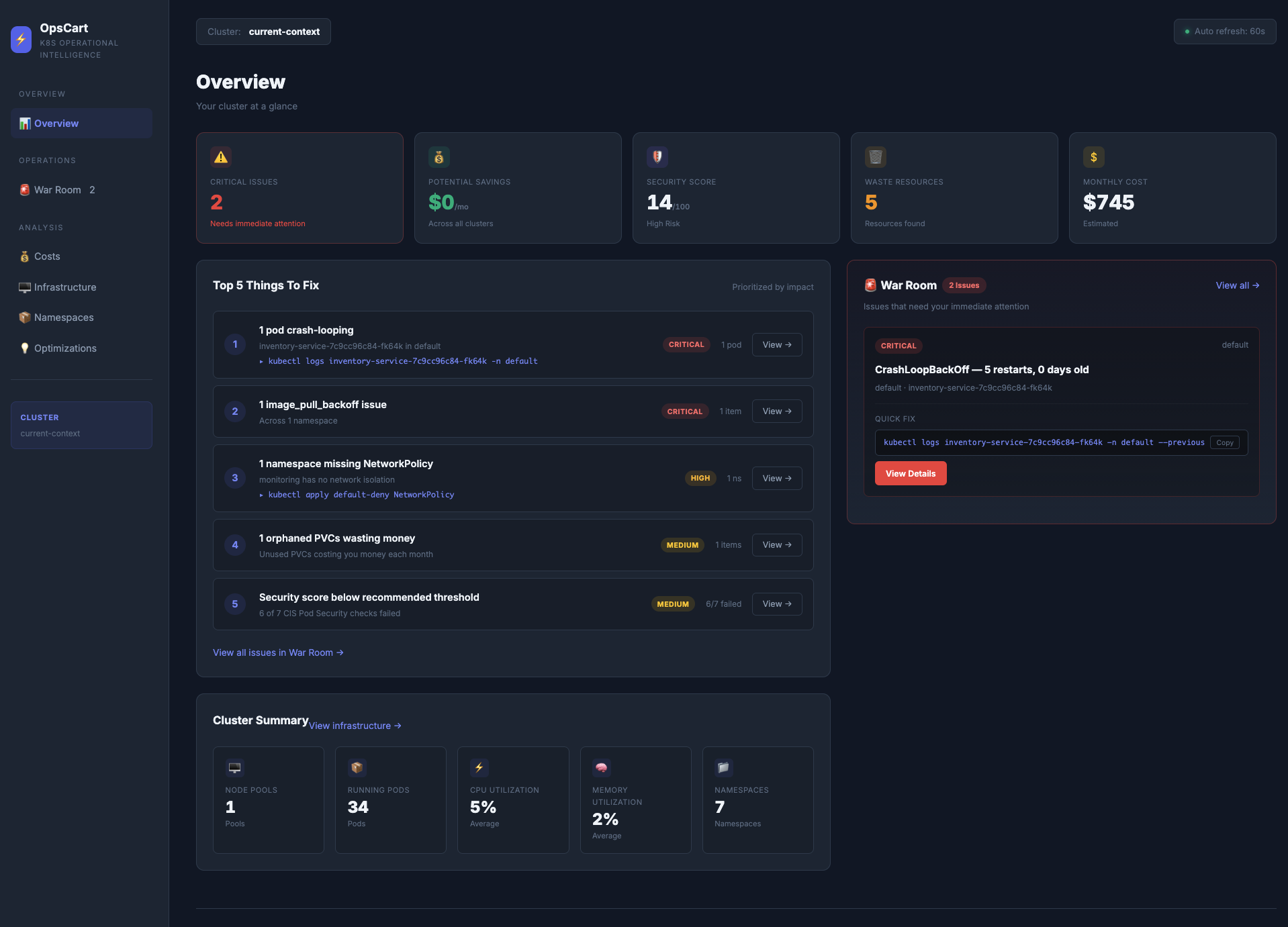
What OpsCart Does
OpsCart answers one question:
"What deserves my attention right now?"
Every Kubernetes engineer wakes up wondering what's broken, what's wasting money, and what to fix first. OpsCart aggregates issues across operational risk, cost, security, and waste — then surfaces the top 5 things to fix, prioritized by impact.
The War Room
The flagship feature. One screen showing every critical issue across your cluster:
- 🔴 CrashLoopBackOff pods with restart counts and age
- 🟠 ImagePullBackOff failures with
kubectl describecommands - 🔴 OOMKilled containers
- 🟡 Unprotected namespaces (no NetworkPolicy)
- 🟡 Orphaned PVCs wasting storage cost
Each issue includes severity, impact, and a kubectl command you can copy-paste.
🚀 Deployment Options
Three ways to run OpsCart. Pick what fits your workflow.
Option 1: Deploy In-Cluster (Recommended)
The fastest path to running production OpsCart. Read-only ClusterRole, scratch image, non-root.
kubectl apply -f https://raw.githubusercontent.com/opscart/opscart-k8s-watcher/main/deploy/dashboard.yaml
kubectl port-forward -n opscart-system svc/opscart-dashboard 8080:80
open http://localhost:8080
What this gives you:
- Auto-refreshes every 60 seconds
- Multi-cluster aware
- No external dependencies (no Prometheus, no metrics-server required)
- Removable in one command:
kubectl delete -f deploy/dashboard.yaml
Option 2: Local Binary
Useful for testing OpsCart against a cluster from your laptop. Uses your local kubeconfig.
git clone https://github.com/opscart/opscart-k8s-watcher.git
cd opscart-k8s-watcher
go build -o opscart-dashboard ./cmd/opscart-dashboard
./opscart-dashboard --cluster my-cluster --port 8080
open http://localhost:8080
Option 3: Docker
Cross-platform, no Go installation required.
docker run -p 8080:8080 \
  -v ~/.kube:/root/.kube \
  ghcr.io/opscart/opscart-dashboard:v1.0.0
Option 4: CLI Scanner
If you prefer the terminal or want to integrate OpsCart into pipelines:
go build -o opscart-scan ./cmd/opscart-scan

./opscart-scan emergency --cluster prod      # War Room from terminal
./opscart-scan security --cluster prod       # CIS scoring
./opscart-scan waste --cluster prod          # Find idle resources
./opscart-scan cloud-costs --cluster prod    # Azure cost analysis
🧠 What It Detects
🚨 War Room — Operational Risk
Every issue that needs human attention, surfaced and grouped by type:
- CrashLoopBackOff — pod identity, namespace, restart count, age
- OOMKilled — out-of-memory containers
- ImagePullBackOff — image pull failures with
describecommands - Unprotected Namespaces — no NetworkPolicy defined
- Orphaned PVCs — storage charging with no consuming pod
- Zero-Replica Workloads — deployments scaled to 0
💰 Cloud Costs
Reads Kubernetes node labels, looks up Azure retail pricing, allocates costs to namespaces proportionally. No Azure credentials, no API calls — fully offline.
- 40+ VM SKUs (B/D/E/F/L series), Spot and On-Demand
- Reserved Instance savings potential (1yr/3yr)
- Per-deployment cost breakdown
- 15+ Azure region multipliers
🔒 Security Posture
CIS Kubernetes Benchmark v1.8 scoring with environment-aware analysis.
- Separates actionable issues from expected infrastructure configs
- Privileged container whitelist (CNI/CSI/monitoring distinguished from unexpected)
- 50+ infrastructure namespace patterns recognized (calico, tigera, gatekeeper, etc.)
🗑️ Waste & Drift
9 resource types — never modifies the cluster, suggestions only.
| Type | What It Catches |
|---|---|
| Abandoned Namespaces | No running pods for N days |
| Zombie Pods | CrashLoopBackOff, OOMKilled lingering |
| Orphaned PVCs | Unbound or pod-less storage still charging |
| Stale Jobs | Completed jobs not cleaned up |
| Zero-Replica Workloads | Deployments scaled to 0 |
| Broken Ingresses | Backends pointing to missing services |
| Misconfigured HPAs | Stuck at minReplicas, scaling disabled |
🌐 Network Policy Gaps
Which namespaces have zero network isolation — before an attacker finds out first.
📋 CLI Commands
| Command | Description |
|---|---|
emergency |
War Room — what's broken right now |
security |
CIS Benchmark security posture |
waste |
Orphaned, idle, and zombie resources |
cloud-costs |
Real-time Azure cost analysis |
network |
Network policy gap analysis |
costs |
Resource-share cost allocation |
report |
Comprehensive cluster health HTML report |
resources |
Cluster resource inventory |
config |
Multi-cluster configuration |
Common flags:
--cluster CLUSTER         # Target cluster context
--all-clusters            # Scan all configured clusters
--format html|json|table  # Output format
--namespace NS            # Scope to single namespace
🏗️ Architecture
opscart-k8s-watcher/ ├── cmd/ │ ├── opscart-scan/ ← CLI scanner binary │ └── opscart-dashboard/ ← Live dashboard server └── pkg/ ├── analyzer/ ← Detection engines (security, waste, cost, network) ├── models/ ← Data structures ├── report/ ← HTML report generators └── scanner/ ← Multi-cluster orchestration
Dashboard runtime:
opscart-system namespace
└── opscart-dashboard pod ├── ClusterRole: read-only (nodes, pods, deployments, NetworkPolicies, PVCs) ├── Polls cluster every 60 seconds ├── REST API: /api/overview, /api/warroom, /api/report └── Scratch image (~15MB), non-root (UID 65534)
🆚 vs. Other Tools
| Tool | Shows | OpsCart Difference |
|---|---|---|
| kubectl | Resources | OpsCart prioritizes |
| Lens | Cluster state | OpsCart aggregates risk |
| k9s | Real-time pods | OpsCart explains impact |
| Datadog/New Relic | Metrics + logs | OpsCart needs no agents |
| Kubecost | Detailed cost only | OpsCart correlates cost + risk |
OpsCart isn't a replacement — it's the operational intelligence layer between kubectl and full observability platforms.
📅 Version History
| Version | Date | Highlights |
|---|---|---|
| v1.0.0 | Jun 2026 | New Overview page, Top 5 Things to Fix, War Room featured panel, sidebar restructure (Operations as own category), trust-first positioning, complete code refactor |
| v0.9.0 | Jun 2026 | Full dashboard with 5 tabs (Infrastructure, Namespaces, Optimizations, War Room, Cost Overview) |
| v0.8.0 | Jun 2026 | Live in-cluster FinOps dashboard, 60s background polling, multi-cluster UI |
| v0.7.0 | Jun 2026 | cloud-costs command, embedded Azure pricing catalog |
| v0.6.0 | May 2026 | costs command, resource-share allocation |
| v0.5.x | Feb 2026 | Waste detection (9 types), HTML reports |
| v0.4.0 | Feb 2026 | Network policy gap analysis |
| v0.3.0 | Feb 2026 | HTML report generation |
| v0.2.0 | Feb 2026 | Multi-cluster support |
| v0.1.0 | Jan 2026 | Initial release — security auditing |
🗺️ Roadmap
v1.1 — SQLite history, trend charts (Critical Issues ↑/↓, Cost trend), per-issue detail pages, recommended actions section, light theme
v1.2 — AWS/GCP cost analysis, Helm chart, Prometheus integration
v2.0 — Slack/Teams alerts, multi-tenancy, RBAC for dashboard users
⚠️ Disclaimer
Security awareness tool — not for formal compliance auditing. Use kube-bench for official CIS compliance. Cost estimates based on Azure public retail pricing — actual costs vary with EA/MACC agreements.
🤝 Contributing
Issues, PRs, and feature requests welcome.
Author: Shamsher Khan — IEEE Senior Member · opscart.com · DZone Core Member
License: MIT
 Directories

Directories

| Path | Synopsis |
|---|---|
|
cmd
|
|
|
opscart-dashboard
command
|
|
|
opscart-scan
command
|
|
|
pkg
|
|
|
analyzer
Save this as: pkg/analyzer/cis_scorer.go
|
Save this as: pkg/analyzer/cis_scorer.go |