

 README

README




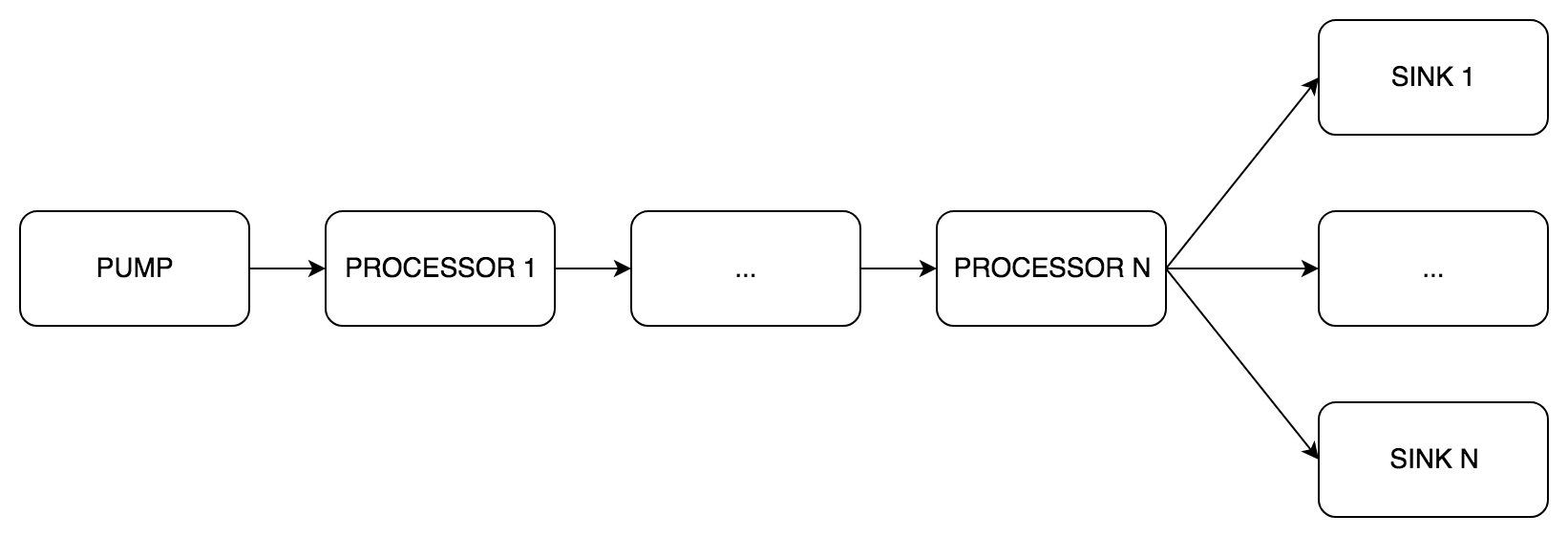
pipe is a framework for floating point signal processing. It utilizes pipeline pattern to build fast, asynchronomous and easy-to-extend pipes for sound processing. Each pipe consists of one Pump, zero or multiple Processors and one or more Sinks. Phono also offers a friendly API for new pipe components implementations.
Getting started
Find examples in example repository.
Testing
mock package can be used to implement integration tests for custom Pumps, Processors and Sinks. It allows to mock up pipe components and then assert the data metrics.
Contributing
For a complete guide to contributing to pipe, see the Contribution guide
License

 Documentation

Documentation

Index 
Constants 
This section is empty.
Variables 
This section is empty.
Functions 
Types 
type L ¶ added in v0.5.0
type L struct {
	// contains filtered or unexported fields
}
L is a pipe(L)ine. It controls the execution of multiple chained pipes. If pipes are not chained, they must be controlled by separate (L)ines. Use Line constructor to instantiate new pipelines.
func (*L) Close ¶ added in v0.5.0
Close must be called to clean up handle's resources. Feedback is closed when line is done.
func (*L) ComponentID ¶ added in v0.5.0
ComponentID finds id of the component within network.
func (*L) Pause ¶ added in v0.5.0
Pause sends a pause event into handle. Calling this method after handle is closed causes a panic. Feedback is closed when Paused state is reached.
func (*L) Push ¶ added in v0.5.0
Push new params into pipe. Calling this method after pipe is closed causes a panic.
type Pipe 
Pipe is a pipeline with fully defined sound processing sequence it has:
1 		pump
0..n 	processors
1..n	sinks
type Processor 
type Processor interface {
	Process(pipeID string, sampleRate, numChannels int) (func([][]float64) ([][]float64, error), error)
}
Processor defines interface for pipe-processors
func Processors ¶ added in v0.5.0
Processors is a helper function to use in pipe constructors.
type Pump 
type Pump interface {
	Pump(pipeID string) (func(bufferSize int) ([][]float64, error), int, int, error)
}
Pump is a source of samples. Pump method returns a new buffer with signal data. Implentetions should use next error conventions:
- nil if a full buffer was read;
- io.EOF if no data was read;
- io.ErrUnexpectedEOF if not a full buffer was read.
The latest case means that pump executed as expected, but not enough data was available. This incomplete buffer still will be sent further and pump will be finished gracefully. If no data was read or any other error was met, buffer should be nil.
 Source Files
 Directories