

 README

reviewdog - A code review dog who keeps your codebase healthy



| CI | Status |
|---|---|
| Travis CI |  |
| CircleCI |  |
| drone.io |  |
| codecov |  |
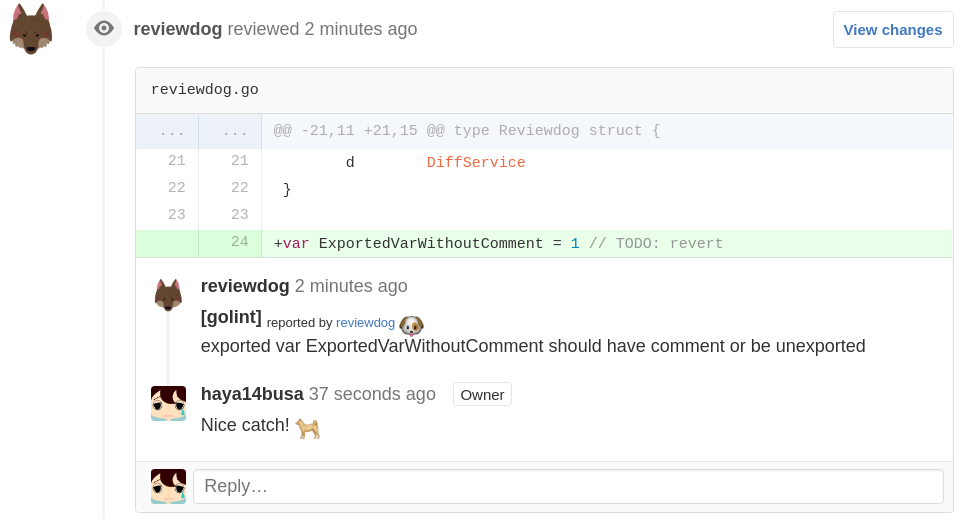
"reviewdog" provides a way to post review comments to code hosting service, such as GitHub, automatically by integrating with any linter tools with ease. It uses any output of lint tools and post them as a comment if the file and line are in diff of patches to review.
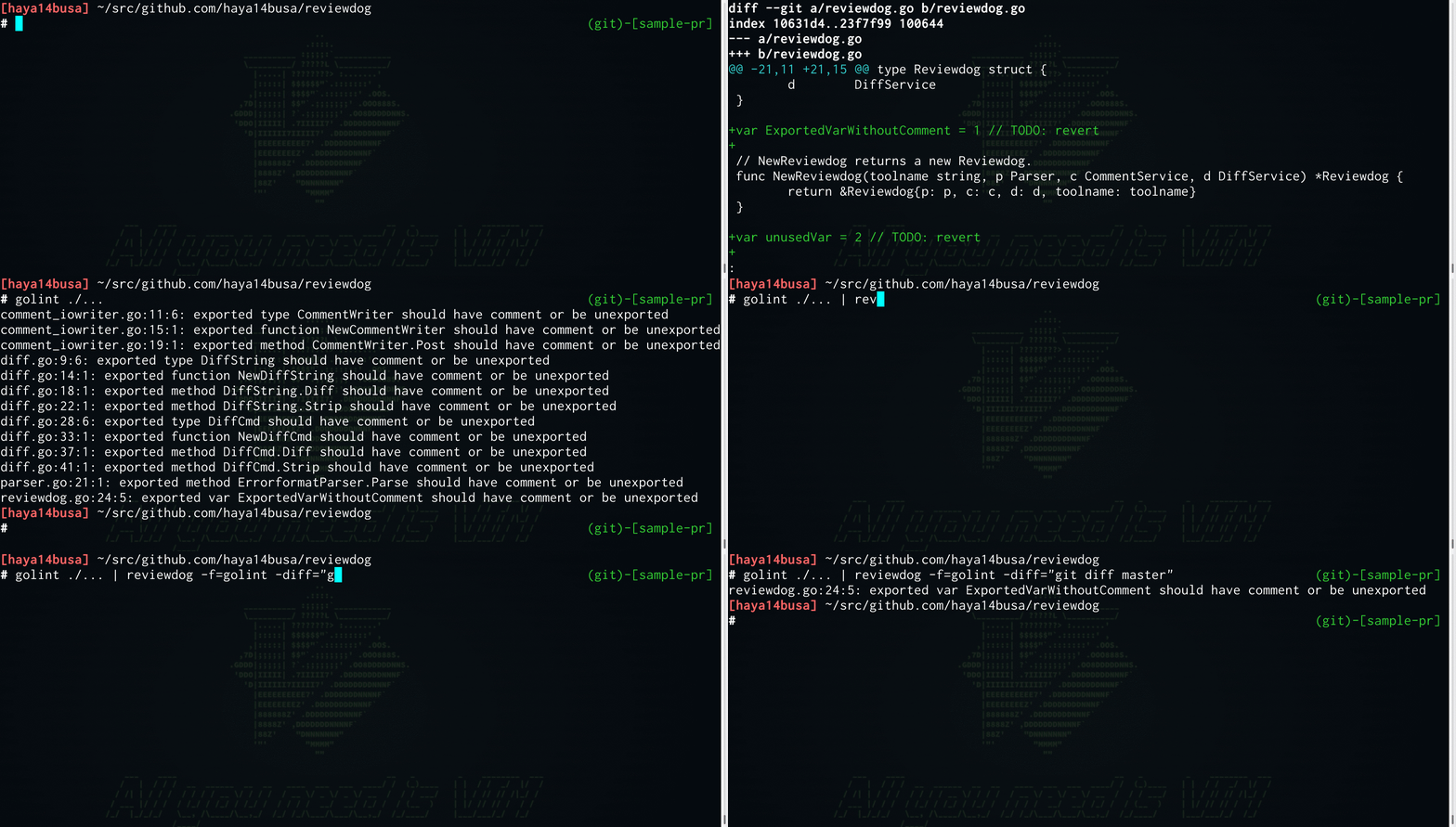
reviewdog also supports run in local environment to filter output of lint tools by diff.
Automatic code review (sample PR)
Local run
Installation
Get the binary release (recommended way)
or
go get -u github.com/haya14busa/reviewdog/cmd/reviewdog
Usage
'errorformat'
reviewdog accepts any compiler or linter result from stdin and parses it with scan-f like 'errorformat', which is the port of Vim's errorformat feature.
For example, if the result format is {file}:{line number}:{column number}: {message},
errorformat should be %f:%l:%c: %m and you can pass it as -efm arguments.
$ golint ./...
comment_iowriter.go:11:6: exported type CommentWriter should have comment or be unexported
$ golint ./... | reviewdog -efm="%f:%l:%c: %m" -diff="git diff master"
| name | description |
|---|---|
| %f | file name |
| %l | line number |
| %c | column number |
| %m | error message |
| %% | the single '%' character |
| ... | ... |
Please see haya14busa/errorformat and :h errorformat if you want to deal with more complex output. 'errorformat' can handle more complex output like multi-line error message.
By this 'errorformat' feature, reviewdog can support any tools output with ease.
Available pre-defined 'errorformat'
But, you don't have to write 'errorformat' in many cases. reviewdog supports pre-defined errorformat for major compiler or linter tools.
You can find available errorformat name by reviewdog -list and you can use it
with -f={name}.
$ reviewdog -list
golint          linter for Go source code                                       - https://github.com/golang/lint
govet           Vet examines Go source code and reports suspicious problems     - https://golang.org/cmd/vet/
sbt             the interactive build tool                                      - http://www.scala-sbt.org/
...
$ golint ./... | reviewdog -f=golint -diff="git diff master"
You can add supported pre-defined 'errorformat' by contributing to haya14busa/errorformat
checkstyle format
reviewdog also accepts checkstyle XML format as well. If the linter supports checkstyle format as a report format, you can us -f=checkstyle instead of using 'errorformat'.
# Local
$ eslint -f checkstyle . | reviewdog -f=checkstyle -diff="git diff"

# CI (overwrite tool name which is shown in review comment by -name arg)
$ eslint -f checkstyle . | reviewdog -f=checkstyle -name="eslint" -ci="circle-ci"
Also, if you want to pass other Json/XML/etc... format to reviewdog, you can write a converter.
$ <linter> | <convert-to-checkstyle> | reviewdog -f=checkstyle -name="<linter>" -ci="circle-ci"
Project Configuration Based Run
[experimental]
reviewdog can also be controlled via the reviewdog.yml configuration file instead of "-f" or "-efm" arguments.
With reviewdog.yml, you can run the same commands both CI service and local environment including editor intergration with ease.
reviewdog.yml
runner:
  <tool-name>:
    cmd: <command> # (required)
    errorformat: # (optional if there is supporeted format for <tool-name>. see reviewdog -list)
      - <list of errorformat>
    name: <tool-name> # (optional. you can overwrite <tool-name> defined by runner key)

  # examples
  golint:
    cmd: golint ./...
    errorformat:
      - "%f:%l:%c: %m"
  govet:
    cmd: go tool vet -all -shadowstrict .
$ reviewdog -diff="git diff master"
project/run_test.go:61:28: [golint] error strings should not end with punctuation
project/run.go:57:18: [errcheck]        defer os.Setenv(name, os.Getenv(name))
project/run.go:58:12: [errcheck]        os.Setenv(name, "")
# You can use -conf to specify config file path.
$ reviewdog -ci=droneio -conf=./reviewdog.yml
Output format for project config based run is one of following formats.
<file>: [<tool name>] <message><file>:<lnum>: [<tool name>] <message><file>:<lnum>:<col>: [<tool name>] <message>
Run locally
reviewdog can find new introduced warnings or error by filtering linter results
using diff. You can pass diff command as -diff arg, like -diff="git diff",
-diff="git diff master", etc... when you use reviewdog in local environment.
Working with GitHub and CI services
reviewdog can intergrate with CI service and post review comments to report results automatically as well!
Supported code hosting (or code review) service
At the time of writing, reviewdog supports GitHub and GitHub Enterprise as a code hosting service for posting comments.
It may support Gerrit, Bitbucket, or other services later.
reviewdog requires GitHub Personal API Access token as an environment variable
(REVIEWDOG_GITHUB_API_TOKEN) to post comments to GitHub or GitHub Enterprise.
Go to https://github.com/settings/tokens and generate new API token.
Check repo for private repositories or public_repo for public repositories.
Export the token environment variable by secure way, depending on CI services.
For GitHub Enterprise, please set API endpoint by environment variable.
export GITHUB_API="https://example.githubenterprise.com/api/v3"
Supported CI services
| Name | Pull Request from the same repository | Pull Request from forked repository |
|---|---|---|
| Travis CI | ⭕ | ❌ |
| CircleCI | ⭕ | ❌ (but possible with insecure way) |
| drone.io (OSS) v0.4 | ⭕ | ⭕ |
| common (Your managed CI server like Jenkins) | ⭕ | ⭕ |
reviewdog can run in CI services which supports Pull Request build and secret environment variable feature for security reason.
But, for the Pull Request from forked repository, most CI services restrict secret environment variable for security reason, to avoid leak of secret data with malicious Pull Request. (Travis CI, CircleCI)
Travis CI
Store GitHub API token by travis encryption keys.
$ gem install travis
$ travis encrypt REVIEWDOG_GITHUB_API_TOKEN=<your token> --add env.global
Example:
env:
  global:
    - secure: xxxxxxxxxxxxx
    - REVIEWDOG_VERSION=0.9.8

install:
  - mkdir -p ~/bin/ && export export PATH="~/bin/:$PATH"
  - curl -fSL https://github.com/haya14busa/reviewdog/releases/download/$REVIEWDOG_VERSION/reviewdog_linux_amd64 -o ~/bin/reviewdog && chmod +x ~/bin/reviewdog

script:
  - >-
    golint ./... | reviewdog -f=golint -ci=travis
Examples
Circle CI
Store GitHub API token in Environment variables - CircleCI
Circle CI do not build by pull-request hook by default, so please turn on "Only build pull requests" in Advanced option in Circle CI (changelog).
Pull Requests from fork repo cannot set environment variable for security reason. However, if you want to run fork PR builds for private repositories or want to run reviewdog for forked PR to OSS project, CircleCI have an option to enable it. Unsafe fork PR builds
I thinks it's not a big problem if GitHub API token has limited scope (e.g. only public_repo),
but if you enables Unsafe fork PR builds
to run reviewdog for fork PR, please use it at your own risk.
circle.yml sample
machine:
  environment:
    REVIEWDOG_VERSION: 0.9.8

dependencies:
  override:
    - curl -fSL https://github.com/haya14busa/reviewdog/releases/download/$REVIEWDOG_VERSION/reviewdog_linux_amd64 -o reviewdog && chmod +x ./reviewdog

test:
  override:
    - >-
      go tool vet -all -shadowstrict . 2>&1 | ./reviewdog -f=govet -ci="circle-ci"
drone.io
Store GitHub API token in environment variable. Secrets · Drone
Install 'drone' cli command http://readme.drone.io/devs/cli/ and setup configuration.
echo '.drone.sec.yaml' >> .gitignore
.drone.sec.yaml
environment:
  REVIEWDOG_GITHUB_API_TOKEN: <your token>
.drone.yaml example
build:
  lint:
    image: golang
    environment:
      - REVIEWDOG_GITHUB_API_TOKEN=$$REVIEWDOG_GITHUB_API_TOKEN
    commands:
      - go get github.com/haya14busa/reviewdog/cmd/reviewdog
      - |
        go tool vet -all -shadowstrict . 2>&1 | reviewdog -f=govet -ci=droneio
    when:
      event: pull_request
Finally, run drone secure to encrypt the .drone.sec.yaml file and generate a .drone.sec file
$ drone secure --repo {github-user-name}/{repo-name} --in .drone.sec.yaml
drone.io supports encrypted environment variable for fork Pull Request build in secure way, but you have to read document carefully http://readme.drone.io/usage/secrets/ not to expose secret data unexpectedly.
Common (Jenkins, local, etc...)
You can use reviewdog to post review comments anywhere with following environment variables.
| name | description |
|---|---|
CI_PULL_REQUEST |
Pull Request number (e.g. 14) |
CI_COMMIT |
SHA1 for the current build |
CI_REPO_OWNER |
repository owner (e.g. "haya14busa" for https://github.com/haya14busa/reviewdog) |
CI_REPO_NAME |
repository name (e.g. "reviewdog" for https://github.com/haya14busa/reviewdog) |
REVIEWDOG_GITHUB_API_TOKEN |
GitHub Personal API Access token |
$ export CI_PULL_REQUEST=14
$ export CI_REPO_OWNER=haya14busa
$ export CI_REPO_NAME=reviewdog
$ export CI_COMMIT=$(git rev-parse HEAD)
$ export REVIEWDOG_GITHUB_API_TOKEN="<your token>"
$ golint ./... | reviewdog -f=golint -ci=common
Jenkins with Github pull request builder plugin
$ export CI_PULL_REQUEST=${ghprbPullId}
$ export CI_REPO_OWNER=haya14busa
$ export CI_REPO_NAME=reviewdog
$ export CI_COMMIT=${ghprbActualCommit}
$ export REVIEWDOG_GITHUB_API_TOKEN="<your token>"
$ export REVIEWDOG_INSECURE_SKIP_VERIFY=true # set this as you need
$ reviewdog -ci=common -conf=reviewdog.yml
🐦 Author
haya14busa (https://github.com/haya14busa)
 Documentation

Index 
- type AddedLine
- type BulkCommentService
- type CheckResult
- type CheckStyleError
- type CheckStyleFile
- type CheckStyleParser
- type CheckStyleResult
- type Comment
- type CommentService
- type DiffCmd
- type DiffService
- type DiffString
- type ErrorformatParser
- type GitHubPullRequest
- type Parser
- type ParserOpt
- type RawCommentWriter
- type Reviewdog
- type UnifiedCommentWriter
Examples 
Constants 
This section is empty.
Variables 
This section is empty.
Functions 
This section is empty.
Types 
type AddedLine 
type AddedLine struct {
	Path     string // path to new file
	Lnum     int    // the line number in the new file
	LnumDiff int    // the line number of the diff (Same as Lnumdiff of diff.Line)
	Content  string // line content
}
AddedLine represents added line in diff.
type BulkCommentService 
type BulkCommentService interface {
	CommentService
	Flush(context.Context) error
}
BulkCommentService posts comments all at once when Flush() is called. Flush() will be called at the end of reviewdog run.
type CheckResult 
type CheckResult struct {
	Path    string   // relative file path
	Lnum    int      // line number
	Col     int      // column number (1 <tab> == 1 character column)
	Message string   // error message
	Lines   []string // Original error lines (often one line)
}
CheckResult represents a checked result of static analysis tools. :h error-file-format
type CheckStyleError 
type CheckStyleError struct {
	Column   int    `xml:"column,attr,omitempty"`
	Line     int    `xml:"line,attr"`
	Message  string `xml:"message,attr"`
	Severity string `xml:"severity,attr,omitempty"`
	Source   string `xml:"source,attr,omitempty"`
}
CheckStyleError represents <error line="1" column="10" severity="error" message="msg" source="src" />
type CheckStyleFile 
type CheckStyleFile struct {
	Name   string             `xml:"name,attr"`
	Errors []*CheckStyleError `xml:"error"`
}
CheckStyleFile represents <file name="fname"><error ... />...</file>
type CheckStyleParser 
type CheckStyleParser struct{}
CheckStyleParser is checkstyle parser.
func (*CheckStyleParser) Parse 
func (p *CheckStyleParser) Parse(r io.Reader) ([]*CheckResult, error)
type CheckStyleResult 
type CheckStyleResult struct {
	XMLName xml.Name          `xml:"checkstyle"`
	Version string            `xml:"version,attr"`
	Files   []*CheckStyleFile `xml:"file,omitempty"`
}
CheckStyleResult represents checkstyle XML result. <?xml version="1.0" encoding="utf-8"?><checkstyle version="4.3"><file ...></file>...</checkstyle>
References:
type Comment 
type Comment struct {
	*CheckResult
	Body     string
	LnumDiff int
	ToolName string
}
Comment represents a reported result as a comment.
type CommentService 
CommentService is an interface which posts Comment.
func MultiCommentService 
func MultiCommentService(services ...CommentService) CommentService
MultiCommentService creates a comment service that duplicates its post to all the provided comment services.
type DiffCmd 
type DiffCmd struct {
	// contains filtered or unexported fields
}
type DiffService 
DiffService is an interface which get diff.
func NewDiffString 
func NewDiffString(diff string, strip int) DiffService
type DiffString 
type DiffString struct {
	// contains filtered or unexported fields
}
func (*DiffString) Strip 
func (d *DiffString) Strip() int
type ErrorformatParser 
type ErrorformatParser struct {
	// contains filtered or unexported fields
}
ErrorformatParser is errorformat parser.
func NewErrorformatParser 
func NewErrorformatParser(efm *errorformat.Errorformat) *ErrorformatParser
NewErrorformatParser returns a new ErrorformatParser.
func NewErrorformatParserString 
func NewErrorformatParserString(efms []string) (*ErrorformatParser, error)
NewErrorformatParserString returns a new ErrorformatParser from errorformat in string representation.
func (*ErrorformatParser) Parse 
func (p *ErrorformatParser) Parse(r io.Reader) ([]*CheckResult, error)
type GitHubPullRequest 
type GitHubPullRequest struct {
	// contains filtered or unexported fields
}
GitHubPullRequest is a comment and diff service for GitHub PullRequest.
API:
https://developer.github.com/v3/pulls/comments/#create-a-comment
POST /repos/:owner/:repo/pulls/:number/comments
func NewGitHubPullReqest 
func NewGitHubPullReqest(cli *github.Client, owner, repo string, pr int, sha string) (*GitHubPullRequest, error)
NewGitHubPullReqest returns a new GitHubPullRequest service. GitHubPullRequest service needs git command in $PATH.
func (*GitHubPullRequest) Diff 
func (g *GitHubPullRequest) Diff(ctx context.Context) ([]byte, error)
Diff returns a diff of PullRequest.
func (*GitHubPullRequest) Flush 
func (g *GitHubPullRequest) Flush(ctx context.Context) error
Flush posts comments which has not been posted yet.
func (*GitHubPullRequest) Post 
func (g *GitHubPullRequest) Post(_ context.Context, c *Comment) error
Post accepts a comment and holds it. Flush method actually posts comments to GitHub in parallel.
func (*GitHubPullRequest) Strip 
func (g *GitHubPullRequest) Strip() int
Strip returns 1 as a strip of git diff.
type Parser 
type Parser interface {
	Parse(r io.Reader) ([]*CheckResult, error)
}
Parser is an interface which parses compilers, linters, or any tools results.
func NewCheckStyleParser 
func NewCheckStyleParser() Parser
NewCheckStyleParser returns a new CheckStyleParser.
type ParserOpt 
ParserOpt represents option to create Parser. Either FormatName or Errorformat should be specified.
type RawCommentWriter 
type RawCommentWriter struct {
	// contains filtered or unexported fields
}
RawCommentWriter is comment writer which writes results to given writer without any formatting.
func NewRawCommentWriter 
func NewRawCommentWriter(w io.Writer) *RawCommentWriter
type Reviewdog 
type Reviewdog struct {
	// contains filtered or unexported fields
}
Reviewdog represents review dog application which parses result of compiler or linter, get diff and filter the results by diff, and report filtered results.
Example 
difftext := `diff --git a/golint.old.go b/golint.new.go
index 34cacb9..a727dd3 100644
--- a/golint.old.go
+++ b/golint.new.go
@@ -2,6 +2,12 @@ package test

 var V int

+var NewError1 int
+
 // invalid func comment
 func F() {
 }
+
+// invalid func comment2
+func F2() {
+}
`
lintresult := `golint.new.go:3:5: exported var V should have comment or be unexported
golint.new.go:5:5: exported var NewError1 should have comment or be unexported
golint.new.go:7:1: comment on exported function F should be of the form "F ..."
golint.new.go:11:1: comment on exported function F2 should be of the form "F2 ..."
`
efm, _ := errorformat.NewErrorformat([]string{`%f:%l:%c: %m`})
p := NewErrorformatParser(efm)
c := NewRawCommentWriter(os.Stdout)
d := NewDiffString(difftext, 1)
app := NewReviewdog("tool name", p, c, d)
app.Run(context.Background(), strings.NewReader(lintresult))
Output:
golint.new.go:5:5: exported var NewError1 should have comment or be unexported
golint.new.go:11:1: comment on exported function F2 should be of the form "F2 ..."
func NewReviewdog 
func NewReviewdog(toolname string, p Parser, c CommentService, d DiffService) *Reviewdog
NewReviewdog returns a new Reviewdog.
type UnifiedCommentWriter 
type UnifiedCommentWriter struct {
	// contains filtered or unexported fields
}
UnifiedCommentWriter is comment writer which writes results to given writer in one of following unified formats.
Format:
- <file>: [<tool name>] <message>
- <file>:<lnum>: [<tool name>] <message>
- <file>:<lnum>:<col>: [<tool name>] <message>
where <message> can be multiple lines.
func NewUnifiedCommentWriter 
func NewUnifiedCommentWriter(w io.Writer) *UnifiedCommentWriter
 Source Files

 Directories

| Path | Synopsis |
|---|---|
|
cmd
|
|
|
reviewdog
command
|
|
|
Package diff provides a utility to parse unified diff.
|
Package diff provides a utility to parse unified diff. |
|
Package project provides utility for reviewdog execution based on project config.
|
Package project provides utility for reviewdog execution based on project config. |