

 README

README

uni

About
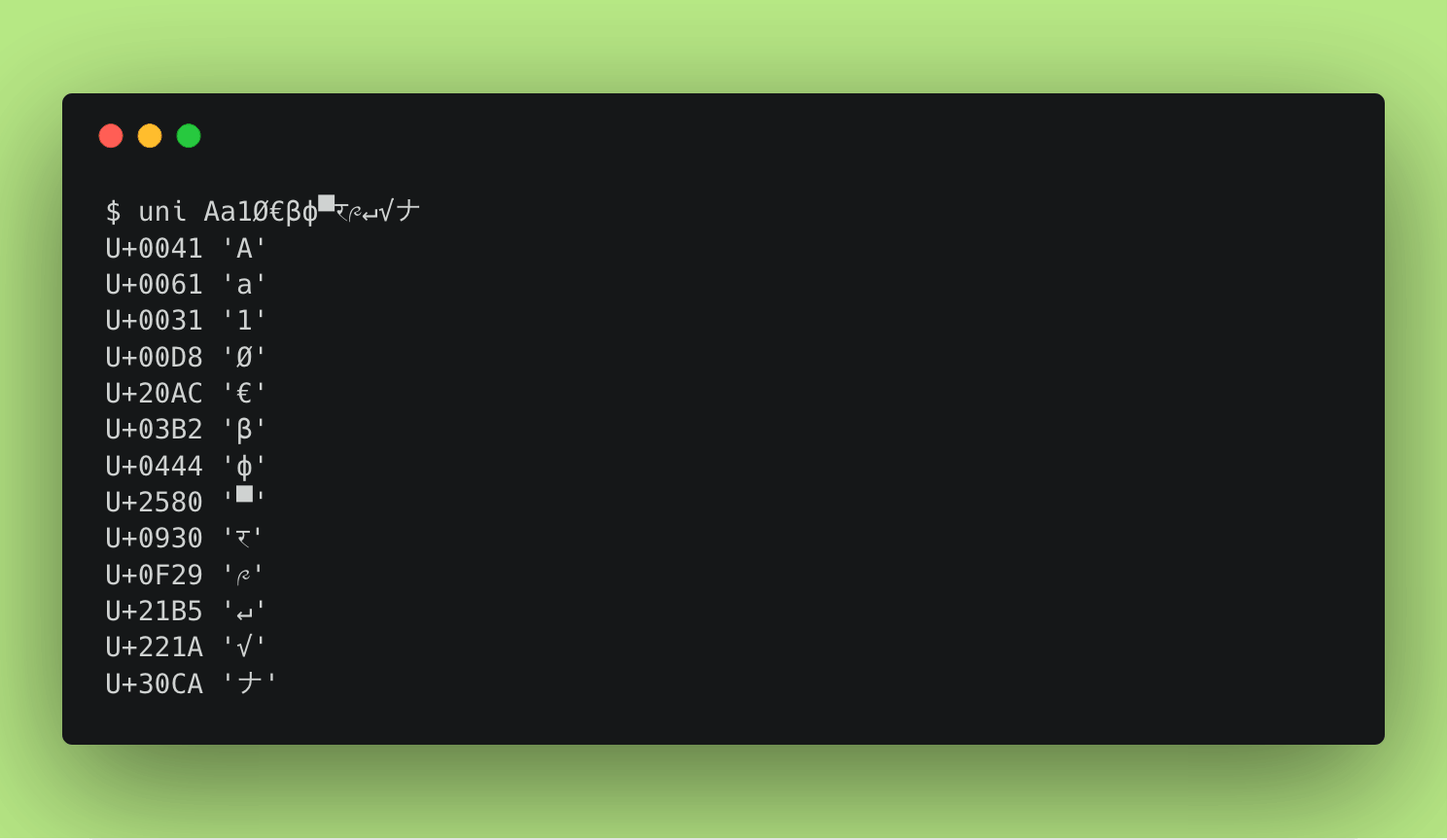
uni is an application that displays Unicode code points for glyphs that are either included as arguments on the command line or piped through the standard input stream to the uni executable.

Install
uni is developed in Go and compiled to the command line executable uni (uni.exe on Windows). A variety of cross-compiled binaries are available for use on Linux, macOS, and Windows systems, or you can download the source and compile the application yourself. Instructions for both approaches follow.
Installation
Approach 1: Install the pre-compiled binary executable file
Download the latest compiled release file for your operating system and architecture from the Releases page.
Linux / macOS
Unpack the tar.gz archive and move the uni executable file to a directory on your system PATH (e.g. /usr/local/bin). This can be performed by executing the following command in the root of the unpacked archive:
$ mv uni /usr/local/bin/uni
There are no dependencies contained in the archive. You can delete all downloaded archive files after the above step.
Windows
Unpack the zip archive and move the uni.exe executable file to a directory on your system PATH. See details here for more information about how to do this.
There are no dependencies contained in the archive. You can delete all downloaded archive files after the above step.
Approach 2: Compile from the source code and install
You must install the Go programming language (which includes the go tool) in order to compile the project from source. Follow the instructions on the Go download page for your platform.
Once you have installed Go and configured your settings so that Go executables are installed on your system PATH, use the following command to (1) pull the master branch of the uni repository; (2) compile the uni executable from source for your platform/architecture configuration; (3) install the executable on your system:
$ go get github.com/source-foundry/uni
Uninstall
The installation includes a single executable binary file. If you installed with go get or added one of the pre-compiled binaries on your system $PATH on *.nix systems, you can uninstall with:
$ rm $(which uni)
Usage
Glyphs as arguments to uni
uni takes glyph arguments and displays the associated Unicode code points. You can include the glyphs in a single string or separate them with spaces. Use quotes around special shell characters.
$ uni [glyph 1]...[glyph n]
Example
$ uni Aa1Ø€βф▀र༩↵√ナ
U+0041 'A'
U+0061 'a'
U+0031 '1'
U+00D8 'Ø'
U+20AC '€'
U+03B2 'β'
U+0444 'ф'
U+2580 '▀'
U+0930 'र'
U+0F29 '༩'
U+21B5 '↵'
U+221A '√'
U+30CA 'ナ'
Glyphs piped through standard input stream
You can also pipe text data to uni through the standard input stream. uni will process every glyph that it receives in the stdin stream and print the associated Unicode code point to standard output.
Example
$ echo -n "Aa1Ø€βф▀र༩↵√ナ" | uni
U+0041 'A'
U+0061 'a'
U+0031 '1'
U+00D8 'Ø'
U+20AC '€'
U+03B2 'β'
U+0444 'ф'
U+2580 '▀'
U+0930 'र'
U+0F29 '༩'
U+21B5 '↵'
U+221A '√'
U+30CA 'ナ'
Issues
Please file an issue report on the repository for any problems that arise with use.
Contributing
Contributions to the project are encouraged and welcomed.
 Documentation
 Source Files