


 README


apitest
A simple and extensible behavioural testing library for Go HTTP services. Tests are written the way a client uses the API: build a request, send it to the handler, and assert on the response. External HTTP calls can be mocked, and every test can render a sequence diagram of what happened.
In behavioural tests the internal structure of the app is not known by the tests. Data is input to the system and the outputs are expected to meet certain conditions.
- Fluent builders for requests and expectations
- Works with anything that implements
http.Handler, or against a running server - Declarative mocks for outbound HTTP calls, with matchers for every part of the request
- Sequence diagrams of each test, including mocked calls and database queries
- No third party dependencies; integrates with
testing, Ginkgo and custom assertion libraries
The API is stable. The library is maintained and issues are addressed; feature requests are considered.
Join the conversation at #apitest on https://gophers.slack.com.
Logo by @egonelbre
Documentation
This README covers the whole library. The same material with more narrative is at https://apitest.dev, and the API reference is on pkg.go.dev.
AI coding agents
This repository includes an Agent Skill that teaches coding agents how to write apitest tests, including the mistakes that are easy to make with mocks and JSONPath. In Claude Code, add the repository as a plugin marketplace and install the plugin:
claude plugin marketplace add steinfletcher/apitest
claude plugin install apitest@apitest
Inside a session, /plugin marketplace add steinfletcher/apitest followed by /plugin install apitest@apitest does the
same. To use the skill without the plugin, or with another agent that supports Agent Skills, copy
skills/apitest into the agent's skills directory, such as .claude/skills/apitest in your project.
The documentation is also available as Markdown for agents, at apitest.dev/llms-full.txt.
Installation
go get github.com/steinfletcher/apitest
Quick start
func TestGetUser(t *testing.T) {
	apitest.New().
		Handler(handler).
		Get("/user/1234").
		Expect(t).
		Status(http.StatusOK).
		Body(`{"id": "1234", "name": "Tate"}`).
		End()
}
Handler takes any http.Handler, so a http.ServeMux, a gin engine, an echo instance and so on all work. Everything
before Expect(t) describes the request; everything after it describes the expected response. End() runs the test.
When the expected body is valid JSON it is compared structurally, so key order and whitespace do not matter.
Demo

Building the request
Method and URL
Get, Post, Put, Patch and Delete set the method and URL. Each has an f variant that formats the URL, and
Method covers anything else.
apitest.Handler(handler).Getf("/user/%s", id)

apitest.Handler(handler).Method(http.MethodOptions).URL("/user")
A ready-made *http.Request can be used instead of the builder.
req := httptest.NewRequest(http.MethodGet, "/user/1234", nil)

apitest.Handler(handler).
	HttpRequest(req).
	Expect(t).
	Status(http.StatusOK).
	End()
Headers
apitest.Handler(handler).
	Get("/hello").
	Header("Authorization", "Bearer token").
	Headers(map[string]string{"X-Request-Id": "12345"}).
	ContentType("application/json").
	Expect(t).
	Status(http.StatusOK).
	End()
Query parameters
Query, QueryParams and QueryCollection can be combined. QueryCollection sets repeated parameters, so
map[string][]string{"a": {"b", "c", "d"}} is encoded as a=b&a=c&a=d. A query string written in the URL, as in
Get("/hello?page=2"), is kept, and parameters from the builder methods are appended to it.
apitest.Handler(handler).
	Get("/hello").
	QueryParams(map[string]string{"a": "1", "b": "2"}).
	Query("c", "d").
	QueryCollection(map[string][]string{"e": {"f", "g"}}).
	Expect(t).
	Status(http.StatusOK).
	End()
Cookies
apitest.Handler(handler).
	Get("/hello").
	Cookie("session", "12345").
	Cookies(apitest.NewCookie("theme").Value("dark").Path("/")).
	Expect(t).
	Status(http.StatusOK).
	End()
Body
Body sets a raw body. JSON sets the body and the Content-Type header; it accepts a string, a []byte, or any
value that can be marshalled. BodyFromFile and JSONFromFile read the body from disk.
apitest.Handler(handler).
	Post("/user").
	JSON(map[string]any{"name": "jan", "age": 32}).
	Expect(t).
	Status(http.StatusCreated).
	End()
GraphQL requests are built with GraphQLQuery, or GraphQLRequest when an operation name is needed.
apitest.Handler(handler).
	Post("/graphql").
	GraphQLQuery(`query User($id: ID!) { user(id: $id) { name } }`, map[string]any{"id": "1234"}).
	Expect(t).
	Status(http.StatusOK).
	End()
Form data
FormData sends an application/x-www-form-urlencoded body.
apitest.Handler(handler).
	Post("/hello").
	FormData("a", "1").
	FormData("b", "2", "3").
	Expect(t).
	Status(http.StatusOK).
	End()
MultipartFormData and MultipartFile send multipart/form-data. The two form styles cannot be combined in one
request.
apitest.Handler(handler).
	Post("/upload").
	MultipartFormData("description", "holiday photos").
	MultipartFile("file", "testdata/beach.jpg", "testdata/sunset.jpg").
	Expect(t).
	Status(http.StatusOK).
	End()
Files are read from the OS by default. UseFS swaps in any fs.FS, such as an in-memory fstest.MapFS.
inMemFS := fstest.MapFS{
	"audio.wav": &fstest.MapFile{Data: []byte{19, 2, 123, 12, 35, 1}},
}

apitest.Handler(handler).
	UseFS(inMemFS).
	Post("/upload").
	MultipartFile("file", "audio.wav").
	Expect(t).
	Status(http.StatusOK).
	End()
Basic auth
apitest.Handler(handler).
	Get("/hello").
	BasicAuth("username", "password").
	Expect(t).
	Status(http.StatusOK).
	End()
Context
WithContext sets the request context, which is how deadlines, cancellation and context values reach the handler.
ctx, cancel := context.WithTimeout(context.Background(), time.Second)
defer cancel()

apitest.Handler(handler).
	Get("/hello").
	WithContext(ctx).
	Expect(t).
	Status(http.StatusOK).
	End()
Intercept
Intercept receives the built *http.Request just before it is sent, for changes the builder does not cover.
apitest.Handler(handler).
	Intercept(func(req *http.Request) {
		req.URL.RawQuery = "a[]=xxx&a[]=yyy"
	}).
	Get("/hello").
	Expect(t).
	Status(http.StatusOK).
	End()
Asserting on the response
Status and body
apitest.Handler(handler).
	Get("/user/1234").
	Expect(t).
	Status(http.StatusOK).
	Body(`{"id": "1234", "name": "Tate"}`).
	End()
A JSON body is compared structurally. Any other body is compared as an exact string. Bodyf formats the expected
body and BodyFromFile reads it from disk.
Headers
apitest.Handler(handler).
	Get("/hello").
	Expect(t).
	Status(http.StatusOK).
	Header("Content-Type", "application/json").
	Headers(map[string]string{"X-Request-Id": "12345"}).
	HeaderPresent("Etag").
	HeaderNotPresent("X-Powered-By").
	End()
Cookies
Only the fields set on the expected cookie are compared, so NewCookie("session").Value("12345") ignores the path,
expiry and other attributes of the actual cookie.
apitest.Handler(handler).
	Patch("/hello").
	Expect(t).
	Status(http.StatusOK).
	Cookie("session", "12345").
	Cookies(apitest.NewCookie("theme").Value("dark").HttpOnly(true)).
	CookiePresent("csrf").
	CookieNotPresent("legacy").
	End()
Custom assertions
Assert takes a function that receives copies of the response and request and returns an error on failure. It can
be called several times.
apitest.Handler(handler).
	Get("/hello").
	Expect(t).
	Assert(func(res *http.Response, req *http.Request) error {
		if res.Header.Get("X-Rate-Limit") == "" {
			return errors.New("expected a rate limit header")
		}
		return nil
	}).
	End()
apitest.IsSuccess, apitest.IsClientError and apitest.IsServerError are ready-made assertions on the status code
range.
JSONPath
For asserting on parts of the response body, the separate apitest-jsonpath module provides JSONPath assertions. It is packaged separately to keep this library dependency free.
Given the response {"a": 12345, "b": [{"key": "c", "value": "result"}]}:
apitest.Handler(handler).
	Get("/hello").
	Expect(t).
	Assert(jsonpath.Contains(`$.b[? @.key=="c"].value`, "result")).
	Assert(jsonpath.Equal(`$.a`, float64(12345))).
	End()
The result
End() returns a Result holding the response, so further checks can be made after the test has run.
result := apitest.Handler(handler).
	Get("/user/1234").
	Expect(t).
	Status(http.StatusOK).
	End()

var user struct {
	Name string `json:"name"`
}
result.JSON(&user)
Mocking external HTTP calls
If the handler under test calls other services, those calls can be answered by mocks. A mock describes the request to match and the response to return.
var getUser = apitest.NewMock().
	Get("http://users/api/user/12345").
	RespondWith().
	Body(`{"name": "jon", "id": "1234"}`).
	Status(http.StatusOK).
	End()

var getPreferences = apitest.NewMock().
	Get("http://preferences/api/preferences/12345").
	Header("Authorization", "Bearer .*").
	RespondWith().
	JSON(map[string]any{"is_contactable": true}).
	Status(http.StatusOK).
	End()

func TestGetUser(t *testing.T) {
	apitest.New().
		Mocks(getUser, getPreferences).
		Handler(handler).
		Get("/user/12345").
		Expect(t).
		Status(http.StatusOK).
		Body(`{"name": "jon", "is_contactable": true}`).
		End()
}
The request side supports Header, Headers, Query, QueryParams, QueryCollection, Body, Bodyf,
BodyFromFile, BodyRegexp, JSON, FormData, Cookie and BasicAuth, plus Present and NotPresent
variants for headers, query parameters, form data and cookies. The response side supports Status, Body, Bodyf,
BodyFromFile, JSON, Header, Headers, Cookie and Cookies. When no Content-Type is set on the response,
application/json is used for a JSON body and text/plain otherwise.
Mocks work by replacing the transport of http.DefaultClient for the duration of the test. If the code under test
uses its own http.Client, pass it with HttpClient so its transport is replaced instead. Because the default
transport is process-wide, tests that use mocks should not run in parallel unless each provides its own client.
apitest.New().
	HttpClient(client).
	Mocks(getUser).
	Handler(handler).
	Get("/user/12345").
	Expect(t).
	Status(http.StatusOK).
	End()
How mocks are matched
Mocks are tried in the order they are passed to Mocks, and the first mock whose matchers all pass is used. Each mock
is used once unless Times or AnyTimes is set. The built-in matchers behave as follows:
- Path must equal the mock path, or match it as a regular expression. The expression is not anchored, so
Get("/user")also matches/user/1234; useGet("^/user$")for an exact match. - Host and scheme must equal the mock's when the mock URL specifies them, otherwise they are ignored.
- Method must equal the mock's. A mock started with
Methodinstead of a verb method such asGetmatches any URL unless one is set, as inNewMock().Method(http.MethodOptions).URL("http://users/api/user"). - Header, query and form data values are regular expressions matched against the received values.
HeaderPresent,QueryPresent,FormDataPresentandCookiePresent(and theirNotPresentcounterparts) check for presence regardless of value. - Body must equal the mock body, or be equivalent JSON.
BodyRegexpmatches the body against a regular expression. - Cookies and basic auth must equal the mock's.
When no mock matches, the call fails with an error listing why each mock was rejected. Run the test with Debug() to
see it.
Custom matchers
AddMatcher adds a matcher alongside the built-in ones. It receives the actual request and the mock's request
specification, and returns an error when the request should not match.
var getPreferences = apitest.NewMock().
	Get("/preferences/12345").
	AddMatcher(func(r *http.Request, mr *apitest.MockRequest) error {
		if r.URL.Scheme != "https" {
			return errors.New("expected an https request")
		}
		return nil
	}).
	RespondWith().
	Status(http.StatusOK).
	End()
Times and unused mocks
By default a mock answers one request. Times(n) makes it answer n requests and fails the test if it is called
fewer times. AnyTimes lets a mock answer any number of calls, including none, and takes precedence over Times.
var getUser = apitest.NewMock().
	Get("http://users/api/user/12345").
	RespondWith().
	Status(http.StatusOK).
	Times(2).
	End()

var healthCheck = apitest.NewMock().
	Get("http://users/health").
	RespondWith().
	Status(http.StatusOK).
	AnyTimes().
	End()
Mocks that were never called are reported on the result.
result := apitest.New().
	Mocks(getUser, getPreferences).
	Handler(handler).
	Get("/user/12345").
	Expect(t).
	Status(http.StatusOK).
	End()

for _, unmatched := range result.UnmatchedMocks() {
	t.Logf("mock not called: %s", unmatched.URL.String())
}
Slow and failing dependencies
Timeout makes the mocked call fail with a timeout error. FixedDelay waits the given number of milliseconds before
responding, and only takes effect when the test enables delays with EnableMockResponseDelay.
var slowUsers = apitest.NewMock().
	Get("http://users/api/user/12345").
	RespondWith().
	FixedDelay(500).
	Status(http.StatusOK).
	End()

var brokenPreferences = apitest.NewMock().
	Get("http://preferences/api/preferences/12345").
	RespondWith().
	Timeout().
	End()

func TestGetUser_WhenDependenciesAreSlow(t *testing.T) {
	apitest.New().
		EnableMockResponseDelay().
		Mocks(slowUsers, brokenPreferences).
		Handler(handler).
		Get("/user/12345").
		Expect(t).
		Status(http.StatusGatewayTimeout).
		End()
}
Observing mock calls
ObserveMocks is called with the request and response of every mocked call.
apitest.New().
	ObserveMocks(func(res *http.Response, req *http.Request, apiTest *apitest.APITest) {
		t.Logf("%s %s -> %d", req.Method, req.URL, res.StatusCode)
	}).
	Mocks(getUser).
	Handler(handler).
	Get("/user/12345").
	Expect(t).
	Status(http.StatusOK).
	End()
Standalone mocks
Mocks can also be used outside an apitest test, for example in a unit test of an HTTP client. EndStandalone and
NewStandaloneMocks(...).End() install the mocks and return a function that removes them. Times and AnyTimes set
how many calls each mock answers, as in a test, but a mock called fewer times than expected is not reported.
func TestUserClient(t *testing.T) {
	reset := apitest.NewMock().
		Get("http://users/api/user/12345").
		RespondWith().
		Body(`{"name": "jon"}`).
		Status(http.StatusOK).
		EndStandalone()
	defer reset()

	user, err := userClient.Get("12345")
	if err != nil {
		t.Fatal(err)
	}
	if user.Name != "jon" {
		t.Fatalf("unexpected user %+v", user)
	}
}
Use HttpClient on the mock to target a specific client, and Debug on the mock to log the matching.
Sequence diagrams and reports
Report renders every test into a report once it completes. The built-in SequenceDiagram formatter writes an HTML
page per test with a sequence diagram of the request, any mocked calls, and the response, followed by the wire
representation of each message. See the demo.
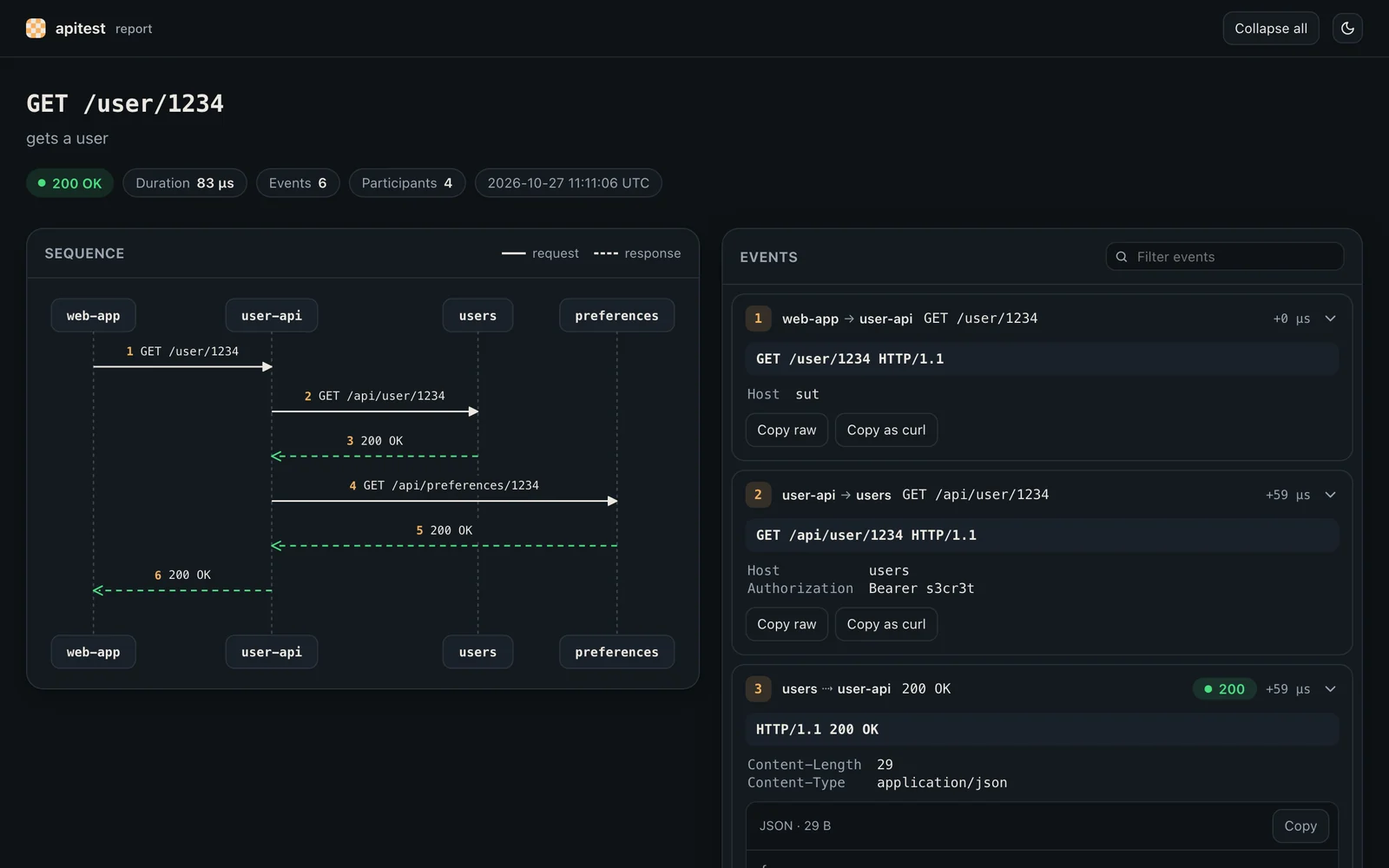
The page is self-contained: styles, scripts and the diagram are inline, so it loads nothing from the network and can be archived as a CI artifact. Click an arrow to jump to its message, filter the events, focus on one participant, and copy any request as a curl command. Requests that received no response, such as calls that matched no mock, are flagged. The diagram is drawn as SVG on the server side, so it renders even where JavaScript is disabled.
func TestGetUser(t *testing.T) {
	apitest.New("gets the user").
		Report(apitest.SequenceDiagram()).
		Mocks(getUser, getPreferences).
		Handler(handler).
		Get("/user/12345").
		Expect(t).
		Status(http.StatusOK).
		End()
}
The name passed to New appears in the report. Diagrams are written to .sequence by default; pass a path to
SequenceDiagram to change that. The participants are labelled cli and sut unless Meta provides names.
apitest.New("gets the user").
	Report(apitest.SequenceDiagram(".sequence-diagrams")).
	Meta(map[string]any{
		"consumerName":        "web-app",
		"systemUnderTestName": "user-api",
	}).
	Handler(handler).
	Get("/user/12345").
	Expect(t).
	Status(http.StatusOK).
	End()
Database calls in diagrams
The x/db package wraps a database/sql driver so that queries made during the test appear in the diagram. Wrap the
driver with a Recorder, register the wrapped driver, open the database through it, and pass the same recorder to the
test.
var recorder = apitest.NewTestRecorder()

func init() {
	sql.Register("recorded-sqlite3", apitestdb.WrapWithRecorder("sqlite3", recorder))
}

func TestGetUser(t *testing.T) {
	db, err := sql.Open("recorded-sqlite3", "./users.db")
	if err != nil {
		t.Fatal(err)
	}
	defer db.Close()

	apitest.New("gets the user").
		Recorder(recorder).
		Report(apitest.SequenceDiagram()).
		Handler(newApp(db)).
		Get("/user/12345").
		Expect(t).
		Status(http.StatusOK).
		End()
}
WrapConnectorWithRecorder does the same for a driver.Connector. See the
sqlite,
mysql and
postgres
examples.
Custom reports
Anything implementing ReportFormatter can be passed to Report. It receives the Recorder, which holds the title,
the meta data and the ordered list of events, so reports can be rendered in any format. The
PlantUML companion library is one example. Custom events can be
added to the recorder from your own code with AddMessageRequest and AddMessageResponse.
Testing a running server
EnableNetworking sends the request over the network instead of to a handler. Pass a client to control timeouts,
cookies and redirects.
client := &http.Client{Timeout: 5 * time.Second}

apitest.New().
	EnableNetworking(client).
	Get("http://localhost:8080/health").
	Expect(t).
	Status(http.StatusOK).
	End()
Debugging
Debug prints the wire representation of the inbound request, the final response, and every mocked call, together
with the reasons a request failed to match any mock.
apitest.New().
	Debug().
	Handler(handler).
	Get("/hello").
	Expect(t).
	Status(http.StatusOK).
	End()
Observe gives programmatic access to the same data.
apitest.New().
	Observe(func(res *http.Response, req *http.Request, apiTest *apitest.APITest) {
		// inspect the copies of res and req
	}).
	Handler(handler).
	Get("/hello").
	Expect(t).
	Status(http.StatusOK).
	End()
Testing handler timeouts
Wrap the handler in the standard library's http.TimeoutHandler when passing it to apitest. A handler that overruns
the timeout produces the 503 status and body that TimeoutHandler generates, which can be asserted on as usual. To
check that a handler honours a deadline instead, pass a context with a deadline using WithContext.
func TestSlowEndpoint(t *testing.T) {
	handler := http.TimeoutHandler(slowHandler, 50*time.Millisecond, "request timed out")

	apitest.Handler(handler).
		Get("/slow").
		Expect(t).
		Status(http.StatusServiceUnavailable).
		Body("request timed out").
		End()
}
Test framework integration
Expect accepts any value implementing TestingT, which is the subset of *testing.T that apitest needs:
Errorf, Fatal and Fatalf. Ginkgo's GinkgoT() satisfies it, so apitest works inside Ginkgo specs; see the
Ginkgo example.
Assertions are performed through the Verifier interface. Verifier swaps in a different implementation, for example
NoopVerifier to run a test without failing it, or an adapter over your preferred assertion library.
apitest.New().
	Verifier(apitest.NoopVerifier{}).
	Handler(handler).
	Get("/hello").
	Expect(t).
	Status(http.StatusTeapot).
	End()
Examples
Framework and library integration examples
| Example | Comment |
|---|---|
| gin | popular martini-like web framework |
| graphql | using gqlgen.com to generate a graphql server |
| gorilla | the gorilla web toolkit |
| iris | iris web framework |
| echo | High performance, extensible, minimalist Go web framework |
| fiber | Express inspired web framework written in Go |
| httprouter | High performance HTTP request router that scales well |
| Ginkgo | Ginkgo BDD test framework |
| mocks | mocking out external http calls, including a custom matcher |
| websockets | a websocket handler under test |
| sequence diagrams | generate sequence diagrams from tests. See the demo |
| sqlite, mysql, postgres | database queries recorded in sequence diagrams |
Companion libraries
| Library | Comment |
|---|---|
| JSONPath | JSONPath assertion addons |
| CSS Selectors | CSS selector assertion addons |
| PlantUML | Export sequence diagrams as plantUML |
| DynamoDB | Add DynamoDB interactions to sequence diagrams |
Credits
This library was influenced by the following software packages:
- YatSpec for creating sequence diagrams from tests
- MockMVC and superagent for the concept and behavioural testing approach
- Gock for the approach to mocking HTTP services in Go
- Baloo for API design
Contributing
View the contributing guide.
 Documentation

Index 
- Constants
- type APITest
- func (a *APITest) Debug() *APITest
- func (a *APITest) Delete(url string) *Request
- func (a *APITest) Deletef(format string, args ...any) *Request
- func (a *APITest) EnableMockResponseDelay() *APITest
- func (a *APITest) EnableNetworking(cli ...*http.Client) *APITest
- func (a *APITest) Get(url string) *Request
- func (a *APITest) Getf(format string, args ...any) *Request
- func (a *APITest) Handler(handler http.Handler) *APITest
- func (a *APITest) HandlerFunc(handlerFunc http.HandlerFunc) *APITest
- func (a *APITest) Host(host string) *APITest
- func (a *APITest) HttpClient(cli *http.Client) *APITest
- func (a *APITest) HttpRequest(req *http.Request) *Request
- func (a *APITest) Intercept(interceptor Intercept) *APITest
- func (a *APITest) Meta(meta map[string]any) *APITest
- func (a *APITest) Method(method string) *Request
- func (a *APITest) Mocks(mocks ...*Mock) *APITest
- func (a *APITest) Observe(observers ...Observe) *APITest
- func (a *APITest) ObserveMocks(observer Observe) *APITest
- func (a *APITest) Patch(url string) *Request
- func (a *APITest) Patchf(format string, args ...any) *Request
- func (a *APITest) Post(url string) *Request
- func (a *APITest) Postf(format string, args ...any) *Request
- func (a *APITest) Put(url string) *Request
- func (a *APITest) Putf(format string, args ...any) *Request
- func (a *APITest) Recorder(recorder *Recorder) *APITest
- func (a *APITest) RecorderHook(hook RecorderHook) *APITest
- func (a *APITest) Report(reporter ReportFormatter) *APITest
- func (a *APITest) Request() *Request
- func (a *APITest) Response() *Response
- func (a *APITest) UseFS(fs fs.FS) *APITest
- func (a *APITest) Verifier(v Verifier) *APITest
- type Assert
- type Cookie
- func (cookie *Cookie) Domain(domain string) *Cookie
- func (cookie *Cookie) Expires(expires time.Time) *Cookie
- func (cookie *Cookie) HttpOnly(httpOnly bool) *Cookie
- func (cookie *Cookie) MaxAge(maxAge int) *Cookie
- func (cookie *Cookie) Path(path string) *Cookie
- func (cookie *Cookie) Secure(secure bool) *Cookie
- func (cookie *Cookie) ToHttpCookie() *http.Cookie
- func (cookie *Cookie) Value(value string) *Cookie
- type DefaultVerifier
- func (a DefaultVerifier) Equal(t TestingT, expected, actual any, msgAndArgs ...any) bool
- func (a DefaultVerifier) Fail(t TestingT, failureMessage string, msgAndArgs ...any) bool
- func (a DefaultVerifier) JSONEq(t TestingT, expected string, actual string, msgAndArgs ...any) bool
- func (a DefaultVerifier) NoError(t TestingT, err error, msgAndArgs ...any) bool
- func (a DefaultVerifier) True(t TestingT, value bool, msgAndArgs ...any) bool
- type Event
- type FinalResponsedeprecated
- type GraphQLRequestBody
- type HttpRequest
- type HttpResponse
- type InboundRequestdeprecated
- type Intercept
- type Matcher
- type MessageRequest
- type MessageResponse
- type Mock
- func (m *Mock) Debug() *Mock
- func (m *Mock) Delete(u string) *MockRequest
- func (m *Mock) Deletef(format string, args ...any) *MockRequest
- func (m *Mock) Get(u string) *MockRequest
- func (m *Mock) Getf(format string, args ...any) *MockRequest
- func (m *Mock) Head(u string) *MockRequest
- func (m *Mock) HttpClient(cli *http.Client) *Mock
- func (m *Mock) Matches(req *http.Request) []error
- func (m *Mock) Method(method string) *MockRequest
- func (m *Mock) Patch(u string) *MockRequest
- func (m *Mock) Patchf(format string, args ...any) *MockRequest
- func (m *Mock) Post(u string) *MockRequest
- func (m *Mock) Postf(format string, args ...any) *MockRequest
- func (m *Mock) Put(u string) *MockRequest
- func (m *Mock) Putf(format string, args ...any) *MockRequest
- type MockRequest
- func (r *MockRequest) AddMatcher(matcher Matcher) *MockRequest
- func (r *MockRequest) BasicAuth(username, password string) *MockRequest
- func (r *MockRequest) Body(b string) *MockRequest
- func (r *MockRequest) BodyFromFile(f string) *MockRequest
- func (r *MockRequest) BodyRegexp(b string) *MockRequest
- func (r *MockRequest) Bodyf(format string, args ...any) *MockRequest
- func (r *MockRequest) Cookie(name, value string) *MockRequest
- func (r *MockRequest) CookieNotPresent(name string) *MockRequest
- func (r *MockRequest) CookiePresent(name string) *MockRequest
- func (r *MockRequest) FormData(key string, values ...string) *MockRequest
- func (r *MockRequest) FormDataNotPresent(key string) *MockRequest
- func (r *MockRequest) FormDataPresent(key string) *MockRequest
- func (r *MockRequest) Header(key, value string) *MockRequest
- func (r *MockRequest) HeaderNotPresent(key string) *MockRequest
- func (r *MockRequest) HeaderPresent(key string) *MockRequest
- func (r *MockRequest) Headers(headers map[string]string) *MockRequest
- func (r *MockRequest) JSON(v any) *MockRequest
- func (r *MockRequest) Query(key, value string) *MockRequest
- func (r *MockRequest) QueryCollection(queryParams map[string][]string) *MockRequest
- func (r *MockRequest) QueryNotPresent(key string) *MockRequest
- func (r *MockRequest) QueryParams(queryParams map[string]string) *MockRequest
- func (r *MockRequest) QueryPresent(key string) *MockRequest
- func (r *MockRequest) RespondWith() *MockResponse
- func (r *MockRequest) URL(u string) *MockRequest
- func (r *MockRequest) URLf(format string, args ...any) *MockRequest
- type MockResponse
- func (r *MockResponse) AnyTimes() *MockResponse
- func (r *MockResponse) Body(body string) *MockResponse
- func (r *MockResponse) BodyFromFile(f string) *MockResponse
- func (r *MockResponse) Bodyf(format string, args ...any) *MockResponse
- func (r *MockResponse) Cookie(name, value string) *MockResponse
- func (r *MockResponse) Cookies(cookie ...*Cookie) *MockResponse
- func (r *MockResponse) End() *Mock
- func (r *MockResponse) EndStandalone(other ...*Mock) func()
- func (r *MockResponse) FixedDelay(delay int64) *MockResponse
- func (r *MockResponse) Header(key string, value string) *MockResponse
- func (r *MockResponse) Headers(headers map[string]string) *MockResponse
- func (r *MockResponse) JSON(v any) *MockResponse
- func (r *MockResponse) Status(statusCode int) *MockResponse
- func (r *MockResponse) Timeout() *MockResponse
- func (r *MockResponse) Times(times int) *MockResponse
- type NoopVerifier
- func (n NoopVerifier) Equal(t TestingT, expected, actual any, msgAndArgs ...any) bool
- func (n NoopVerifier) Fail(t TestingT, failureMessage string, msgAndArgs ...any) bool
- func (n NoopVerifier) JSONEq(t TestingT, expected string, actual string, msgAndArgs ...any) bool
- func (n NoopVerifier) NoError(t TestingT, err error, msgAndArgs ...any) bool
- func (n NoopVerifier) True(t TestingT, v bool, msgAndArgs ...any) bool
- type OSFS
- type Observe
- type Recorder
- func (r *Recorder) AddHttpRequest(req HttpRequest) *Recorder
- func (r *Recorder) AddHttpResponse(req HttpResponse) *Recorder
- func (r *Recorder) AddMessageRequest(m MessageRequest) *Recorder
- func (r *Recorder) AddMessageResponse(m MessageResponse) *Recorder
- func (r *Recorder) AddMeta(meta map[string]any) *Recorder
- func (r *Recorder) AddSubTitle(subTitle string) *Recorder
- func (r *Recorder) AddTitle(title string) *Recorder
- func (r *Recorder) Reset()
- func (r *Recorder) ResponseStatus() (int, error)
- type RecorderHook
- type ReportFormatter
- type Request
- func (r *Request) BasicAuth(username, password string) *Request
- func (r *Request) Body(b string) *Request
- func (r *Request) BodyFromFile(f string) *Request
- func (r *Request) Bodyf(format string, args ...any) *Request
- func (r *Request) ContentType(contentType string) *Request
- func (r *Request) Cookie(name, value string) *Request
- func (r *Request) Cookies(c ...*Cookie) *Request
- func (r *Request) Expect(t TestingT) *Response
- func (r *Request) FormData(name string, values ...string) *Request
- func (r *Request) GraphQLQuery(query string, variables ...map[string]any) *Request
- func (r *Request) GraphQLRequest(body GraphQLRequestBody) *Request
- func (r *Request) Header(key, value string) *Request
- func (r *Request) Headers(headers map[string]string) *Request
- func (r *Request) JSON(v any) *Request
- func (r *Request) JSONFromFile(f string) *Request
- func (r *Request) MultipartFile(name string, ff ...string) *Request
- func (r *Request) MultipartFormData(name string, values ...string) *Request
- func (r *Request) Query(key, value string) *Request
- func (r *Request) QueryCollection(q map[string][]string) *Request
- func (r *Request) QueryParams(params map[string]string) *Request
- func (r *Request) URL(url string) *Request
- func (r *Request) URLf(format string, args ...any) *Request
- func (r *Request) WithContext(ctx context.Context) *Request
- type Response
- func (r *Response) Assert(fn func(*http.Response, *http.Request) error) *Response
- func (r *Response) Body(b string) *Response
- func (r *Response) BodyFromFile(f string) *Response
- func (r *Response) Bodyf(format string, args ...any) *Response
- func (r *Response) Cookie(name, value string) *Response
- func (r *Response) CookieNotPresent(cookieName string) *Response
- func (r *Response) CookiePresent(cookieName string) *Response
- func (r *Response) Cookies(cookies ...*Cookie) *Response
- func (r *Response) End() Result
- func (r *Response) Header(key, value string) *Response
- func (r *Response) HeaderNotPresent(name string) *Response
- func (r *Response) HeaderPresent(name string) *Response
- func (r *Response) Headers(headers map[string]string) *Response
- func (r *Response) Status(s int) *Response
- type Result
- type SequenceDiagramFormatter
- type StandaloneMocks
- type TestingT
- type Transport
- type UnmatchedMock
- type Verifier
Constants 
const ConsumerDefaultName = "cli"
ConsumerDefaultName default consumer name
const SystemUnderTestDefaultName = "sut"
SystemUnderTestDefaultName default name for system under test
Variables 
This section is empty.
Functions 
This section is empty.
Types 
type APITest 
type APITest struct {
	// contains filtered or unexported fields
}
APITest is the top level struct holding the test spec
func Handler ¶ added in v1.5.4
Handler is a convenience method for creating a new apitest with a handler
func HandlerFunc ¶ added in v1.5.4
func HandlerFunc(handlerFunc http.HandlerFunc) *APITest
HandlerFunc is a convenience method for creating a new apitest with a handler func
func (*APITest) Debug 
Debug logs to the console the http wire representation of all http interactions that are intercepted by apitest. This includes the inbound request to the application under test, the response returned by the application and any interactions that are intercepted by the mock server.
func (*APITest) Delete ¶ added in v1.0.3
Delete is a convenience method for setting the request as http.MethodDelete
func (*APITest) Deletef ¶ added in v1.4.14
Deletef is a convenience method that adds formatting support to Delete
func (*APITest) EnableMockResponseDelay ¶ added in v1.5.0
EnableMockResponseDelay turns on mock response delays (defaults to OFF)
func (*APITest) EnableNetworking ¶ added in v1.3.0
EnableNetworking will enable networking for provided clients
func (*APITest) Get ¶ added in v1.0.3
Get is a convenience method for setting the request as http.MethodGet
func (*APITest) Getf ¶ added in v1.4.14
Getf is a convenience method that adds formatting support to Get
func (*APITest) HandlerFunc ¶ added in v1.4.5
func (a *APITest) HandlerFunc(handlerFunc http.HandlerFunc) *APITest
HandlerFunc defines the http handler that is invoked when the test is run
func (*APITest) HttpClient 
HttpClient allows the developer to provide a custom http client when using mocks
func (*APITest) HttpRequest ¶ added in v1.5.11
HttpRequest defines the native `http.Request`
func (*APITest) Intercept ¶ added in v1.0.3
Intercept is a builder method for setting the request interceptor
func (*APITest) Meta ¶ added in v1.0.2
Meta provides a hook to add custom meta data to the test which can be picked up when defining a custom reporter
func (*APITest) Method ¶ added in v1.0.3
Method is a builder method for setting the http method of the request
func (*APITest) ObserveMocks 
ObserveMocks is a builder method for setting the mocks observers
func (*APITest) Patch ¶ added in v1.0.3
Patch is a convenience method for setting the request as http.MethodPatch
func (*APITest) Patchf ¶ added in v1.4.14
Patchf is a convenience method that adds formatting support to Patch
func (*APITest) Post ¶ added in v1.0.3
Post is a convenience method for setting the request as http.MethodPost
func (*APITest) Postf ¶ added in v1.4.14
Postf is a convenience method that adds formatting support to Post
func (*APITest) Put ¶ added in v1.0.3
Put is a convenience method for setting the request as http.MethodPut
func (*APITest) Putf ¶ added in v1.4.14
Putf is a convenience method that adds formatting support to Put
func (*APITest) RecorderHook 
func (a *APITest) RecorderHook(hook RecorderHook) *APITest
RecorderHook allows the consumer to provider a function that will receive the recorder instance before the test runs. This can be used to inject custom events which can then be rendered in diagrams Deprecated: use Recorder() instead
func (*APITest) Report ¶ added in v1.0.2
func (a *APITest) Report(reporter ReportFormatter) *APITest
Report provides a hook to add custom formatting to the output of the test
type Assert 
Assert is a user defined custom assertion function
var IsClientError Assert = func(response *http.Response, request *http.Request) error {
	if response.StatusCode >= 400 && response.StatusCode < 500 {
		return nil
	}
	return fmt.Errorf("not a client error. Status code=%d", response.StatusCode)
}
IsClientError is a convenience function to assert on a range of client error status codes
var IsServerError Assert = func(response *http.Response, request *http.Request) error {
	if response.StatusCode >= 500 {
		return nil
	}
	return fmt.Errorf("not a server error. Status code=%d", response.StatusCode)
}
IsServerError is a convenience function to assert on a range of server error status codes
var IsSuccess Assert = func(response *http.Response, request *http.Request) error {
	if response.StatusCode >= 200 && response.StatusCode < 400 {
		return nil
	}
	return fmt.Errorf("not success. Status code=%d", response.StatusCode)
}
IsSuccess is a convenience function to assert on a range of happy path status codes
type Cookie 
type Cookie struct {
	// contains filtered or unexported fields
}
Cookie used to represent an http cookie
func FromHTTPCookie ¶ added in v1.3.10
FromHTTPCookie transforms an http cookie into a Cookie
func (*Cookie) ToHttpCookie 
ToHttpCookie transforms the Cookie to an http cookie
type DefaultVerifier ¶ added in v1.5.7
type DefaultVerifier struct{}
DefaultVerifier is a verifier that uses some code from https://github.com/stretchr/testify to perform assertions
func (DefaultVerifier) Equal ¶ added in v1.5.7
func (a DefaultVerifier) Equal(t TestingT, expected, actual any, msgAndArgs ...any) bool
func (DefaultVerifier) Fail ¶ added in v1.5.7
func (a DefaultVerifier) Fail(t TestingT, failureMessage string, msgAndArgs ...any) bool
Fail reports a failure
type FinalResponse
deprecated
type FinalResponse struct {
	// contains filtered or unexported fields
}
FinalResponse used to wrap the final response with a timestamp
Deprecated: FinalResponse is not used by apitest and is retained only for API compatibility.
type GraphQLRequestBody ¶ added in v1.4.10
type GraphQLRequestBody struct {
	Query         string         `json:"query"`
	Variables     map[string]any `json:"variables,omitempty"`
	OperationName string         `json:"operationName,omitempty"`
}
GraphQLRequestBody represents the POST request body as per the GraphQL spec
type HttpRequest 
HttpRequest represents an http request
func (HttpRequest) GetTime 
func (r HttpRequest) GetTime() time.Time
GetTime gets the time of the HttpRequest interaction
type HttpResponse 
HttpResponse represents an http response
func (HttpResponse) GetTime 
func (r HttpResponse) GetTime() time.Time
GetTime gets the time of the HttpResponse interaction
type InboundRequest
deprecated
type InboundRequest struct {
	// contains filtered or unexported fields
}
InboundRequest used to wrap the incoming request with a timestamp
Deprecated: InboundRequest is not used by apitest and is retained only for API compatibility.
type Intercept 
Intercept will be called before the request is made. Updates to the request will be reflected in the test
type Matcher 
type Matcher func(*http.Request, *MockRequest) error
Matcher type accepts the actual request and a mock request to match against. Will return an error that describes why there was a mismatch if the inputs do not match or nil if they do.
type MessageRequest 
type MessageRequest struct {
	Source    string
	Target    string
	Header    string
	Body      string
	Timestamp time.Time
}
MessageRequest represents a request interaction
func (MessageRequest) GetTime 
func (r MessageRequest) GetTime() time.Time
GetTime gets the time of the MessageRequest interaction
type MessageResponse 
type MessageResponse struct {
	Source    string
	Target    string
	Header    string
	Body      string
	Timestamp time.Time
}
MessageResponse represents a response interaction
func (MessageResponse) GetTime 
func (r MessageResponse) GetTime() time.Time
GetTime gets the time of the MessageResponse interaction
type Mock 
type Mock struct {
	// contains filtered or unexported fields
}
Mock represents the entire interaction for a mock to be used for testing
func NewMock 
func NewMock() *Mock
NewMock create a new mock, ready for configuration using the builder pattern
func (*Mock) Debug ¶ added in v1.2.0
Debug is used to set debug mode for mocks in standalone mode. This is overridden by the debug setting in the `APITest` struct
func (*Mock) Delete 
func (m *Mock) Delete(u string) *MockRequest
Delete configures the mock to match http method DELETE
func (*Mock) Deletef ¶ added in v1.4.15
func (m *Mock) Deletef(format string, args ...any) *MockRequest
Deletef configures the mock to match http method DELETE and supports formatting
func (*Mock) Get 
func (m *Mock) Get(u string) *MockRequest
Get configures the mock to match http method GET
func (*Mock) Getf ¶ added in v1.4.15
func (m *Mock) Getf(format string, args ...any) *MockRequest
Getf configures the mock to match http method GET and supports formatting
func (*Mock) Head ¶ added in v1.4.1
func (m *Mock) Head(u string) *MockRequest
Head configures the mock to match http method HEAD
func (*Mock) HttpClient ¶ added in v1.2.0
HttpClient allows the developer to provide a custom http client when using mocks
func (*Mock) Method 
func (m *Mock) Method(method string) *MockRequest
Method configures mock to match given http method. The mock matches any url unless one is set using MockRequest.URL
func (*Mock) Patch 
func (m *Mock) Patch(u string) *MockRequest
Patch configures the mock to match http method PATCH
func (*Mock) Patchf ¶ added in v1.4.15
func (m *Mock) Patchf(format string, args ...any) *MockRequest
Patchf configures the mock to match http method PATCH and supports formatting
func (*Mock) Post 
func (m *Mock) Post(u string) *MockRequest
Post configures the mock to match http method POST
func (*Mock) Postf ¶ added in v1.4.15
func (m *Mock) Postf(format string, args ...any) *MockRequest
Postf configures the mock to match http method POST and supports formatting
func (*Mock) Put 
func (m *Mock) Put(u string) *MockRequest
Put configures the mock to match http method PUT
type MockRequest 
type MockRequest struct {
	// contains filtered or unexported fields
}
MockRequest represents the http request side of a mock interaction
func (*MockRequest) AddMatcher ¶ added in v1.1.0
func (r *MockRequest) AddMatcher(matcher Matcher) *MockRequest
AddMatcher configures the mock request to match using a custom matcher
func (*MockRequest) BasicAuth ¶ added in v1.4.6
func (r *MockRequest) BasicAuth(username, password string) *MockRequest
BasicAuth configures the mock request to match the given basic auth parameters
func (*MockRequest) Body 
func (r *MockRequest) Body(b string) *MockRequest
Body configures the mock request to match the given body
func (*MockRequest) BodyFromFile ¶ added in v1.4.0
func (r *MockRequest) BodyFromFile(f string) *MockRequest
BodyFromFile configures the mock request to match the given body from a file
func (*MockRequest) BodyRegexp ¶ added in v1.5.6
func (r *MockRequest) BodyRegexp(b string) *MockRequest
BodyRegexp configures the mock request to match the given body using the regexp matcher
func (*MockRequest) Bodyf ¶ added in v1.4.15
func (r *MockRequest) Bodyf(format string, args ...any) *MockRequest
Bodyf configures the mock request to match the given body. Supports formatting the body
func (*MockRequest) Cookie ¶ added in v1.1.5
func (r *MockRequest) Cookie(name, value string) *MockRequest
Cookie configures the mock request to match a cookie
func (*MockRequest) CookieNotPresent ¶ added in v1.1.5
func (r *MockRequest) CookieNotPresent(name string) *MockRequest
CookieNotPresent configures the mock request to match when a cookie is not present
func (*MockRequest) CookiePresent ¶ added in v1.1.5
func (r *MockRequest) CookiePresent(name string) *MockRequest
CookiePresent configures the mock request to match when a cookie is present, regardless of value
func (*MockRequest) FormData ¶ added in v1.3.3
func (r *MockRequest) FormData(key string, values ...string) *MockRequest
FormData configures the mock request to math the given form data
func (*MockRequest) FormDataNotPresent ¶ added in v1.3.3
func (r *MockRequest) FormDataNotPresent(key string) *MockRequest
FormDataNotPresent configures the mock request to match when the form data is not present
func (*MockRequest) FormDataPresent ¶ added in v1.3.3
func (r *MockRequest) FormDataPresent(key string) *MockRequest
FormDataPresent configures the mock request to match when the form data is present, regardless of values
func (*MockRequest) Header 
func (r *MockRequest) Header(key, value string) *MockRequest
Header configures the mock request to match the given header
func (*MockRequest) HeaderNotPresent ¶ added in v1.2.1
func (r *MockRequest) HeaderNotPresent(key string) *MockRequest
HeaderNotPresent configures the mock request to match when the header is not present
func (*MockRequest) HeaderPresent ¶ added in v1.2.1
func (r *MockRequest) HeaderPresent(key string) *MockRequest
HeaderPresent configures the mock request to match when this header is present, regardless of value
func (*MockRequest) Headers 
func (r *MockRequest) Headers(headers map[string]string) *MockRequest
Headers configures the mock request to match the given headers
func (*MockRequest) JSON ¶ added in v1.5.2
func (r *MockRequest) JSON(v any) *MockRequest
JSON is a convenience method for setting the mock request body
func (*MockRequest) Query 
func (r *MockRequest) Query(key, value string) *MockRequest
Query configures the mock request to match a query param
func (*MockRequest) QueryCollection ¶ added in v1.4.6
func (r *MockRequest) QueryCollection(queryParams map[string][]string) *MockRequest
QueryCollection configures the mock request to match a number of repeating query params, e.g. ?a=1&a=2&a=3
func (*MockRequest) QueryNotPresent ¶ added in v1.2.1
func (r *MockRequest) QueryNotPresent(key string) *MockRequest
QueryNotPresent configures the mock request to match when the query param is not present
func (*MockRequest) QueryParams 
func (r *MockRequest) QueryParams(queryParams map[string]string) *MockRequest
QueryParams configures the mock request to match a number of query params
func (*MockRequest) QueryPresent 
func (r *MockRequest) QueryPresent(key string) *MockRequest
QueryPresent configures the mock request to match when a query param is present, regardless of value
func (*MockRequest) RespondWith 
func (r *MockRequest) RespondWith() *MockResponse
RespondWith finalises the mock request phase of set up and allowing the definition of response attributes to be defined
func (*MockRequest) URL ¶ added in v1.7.0
func (r *MockRequest) URL(u string) *MockRequest
URL configures the mock request to match the given url
func (*MockRequest) URLf ¶ added in v1.7.0
func (r *MockRequest) URLf(format string, args ...any) *MockRequest
URLf configures the mock request to match the given url and supports formatting
type MockResponse 
type MockResponse struct {
	// contains filtered or unexported fields
}
MockResponse represents the http response side of a mock interaction
func (*MockResponse) AnyTimes ¶ added in v1.5.17
func (r *MockResponse) AnyTimes() *MockResponse
AnyTimes respond any number of times
func (*MockResponse) Body 
func (r *MockResponse) Body(body string) *MockResponse
Body sets the mock response body
func (*MockResponse) BodyFromFile ¶ added in v1.4.0
func (r *MockResponse) BodyFromFile(f string) *MockResponse
BodyFromFile defines the mock response body from a file
func (*MockResponse) Bodyf ¶ added in v1.4.15
func (r *MockResponse) Bodyf(format string, args ...any) *MockResponse
Bodyf sets the mock response body. Supports formatting
func (*MockResponse) Cookie 
func (r *MockResponse) Cookie(name, value string) *MockResponse
Cookie respond with the given cookie
func (*MockResponse) Cookies 
func (r *MockResponse) Cookies(cookie ...*Cookie) *MockResponse
Cookies respond with the given cookies
func (*MockResponse) End 
func (r *MockResponse) End() *Mock
End finalise the response definition phase in order for the mock to be used
func (*MockResponse) EndStandalone ¶ added in v1.2.0
func (r *MockResponse) EndStandalone(other ...*Mock) func()
EndStandalone finalises the response definition of standalone mocks
func (*MockResponse) FixedDelay ¶ added in v1.5.0
func (r *MockResponse) FixedDelay(delay int64) *MockResponse
FixedDelay will return the response after the given number of milliseconds. APITest::EnableMockResponseDelay must be set for this to take effect. If Timeout is set this has no effect.
func (*MockResponse) Header 
func (r *MockResponse) Header(key string, value string) *MockResponse
Header respond with the given header
func (*MockResponse) Headers 
func (r *MockResponse) Headers(headers map[string]string) *MockResponse
Headers respond with the given headers
func (*MockResponse) JSON ¶ added in v1.5.2
func (r *MockResponse) JSON(v any) *MockResponse
JSON is a convenience method for setting the mock response body
func (*MockResponse) Status 
func (r *MockResponse) Status(statusCode int) *MockResponse
Status respond with the given status
func (*MockResponse) Timeout ¶ added in v1.4.11
func (r *MockResponse) Timeout() *MockResponse
Timeout forces the mock to return a http timeout
func (*MockResponse) Times 
func (r *MockResponse) Times(times int) *MockResponse
Times respond the given number of times, if AnyTimes is set this has no effect
type NoopVerifier ¶ added in v1.3.8
type NoopVerifier struct{}
NoopVerifier is a verifier that does not perform verification
func (NoopVerifier) Equal ¶ added in v1.3.8
func (n NoopVerifier) Equal(t TestingT, expected, actual any, msgAndArgs ...any) bool
Equal does not perform any assertion and always returns true
func (NoopVerifier) Fail ¶ added in v1.3.8
func (n NoopVerifier) Fail(t TestingT, failureMessage string, msgAndArgs ...any) bool
Fail does not perform any assertion and always returns true
func (NoopVerifier) JSONEq ¶ added in v1.3.8
JSONEq does not perform any assertion and always returns true
type OSFS ¶ added in v1.6.0
type OSFS struct {
}
An implementation of fs.FS that wraps your OS's filesystem
type Recorder 
Recorder represents all of the report data
func (*Recorder) AddHttpRequest 
func (r *Recorder) AddHttpRequest(req HttpRequest) *Recorder
AddHttpRequest add an http request to recorder
func (*Recorder) AddHttpResponse 
func (r *Recorder) AddHttpResponse(req HttpResponse) *Recorder
AddHttpResponse add an HttpResponse to the recorder
func (*Recorder) AddMessageRequest 
func (r *Recorder) AddMessageRequest(m MessageRequest) *Recorder
AddMessageRequest add a MessageRequest to the recorder
func (*Recorder) AddMessageResponse 
func (r *Recorder) AddMessageResponse(m MessageResponse) *Recorder
AddMessageResponse add a MessageResponse to the recorder
func (*Recorder) AddSubTitle 
AddSubTitle add a SubTitle to the recorder
func (*Recorder) Reset ¶ added in v1.2.2
func (r *Recorder) Reset()
Reset resets the recorder to default starting state
func (*Recorder) ResponseStatus 
ResponseStatus get response status of the recorder, returning an error when this wasn't possible
type RecorderHook 
type RecorderHook func(*Recorder)
RecorderHook used to implement a custom interaction recorder
type ReportFormatter 
type ReportFormatter interface {
	// Format formats the events received from the recorder
	Format(*Recorder)
}
ReportFormatter represents the report formatter
type Request 
type Request struct {
	// contains filtered or unexported fields
}
Request is the user defined request that will be invoked on the handler under test
func (*Request) BodyFromFile ¶ added in v1.4.0
BodyFromFile is a builder method to set the request body
func (*Request) ContentType ¶ added in v1.3.3
ContentType is a builder method to set the Content-Type header of the request
func (*Request) Cookie 
Cookie is a convenience method for setting a single request cookies by name and value
func (*Request) Expect 
Expect marks the request spec as complete and following code will define the expected response
func (*Request) FormData ¶ added in v1.3.3
FormData is a builder method to set the body form data Also sets the content type of the request to application/x-www-form-urlencoded
func (*Request) GraphQLQuery ¶ added in v1.4.10
GraphQLQuery is a convenience method for building a graphql POST request
func (*Request) GraphQLRequest ¶ added in v1.4.10
func (r *Request) GraphQLRequest(body GraphQLRequestBody) *Request
GraphQLRequest builds a graphql POST request
func (*Request) JSON 
JSON is a convenience method for setting the request body and content type header as "application/json". If v is not a string or []byte it will marshall the provided variable as json
func (*Request) JSONFromFile ¶ added in v1.4.0
JSONFromFile is a convenience method for setting the request body and content type header as "application/json"
func (*Request) MultipartFile ¶ added in v1.5.12
MultipartFile is a builder method to set the file in multipart form data Also sets the content type of the request to multipart/form-data
func (*Request) MultipartFormData ¶ added in v1.5.12
MultipartFormData is a builder method to set the field in multipart form data Also sets the content type of the request to multipart/form-data
func (*Request) QueryCollection 
QueryCollection is a builder method to set the request query parameters This can be used in combination with request.Query
func (*Request) QueryParams 
QueryParams is a builder method to set the request query parameters. This can be used in combination with request.QueryCollection
type Response 
type Response struct {
	// contains filtered or unexported fields
}
Response is the user defined expected response from the application under test
func (*Response) Assert 
Assert allows the consumer to provide a user defined function containing their own custom assertions
func (*Response) BodyFromFile ¶ added in v1.4.0
BodyFromFile reads the given file and uses the content as the expected response body
func (*Response) Bodyf ¶ added in v1.4.14
Bodyf is the expected response body that supports a formatter
func (*Response) Cookie ¶ added in v1.0.12
Cookie is used to match on an individual cookie name/value pair in the expected response cookies
func (*Response) CookieNotPresent 
CookieNotPresent is used to assert that a cookie is not present in the response
func (*Response) CookiePresent 
CookiePresent is used to assert that a cookie is present in the response, regardless of its value
func (*Response) HeaderNotPresent ¶ added in v1.1.5
HeaderNotPresent is a builder method to set the headers that should not be present in the response. The check fails whenever the header key exists, regardless of value, including an empty value.
func (*Response) HeaderPresent ¶ added in v1.1.5
HeaderPresent is a builder method to set the headers that should be present in the response. The check passes when the header key exists, regardless of value, including an empty value.
type Result ¶ added in v1.1.5
Result provides the final result
func (Result) UnmatchedMocks ¶ added in v1.4.9
func (r Result) UnmatchedMocks() []UnmatchedMock
UnmatchedMocks returns any mocks that were not used, e.g. there was not a matching http Request for the mock
type SequenceDiagramFormatter 
type SequenceDiagramFormatter struct {
	// contains filtered or unexported fields
}
SequenceDiagramFormatter implementation of a ReportFormatter
func SequenceDiagram ¶ added in v1.0.2
func SequenceDiagram(path ...string) *SequenceDiagramFormatter
SequenceDiagram produce a sequence diagram at the given path or .sequence by default
func (*SequenceDiagramFormatter) Format 
func (r *SequenceDiagramFormatter) Format(recorder *Recorder)
Format formats the events received by the recorder
type StandaloneMocks ¶ added in v1.3.2
type StandaloneMocks struct {
	// contains filtered or unexported fields
}
StandaloneMocks for using mocks outside of API tests context
func NewStandaloneMocks ¶ added in v1.3.2
func NewStandaloneMocks(mocks ...*Mock) *StandaloneMocks
NewStandaloneMocks create a series of StandaloneMocks
func (*StandaloneMocks) Debug ¶ added in v1.3.2
func (r *StandaloneMocks) Debug() *StandaloneMocks
Debug switch on debugging mode
func (*StandaloneMocks) End ¶ added in v1.3.2
func (r *StandaloneMocks) End() func()
End finalises the mock, ready for use
func (*StandaloneMocks) HttpClient ¶ added in v1.3.2
func (r *StandaloneMocks) HttpClient(cli *http.Client) *StandaloneMocks
HttpClient use the given http client
type TestingT ¶ added in v1.5.2
type TestingT interface {
	Errorf(format string, args ...any)
	Fatal(args ...any)
	Fatalf(format string, args ...any)
}
TestingT is an interface to wrap the native *testing.T interface, this allows integration with GinkgoT() interface GinkgoT interface defined in https://github.com/onsi/ginkgo/blob/55c858784e51c26077949c81b6defb6b97b76944/ginkgo_dsl.go#L91
type Transport 
type Transport struct {
	// contains filtered or unexported fields
}
Transport wraps components used to observe and manipulate the real request and response objects
func (*Transport) Hijack 
func (r *Transport) Hijack()
Hijack replace the transport implementation of the interaction under test in order to observe, mock and inject expectations
type UnmatchedMock ¶ added in v1.4.9
UnmatchedMock exposes some information about mocks that failed to match a request
type Verifier ¶ added in v1.3.8
type Verifier interface {
	Equal(t TestingT, expected, actual any, msgAndArgs ...any) bool
	True(t TestingT, value bool, msgAndArgs ...any) bool
	JSONEq(t TestingT, expected string, actual string, msgAndArgs ...any) bool
	Fail(t TestingT, failureMessage string, msgAndArgs ...any) bool
	NoError(t TestingT, err error, msgAndArgs ...any) bool
}
Verifier is the assertion interface allowing consumers to inject a custom assertion implementation. It also allows failure scenarios to be tested within apitest
 Source Files
 Directories