

 README

README

rest
Goes well with rest.vim
Build rest requests for testing. The format is similar to vim-rest-console:
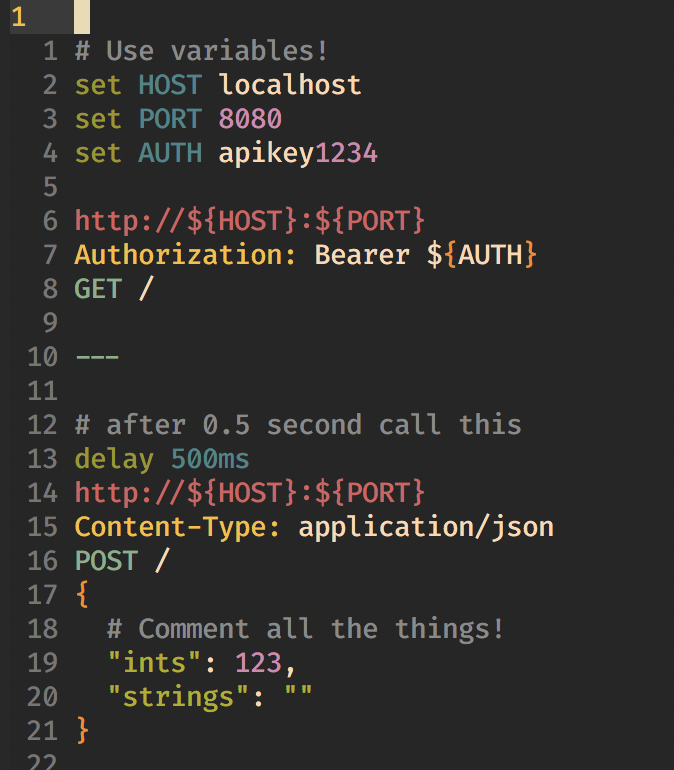
Command line execution
$ go install github.com/taybart/rest/cmd/rest
$ cat <<EOF > post.rest
http://localhost:8080
Content-Type: application/json
POST /
{
  "data": "Yeah!"
}
EOF
$ rest -f post.rest
{ "status": "ok" }

# STDIN
$ rest -i
http://localhost:8080
GET /
# <C-d>
http://localhost:8080/
HTTP/1.1 200 OK
Content-Length: 16
Content-Type: text/plain; charset=utf-8
Date: Fri, 06 Dec 2019 18:55:01 GMT

{"status":"ok"}

---
Programatic parsing
import (
  "fmt"

  "github.com/taybart/rest"
)

func main {
  r := rest.New()
  err := r.Read("./test/post.rest")
  if err != nil {
    panic("HOLY SHIT!")
  }
  success, failed := r.Exec() // Execute dem requests
  fmt.Println(success, failed)
}
System tests!
set HOST real.url.net
set ID 123

https://${HOST}
Content-Type: application/json
POST /user
{ "id": ${ID}, "name": "taybart" }

expect 200

---

delay 3s

https://${HOST}
Content-Type: application/json
GET /user?id=${ID}

expect 200 { "id": ${ID}, "name": "taybart" }
~ » rest -i
https://httpbin.org
GET /status/401
expect 200
Failed requests
Incorrect status code returned 200 != 401
body:
Create other language requests!
import (
  "fmt"

  "github.com/taybart/rest"
)

func main() {
  r := rest.New()
  err := r.Read("./test/post.rest")
  if err != nil {
  fmt.Println(err)
    panic("HOLY SHIT!")
  }
  requests, err := r.SynthesizeRequest("javascript")
  if err != nil {
    fmt.Println(err)
    panic("HOLY SHIT!")
  }
  fmt.Println(requests[0])
}
// output
fetch('http://localhost:8080/post-test', {
  method: 'POST',
  headers: { 'Content-Type': 'application/json', },
  body: JSON.stringify({  "data": "Yeah!"}),
}).then((res) => { if (res.status == 200) { /* woohoo! */ } })
Create full clients
$ rest -f ./test/client.rest -c -o go > client.go
// client.go
package main
import (
  "fmt"
  "io/ioutil"
  "net/http"
  "strings"
)
// Client : my client
type Client struct { }

func (c Client) GetThing() {
  req, err := http.NewRequest("GET", "http://localhost:8080/", nil)

  res, err := http.DefaultClient.Do(req)
  if err != nil {
    fmt.Println(err)
  }
  defer res.Body.Close()
  body, err := ioutil.ReadAll(res.Body)
  if err != nil {
    fmt.Println(err)
  }
  fmt.Println(string(body))
}


func (c Client) PostThing() {
  req, err := http.NewRequest("POST", "http://localhost:8080/user", strings.NewReader(`{  "user": "taybart"}`))

  res, err := http.DefaultClient.Do(req)
  if err != nil {
    fmt.Println(err)
  }
  defer res.Body.Close()
  body, err := ioutil.ReadAll(res.Body)
  if err != nil {
    fmt.Println(err)
  }
  fmt.Println(string(body))
}
Server?
I have had uses for having a server that just accepts requests...So I put it in here:
$ rest -s
2267-11-25 18:38:02 [INFO] Running at localhost:8080
I have also (like many) have used python -m http.server. Mine is not as cool but it does stuff:
$ rest -d
2019-11-25 18:40:01 [INFO] Serving $(pwd) at localhost:8080
But ports!!!
Chill...
$ rest -s -p 1234
2267-11-25 18:38:02 [INFO] Running at localhost:1234
 Documentation

Documentation

Index 
- type Rest
- func (r *Rest) CheckExpectation(req request, res *http.Response) error
- func (r *Rest) Exec() (successful []string, err error)
- func (r *Rest) ExecIndex(i int) (result string, err error)
- func (r *Rest) IsRestFile(fn string) (bool, error)
- func (r *Rest) NoColor()
- func (r *Rest) Read(fn string) error
- func (r *Rest) ReadConcurrent(fn string) error
- func (r *Rest) ReadIO(buf io.Reader) error
- func (r *Rest) SetClient(c *http.Client)
- func (r Rest) SynthesizeClient(lang string) (string, error)
- func (r Rest) SynthesizeRequests(lang string) ([]string, error)
Constants 
This section is empty.
Variables 
This section is empty.
Functions 
This section is empty.
Types 
type Rest 
type Rest struct {
	// contains filtered or unexported fields
}
Rest : client
func (*Rest) CheckExpectation 
CheckExpectation : ensure request did what is was supposed to
func (*Rest) IsRestFile 
IsRestFile : checks if file can be parsed
func (*Rest) ReadConcurrent 
ReadConcurrent : read unordered requests from file
func (Rest) SynthesizeClient 
SynthisizeClient : Holy grail
 Source Files
 Directories
Click to show internal directories.
Click to hide internal directories.