

 README

README

Phemex crypto-exchange Golang SDK
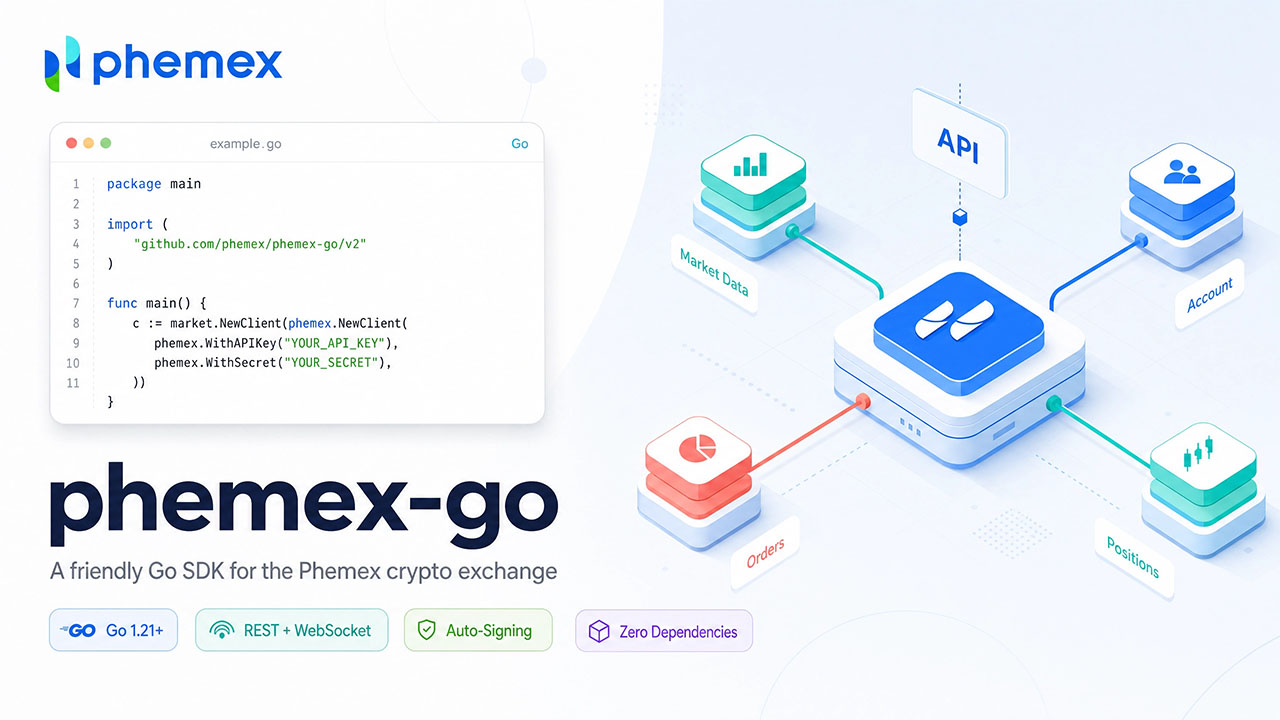
A friendly, batteries-included Golang SDK for the Phemex crypto exchange.
Trade spot, perpetuals, and margin, stream live market data, and manage your wallets — all with clean, idiomatic Go.


Why phemex-go?
Talking to a crypto exchange should feel boring — in the best possible way. No surprises, no leaked goroutines, no mystery around request signing. That's exactly what this library is built for.
Under the hood, phemex-go takes care of the tedious, error-prone parts so you can focus on your strategy:
- Contexts everywhere. Every REST and WebSocket call takes a
context.Context, so cancellation, deadlines, and graceful shutdown just work. - Signing that stays out of your way. Private requests are signed with HMAC SHA256 automatically — you never touch a timestamp or a header.
- A WebSocket client that survives the real world. Networks drop. Servers hiccup. The client reconnects on its own, keeps the connection alive with heartbeats, and hands you events over plain Go channels.
- Typed by domain. Market data, spot, USDⓈ-M, Coin-M, margin, and assets each live in their own small, focused package.
- Featherweight. The only third-party dependency is
gorilla/websocket. Everything else is the standard library. - Actually tested. Signature generation and the REST layer are covered by unit tests and
httptestmocks, so you can trust it without hitting live endpoints.
Requirements
- Go 1.21 or newer (the library uses the
anyalias and moderncontextsemantics) - A Phemex account with API credentials for any private (trading/account) endpoints
Public market-data endpoints work without credentials — great for prototyping and read-only tools.
Installation
go get github.com/tigusigalpa/phemex-go
Then import the core package plus whichever domain packages you need:
import (
    "github.com/tigusigalpa/phemex-go"
    "github.com/tigusigalpa/phemex-go/market"
)
Quick Start
Here's the shortest path to your first response — fetching the list of tradable products without any credentials:
package main

import (
    "context"
    "fmt"
    "log"

    "github.com/tigusigalpa/phemex-go"
    "github.com/tigusigalpa/phemex-go/market"
)

func main() {
    ctx := context.Background()

    // The core client handles transport, signing, and retries.
    // Domain clients (like market) wrap it with typed helpers.
    c := market.NewClient(phemex.NewClient(phemex.Config{
        BaseURI: "https://api.phemex.com",
    }))

    products, err := c.Products(ctx)
    if err != nil {
        log.Fatal(err)
    }

    fmt.Println(products)
}
Core Concepts
A little mental model goes a long way. There are two layers you'll interact with:
- The core client (
phemex.NewClient) — owns the HTTP transport, credentials, signing, retries, and error mapping. - Domain clients (
market.NewClient,spot.NewClient, …) — thin, typed wrappers around the core client, one per API area.
You create the core client once and share it across as many domain clients as you like — it's safe for concurrent use.
core := phemex.NewClient(phemex.Config{
    APIKey:    os.Getenv("PHEMEX_API_KEY"),
    APISecret: os.Getenv("PHEMEX_API_SECRET"),
})

spotClient := spot.NewClient(core)
usdtmClient := usdtm.NewClient(core)
assetsClient := assets.NewClient(core)
Configuration
phemex.Config is a plain struct — set only what you need and rely on sensible defaults for the rest.
| Field | Type | Default | Description |
|---|---|---|---|
APIKey |
string |
"" |
Your Phemex API key. Optional for public endpoints. |
APISecret |
string |
"" |
Your Phemex API secret. Required to sign private requests. |
BaseURI |
string |
https://api.phemex.com |
REST base URL. Point this at the testnet when experimenting. |
HTTPClient |
*http.Client |
internal client | Bring your own client to control proxies, TLS, or transport pooling. |
Timeout |
time.Duration |
30s |
Per-request timeout (used only when you don't supply your own HTTPClient). |
Retries |
int |
3 |
How many times to retry on rate limits and 5xx responses. |
RetryDelay |
time.Duration |
1s |
Base delay for exponential backoff between retries. |
RequestTracing |
string |
"" |
Optional trace token attached to signed requests for debugging. |
client := phemex.NewClient(phemex.Config{
    APIKey:     os.Getenv("PHEMEX_API_KEY"),
    APISecret:  os.Getenv("PHEMEX_API_SECRET"),
    BaseURI:    "https://api.phemex.com",
    Timeout:    15 * time.Second,
    Retries:    5,
    RetryDelay: 500 * time.Millisecond,
})
Authentication
For anything that touches your account — placing orders, reading balances, transferring funds — provide an API key and secret. Signing happens automatically on every private call, so you never build a signature by hand.
client := phemex.NewClient(phemex.Config{
    APIKey:    os.Getenv("PHEMEX_API_KEY"),
    APISecret: os.Getenv("PHEMEX_API_SECRET"),
    BaseURI:   "https://api.phemex.com",
})
Keep secrets out of source code. Prefer environment variables or a secrets manager. Never commit real keys to version control.
Behind the scenes, each private request gets three headers:
x-phemex-access-token— your API keyx-phemex-request-expiry— a short-lived expiry timestampx-phemex-request-signature— an HMAC SHA256 signature over the path, query, expiry, and body
REST API
The library mirrors Phemex's structure with one small package per domain. Each exposes typed helpers that return a
*phemex.Response.
| Package | What it covers |
|---|---|
market |
Public market data: products, server time, order book, full book, klines, recent trades, 24h ticker, funding-rate history |
spot |
Spot trading: place, amend, cancel, and query orders; wallets; order history |
usdtm |
USDⓈ-M perpetuals: orders, account positions, leverage, position mode, balance assignment |
coinm |
Coin-M perpetuals: orders, trading account & positions, leverage, balance assignment |
margin |
Margin trading: orders plus borrow and payback history |
assets |
Wallets & transfers: spot↔futures transfers, universal transfers, deposit addresses, deposit/withdraw history |
Working with responses
Every call returns a *phemex.Response that wraps the raw JSON envelope. You can check success and unmarshal the
payload into your own structs:
resp, err := marketClient.Time(ctx)
if err != nil {
    log.Fatal(err)
}

if !resp.IsSuccess() {
    log.Fatalf("phemex returned an error: %s", resp.Msg())
}

var t phemex.TimeResponse
if err := resp.Data(&t); err != nil {
    log.Fatal(err)
}

fmt.Println("Server time:", t.Timestamp)
For public market-data endpoints under /md, use Result(...), ErrorMsg(), and ID() instead of Data(...),
Msg(), and Code() — the envelope shape differs slightly, and the response helpers cover both.
Market data example
import (
    "github.com/tigusigalpa/phemex-go"
    "github.com/tigusigalpa/phemex-go/market"
)

c := market.NewClient(phemex.NewClient(phemex.Config{}))

// Order book snapshot.
book, _ := c.OrderBook(ctx, "BTCUSD")

// Candlesticks with a typed request.
limit := int64(100)
klines, _ := c.Kline(ctx, market.KlineRequest{
    Symbol:     "BTCUSDT",
    Resolution: "1h",
    Limit:      &limit,
})
Spot trading example
import (
    "github.com/tigusigalpa/phemex-go"
    "github.com/tigusigalpa/phemex-go/spot"
)

client := spot.NewClient(phemex.NewClient(phemex.Config{
    APIKey:    os.Getenv("PHEMEX_API_KEY"),
    APISecret: os.Getenv("PHEMEX_API_SECRET"),
}))

// Place a limit buy order.
resp, err := client.CreateOrder(ctx, map[string]any{
    "symbol":   "BTCUSDT",
    "side":     "Buy",
    "ordType":  "Limit",
    "price":    "65000",
    "orderQty": "0.001",
})
if err != nil {
    log.Fatal(err)
}
fmt.Println("Order placed:", resp)

// Review what's still open.
open, _ := client.QueryOpenOrders(ctx, "BTCUSDT")
fmt.Println("Open orders:", open)
WebSocket API
The ws package gives you a resilient, real-time feed. It reconnects automatically after drops, sends periodic
heartbeats to keep the socket healthy, replays your subscriptions on reconnect, and delivers every message over a Go
channel.
import (
    "context"
    "fmt"
    "log"
    "os"
    "time"

    "github.com/tigusigalpa/phemex-go/ws"
)

client := ws.NewClient(ws.Config{
    APIKey:    os.Getenv("PHEMEX_API_KEY"),    // optional — only needed for private channels
    APISecret: os.Getenv("PHEMEX_API_SECRET"),
})

ctx, cancel := context.WithTimeout(context.Background(), 30*time.Second)
defer cancel()

if err := client.Connect(ctx); err != nil {
    log.Fatal(err)
}
defer client.Close()

// Subscribe to the order book for a symbol.
if err := client.Subscribe(ctx, "orderbook", "BTCUSDT"); err != nil {
    log.Fatal(err)
}

// Consume events as they arrive.
for ev := range client.Events() {
    fmt.Printf("%+v\n", ev)
}
Supported channels
| Channel | Description |
|---|---|
orderbook |
Level 2 order book updates |
trade |
Real-time public trades |
kline |
Streaming candlesticks |
aop |
Account / Order / Position updates (requires authentication) |
When you provide credentials, the client authenticates with a user.auth message before your subscriptions go out, so
private channels like aop are ready to use.
Error Handling
Errors are typed, so you can react to specific conditions with a simple type switch instead of parsing strings:
resp, err := client.CreateOrder(ctx, params)
if err != nil {
    switch e := err.(type) {
    case *phemex.RateLimitError:
        log.Printf("slow down — retry after %v", e.RetryAfter)
    case *phemex.AuthenticationError:
        log.Fatal("check your API key and secret")
    case *phemex.ValidationError:
        log.Printf("the request was rejected: %s", e.Message)
    case *phemex.NotFoundError:
        log.Printf("resource not found: %s", e.Message)
    case *phemex.APIError:
        log.Printf("phemex error %d: %s", e.StatusCode, e.Message)
    default:
        log.Printf("unexpected error: %v", err)
    }
}
Rate limits (429) and server errors (5xx) are retried automatically with exponential backoff, honoring the
Retry-After header when present. Only after retries are exhausted does the error reach you.
Examples
Every API group ships with a runnable example under examples/:
go run ./examples/market   # public market data (no credentials needed)
go run ./examples/spot     # spot trading
go run ./examples/usdtm    # USDⓈ-M perpetuals
go run ./examples/coinm    # Coin-M perpetuals
go run ./examples/margin   # margin trading
go run ./examples/assets   # transfers & wallets
go run ./examples/ws       # live WebSocket feed
The trading examples read PHEMEX_API_KEY and PHEMEX_API_SECRET from the environment, so export them first:
export PHEMEX_API_KEY="your-key"
export PHEMEX_API_SECRET="your-secret"
Testing
The whole suite runs offline — no live network calls, no real credentials:
go test ./...
Coverage includes:
- HMAC SHA256 signature correctness (including method case-insensitivity and body signing)
- Signature-header injection for private endpoints, and their absence on public ones
- Query and body serialization edge cases (repeated keys, boolean
true/false) - HTTP error classification and retry behavior (404, 429, 5xx)
- WebSocket subscribe/receive and
user.authhandshake, exercised with a localhttptestserver
Contributing
Contributions are genuinely welcome — bug reports, docs fixes, new endpoints, and ideas all help. A good flow:
- Open an issue to discuss anything non-trivial before diving in.
- Fork the repo and create a feature branch.
- Run
go test ./...,go vet ./..., andgofmt -w .before pushing. - Send a pull request with a clear description of the change.
Documentation
- Phemex API Docs — the authoritative source for endpoints and parameters
- Package reference on pkg.go.dev
Disclaimer
Trading cryptocurrencies carries significant risk. This library is provided as-is, without any warranty. You are solely responsible for your API keys, your orders, and your funds. Test thoroughly — ideally against the Phemex testnet — before running anything with real money.
Author
Igor Sazonov
- GitHub: @tigusigalpa
- Email: sovletig@gmail.com
License
Released under the MIT License — see LICENSE for the full text. Use it freely, build something great, and a star on GitHub is always appreciated.
 Documentation

Documentation

Overview 
Package phemex provides a Go client for the Phemex cryptocurrency exchange REST API.
The Client handles request signing, retries, and error mapping. Subpackages expose typed methods for each API domain (market data, spot, USDⓈ-M, etc.).
Index 
Constants 
This section is empty.
Variables 
This section is empty.
Functions 
Types 
type AuthenticationError 
type AuthenticationError struct {
	APIError
}
AuthenticationError indicates an invalid or missing API key/secret.
func (*AuthenticationError) Error 
func (e *AuthenticationError) Error() string
type Client 
type Client struct {
	// contains filtered or unexported fields
}
Client is the central HTTP client for the Phemex REST API.
func (*Client) Do 
func (c *Client) Do(ctx context.Context, method, path string, params map[string]any) (*Response, error)
Do sends an HTTP request with the provided method and path. Query and body parameters are supplied through params. It returns the raw JSON-decoded response envelope, or an error if the request fails.
For GET and DELETE requests params are encoded as query parameters. For POST/PUT/PATCH requests params are encoded as JSON in the request body.
type Config 
type Config struct {
	// APIKey is the Phemex API key. Optional for public market endpoints.
	APIKey string
	// APISecret is the Phemex API secret. Required for private endpoints.
	APISecret string
	// BaseURI is the base URL for the Phemex REST API.
	BaseURI string
	// HTTPClient allows a custom http.Client to be supplied.
	HTTPClient *http.Client
	// Timeout is the default request timeout.
	Timeout time.Duration
	// Retries is the number of retries for transient failures and rate limits.
	Retries int
	// RetryDelay is the base delay used for exponential backoff.
	RetryDelay time.Duration
	// RequestTracing is an optional trace token sent with signed requests.
	RequestTracing string
}
Config holds the settings used to configure a Client.
type FundingRateHistory 
type FundingRateHistory struct {
	Symbol      string `json:"symbol"`
	Rate        string `json:"rate"`
	FundingTime int64  `json:"fundingTime"`
}
FundingRateHistory represents a single funding rate history entry.
type Kline 
type Kline struct {
	Open      string `json:"open"`
	High      string `json:"high"`
	Low       string `json:"low"`
	Close     string `json:"close"`
	Volume    string `json:"volume"`
	Turnover  string `json:"turnover"`
	Timestamp int64  `json:"timestamp"`
}
Kline represents a single candlestick entry.
type NotFoundError 
type NotFoundError struct {
	APIError
}
NotFoundError indicates the requested resource was not found.
func (*NotFoundError) Error 
func (e *NotFoundError) Error() string
type OrderBook 
type OrderBook struct {
	Asks []OrderBookEntry `json:"asks"`
	Bids []OrderBookEntry `json:"bids"`
}
OrderBook represents a Phemex order book response.
type OrderBookEntry 
OrderBookEntry represents a price/quantity level in an order book.
type RateLimitError 
RateLimitError indicates the request was throttled and exposes retry info.
func (*RateLimitError) Error 
func (e *RateLimitError) Error() string
type Response 
type Response struct {
	Raw map[string]json.RawMessage
}
Response is the raw JSON-decoded response returned by the REST client. Most endpoints reply with `{ "code": <int>, "msg": <string>, "data": <mixed> }`, while market-data endpoints under `/md` use `{ "error": null, "id": 0, "result": <mixed> }`.
type Signer 
type Signer struct {
	// contains filtered or unexported fields
}
Signer generates HMAC SHA256 request signatures for the Phemex API.
The signing material is constructed according to the official Phemex documentation: the URL path (including the leading slash), the raw query string (without the leading question mark), the request expiry timestamp in seconds, and the request body for POST/PUT requests.
type Ticker24h 
type Ticker24h struct {
	Symbol    string `json:"symbol"`
	Open      string `json:"open"`
	High      string `json:"high"`
	Low       string `json:"low"`
	Close     string `json:"close"`
	Volume    string `json:"volume"`
	Turnover  string `json:"turnover"`
	Timestamp int64  `json:"timestamp"`
}
Ticker24h represents a 24-hour ticker entry.
type TimeResponse 
type TimeResponse struct {
	Timestamp int64 `json:"timestamp"`
}
TimeResponse is the response envelope for /public/time.
type Trade 
type Trade struct {
	Symbol    string `json:"symbol"`
	Price     string `json:"price"`
	Size      string `json:"size"`
	Side      string `json:"side"`
	Timestamp int64  `json:"timestamp"`
}
Trade represents a single public trade.
type ValidationError 
type ValidationError struct {
	APIError
}
ValidationError indicates the request parameters were rejected.
func (*ValidationError) Error 
func (e *ValidationError) Error() string
 Source Files
 Directories

Directories

| Path | Synopsis |
|---|---|
|
Package assets provides wallet operations and transfer endpoints for the Phemex API.
|
Package assets provides wallet operations and transfer endpoints for the Phemex API. |
|
Package coinm provides Coin-M perpetual contract endpoints for the Phemex API.
|
Package coinm provides Coin-M perpetual contract endpoints for the Phemex API. |
|
examples
|
|
|
assets
command
Example: asset transfers and wallet operations (requires API credentials).
|
Example: asset transfers and wallet operations (requires API credentials). |
|
coinm
command
Example: Coin-M perpetual contract endpoints (requires API credentials).
|
Example: Coin-M perpetual contract endpoints (requires API credentials). |
|
margin
command
Example: margin trading endpoints (requires API credentials).
|
Example: margin trading endpoints (requires API credentials). |
|
market
command
Example: public market data endpoints.
|
Example: public market data endpoints. |
|
spot
command
Example: spot trading endpoints (requires API credentials).
|
Example: spot trading endpoints (requires API credentials). |
|
usdtm
command
Example: USDⓈ-M perpetual contract endpoints (requires API credentials).
|
Example: USDⓈ-M perpetual contract endpoints (requires API credentials). |
|
ws
command
Example: WebSocket market feed.
|
Example: WebSocket market feed. |
|
Package margin provides margin trading endpoints for the Phemex API.
|
Package margin provides margin trading endpoints for the Phemex API. |
|
Package market provides public market-data endpoints for the Phemex API.
|
Package market provides public market-data endpoints for the Phemex API. |
|
Package spot provides spot trading endpoints for the Phemex API.
|
Package spot provides spot trading endpoints for the Phemex API. |
|
Package usdtm provides USDⓈ-M perpetual contract endpoints for the Phemex API.
|
Package usdtm provides USDⓈ-M perpetual contract endpoints for the Phemex API. |
|
Package ws provides a WebSocket client for the Phemex real-time API.
|
Package ws provides a WebSocket client for the Phemex real-time API. |