

 README

README





Wickra Verify — Go
Part of the Wickra ecosystem — for Go. go get github.com/wickra-lib/wickra-verify-go — over the C ABI via cgo, prebuilt library bundled in the module.
Recompute a claimed backtest report with the deterministic Wickra engine and
confirm or refute it, from Go over the C ABI hub (cgo). A doctored
claimed_report cannot pass, because verification recomputes rather than
trusting the supplied numbers.
Install
Use the published wickra-verify-go module, which bundles the prebuilt C ABI
library for every platform, so go get + go build works with no extra steps
(a C compiler is still required, as the binding uses cgo):
go get github.com/wickra-lib/wickra-verify-go
wickra-verify-go is generated from this directory by the release pipeline: it mirrors
the Go sources, the vendored C ABI header (include/wickra_verify.h) and the prebuilt
libraries under lib/<goos>_<goarch>/. On Linux/macOS the library path is baked
in via rpath; on Windows the DLL must be discoverable at run time (next to the
executable or on PATH).
The binding links the prebuilt C ABI library, staged per platform under
lib/<goos>_<goarch>/, with the header vendored under include/. Building from
source requires a C toolchain (cgo) and the staged native library.
Building from this repository (contributors)
This bindings/go directory is the development source. To build it directly,
compile the C ABI and stage the library into the per-platform directory cgo
links against:
cargo build -p wickra-verify-c --release
mkdir -p bindings/go/lib/linux_amd64
cp target/release/libwickra_verify.so bindings/go/lib/linux_amd64/
Then, with the library on the loader path, run go test ./... from this directory.
Quick start
Everything goes through a Verifier driven by JSON commands — the same command
protocol every Wickra binding shares.
package main

import (
    "encoding/json"
    "fmt"

    wickra "github.com/wickra-lib/wickra-verify-go"
)

func main() {
    v := wickra.New()
    defer v.Close()

    claim := map[string]any{
        "strategy":       strategySpec,                     // a wickra-backtest StrategySpec
        "dataset_ref":    map[string]any{"kind": "inline", "data": data},
        "claimed_report": report,                           // the report being checked (untrusted)
    }
    cmd, _ := json.Marshal(map[string]any{"cmd": "verify", "claim": claim})
    out, err := v.Command(string(cmd))
    if err != nil {
        panic(err)
    }
    fmt.Println(out) // the full Verdict as JSON
}
Commands
cmd |
Payload | Response |
|---|---|---|
verify |
{claim, data?} |
the full Verdict |
explain |
{verdict} |
{ok:true,text:...} |
canonicalize |
{value} |
{ok:true,canonical:...} |
version |
— | {version:...,engine_version:...} |
For files-kind claims, supply the candle data under a top-level data key;
inline claims carry their data already.
Domain errors (a bad claim, an unknown command) come back in-band as
{ok:false,error:...}; only null/UTF-8/panic conditions produce a Go error.
Benchmark
Every binding forwards to the same data-driven Rust core, so what this one adds is
the call overhead of cgo over the C ABI, not a different result. The core's throughput is
measured by the repository's benchmark suite and the nightly bench.yml run; the
numbers, the machine and how to reproduce them are in the repository
BENCHMARKS.md.
Documentation
The full guide, the spec reference and the API documentation live in the main repository and the documentation site:
- Repository: https://github.com/wickra-lib/wickra-verify
- Docs (guides, spec reference, cookbook): https://verify.wickra.org
- Runnable example:
examples/go/
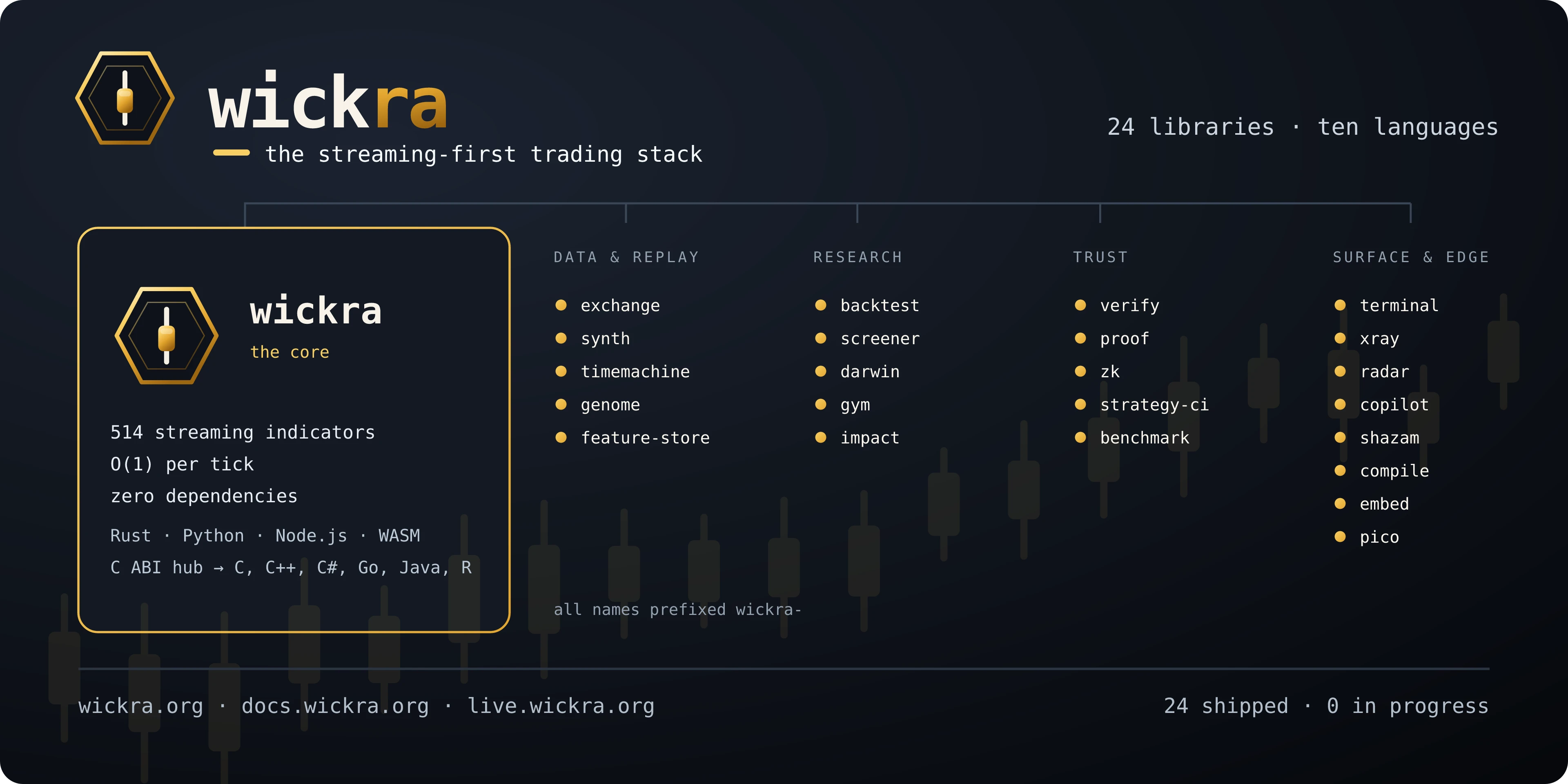
Wickra Verify ships native bindings for Python, Node.js, WASM and Rust, plus a C ABI hub that any
C-capable language (C, C++, C#, Go, Java, R) links against — all forwarding to the
same data-driven, unsafe-forbidden Rust core.
Security
Found a security issue? Please don't open a public issue. Report it privately
via the repository's Security tab ("Report a vulnerability") or email
support@wickra.org with a subject line starting [wickra security]. Full
policy: https://github.com/wickra-lib/wickra-verify/blob/main/SECURITY.md.
Disclaimer
wickra-verify is research and engineering tooling, not financial advice. A
verdict attests only that a claimed report is (or is not) the deterministic
result of a given strategy over given data — it makes no claim about the quality,
profitability or future performance of any strategy, nor about whether the data
itself is genuine. Trading carries risk; you are responsible for your own
decisions. wickra-verify is free software you run yourself: no hosted service,
no data collection, no warranty.
License
Licensed under either of Apache-2.0 or MIT at your option.
 Documentation

Documentation

Overview 
Package wickra provides idiomatic Go bindings for wickra-verify over its C ABI hub: create a Verifier, drive it with command JSON (verify, explain, canonicalize, version) and read back the response JSON — the same protocol as the CLI and every other binding.
The binding links the prebuilt C ABI library, staged per platform under ./lib/<goos>_<goarch>/, with the header vendored under ./include.
Index 
Constants 
This section is empty.
Variables 
This section is empty.
Functions 
Types 
type Verifier 
type Verifier struct {
	// contains filtered or unexported fields
}
Verifier is driven by JSON commands.
func New 
func New() *Verifier
New creates a verifier with the default tolerances. Call Close when done (a finalizer also frees it, but explicit Close is preferred).
 Source Files