

 README

README

Errors
A lightweight Go errors package with stack tracing and structured fields.


Features
- ✅ Standard library compatible: Drop-in replacement for
errorspackage - 🔍 Automatic stack tracing: Captures call stack when errors are created
- 📊 Structured fields: Add key-value pairs with
With()method - 🎨 Multiple formats: Text, JSON, and colorized output
- 🔗 Error wrapping: Full support for
%wverb and error chains - ⚡ High performance: Efficient implementation with object pooling
- 🔌 Logs integration: Native support for github.com/yanun0323/logs package
⚠️ Caution: using
fmt.Errorfto wrap errors is not compatible witherrors.Isanderrors.Asmethods.
Installation
go get github.com/yanun0323/errors
Requirements
- Go 1.21+
Quick Start
import "github.com/yanun0323/errors"

// Create error with fields
err := errors.New("connection failed").
    With(
        "host", "localhost",
        "port", 5432,
    )

// Error wrapping
wrapped := errors.Errorf("database error: %w", err)
// or
wrapped = errors.Wrap(err)
wrapped = errors.Wrap(err, "database error")
wrapped = errors.Wrapf(err, "database %s error", database)

// Format output
println(err.Error())                        // Basic message

errors.Format(err)                          // Text with stack trace
errors.FormatJson(err)                      // JSON text with stack trace
errors.FormatColorized(err)                 // Colorized text with stack trace

fmt.Printf("%s\n", err)                     // Basic message
fmt.Printf("%v\n", err)                     // Formatted text with stack trace
fmt.Printf("%+v\n", err)                    // Formatted & colorized text with stack trace
fmt.Printf("%#v\n", err)                    // JSON text with stack trace

// Error Template
errTmp := errors.NewTemplate("service", "user-service")
errTmpDB := errTmp.With("component", "database")
err1 := errTmpDB.New("connection established")
err2 := errTmpDB.Errorf("query timeout after %d seconds", 30)
err3 := errTmpDB.Wrapf(originalErr, "database operation %d times", 3)

// Logs Package Integration
import "github.com/yanun0323/logs"
logs.WithError(err1).Error("connection established")
logs.WithError(err2).Error("query timeout")
logs.WithError(err3).Error("database operation")
API
Creating Errors
errors.New(text string) Error
errors.Errorf(format string, args ...any) Error
errors.Wrap(err error, args ...any) Error
errors.Wrapf(err error, format string, args ...any) Error
Template
Create error templates with predefined attributes for reuse:
errors.NewTemplate(args ...any) Template
Template Methods
template.With(args ...any) Template             // Add more attributes (chainable)
template.New(text string) Error                 // Create error with template attributes
template.Wrap(err error, args ...any) Error     // Wrap error with template attributes
template.Wrapf(err error, format string, args ...any) Error  // Wrap error with formatted message
template.Errorf(format string, args ...any) Error           // Create formatted error
Error Methods
err.Error() string                          // Standard error message
err.With(args ...any) Error                 // Add fields (chainable)
Standard Functions
errors.Is(err, target error) bool
errors.As(err error, target any) bool
errors.Unwrap(err error) error
Formatting Functions
errors.Format(err error) string             // Text with stack trace
errors.FormatColorized(err error) string    // Colorized text with stack trace
errors.FormatJson(err error) string         // JSON text with stack trace
Logs Package Integration
This package interoperates with the github.com/yanun0323/logs package.
logger := logs.Default()

err := errors.New("database connection failed").
    With(
        "host", "localhost",
        "port", 5432,
    )

logger.WithError(err).Error("Operation error")
When using with the logs package, errors created by this package can be directly passed to log functions and will automatically extract structured fields and stack traces.
Examples
Basic Usage
err := errors.New("validation failed").
    With(
        "field", "email",
        "value", "invalid@",
        "rule", "email_format",
    )
Error Wrapping
original := errors.New("network timeout")
wrapped := errors.Errorf("failed to fetch user: %w", original)
Template Usage
// Create a template with common attributes
errTmp := errors.NewTemplate("service", "user-service", "version", "1.0.0")

// Add more attributes to the template
errTmpDB := errTmp.With("component", "database", "host", "localhost")

// Create errors using the template
err1 := errTmpDB.New("connection failed")
err2 := errTmpDB.Errorf("query timeout after %d seconds", 30)
err3 := errTmpDB.Wrap(originalErr, "database operation failed")
JSON Output
err := errors.New("process failed").With("pid", 1234)
fmt.Printf("%#v\n", err)
// Outputs structured JSON with message, fields, and stack trace
Logs Package Integration
import (
    "github.com/yanun0323/errors"
    "github.com/yanun0323/logs"
)

// Create an error with structured fields
err := errors.New("database connection failed").
    With(
        "host", "localhost",
        "port", 5432,
        "timeout", "30s",
    )

// Pass directly to logs package
logs.Error("Operation failed", err)
// The logs package will automatically extract:
// - Error message
// - Structured attributes (host, port, timeout)
// - Stack trace information
Output Formats
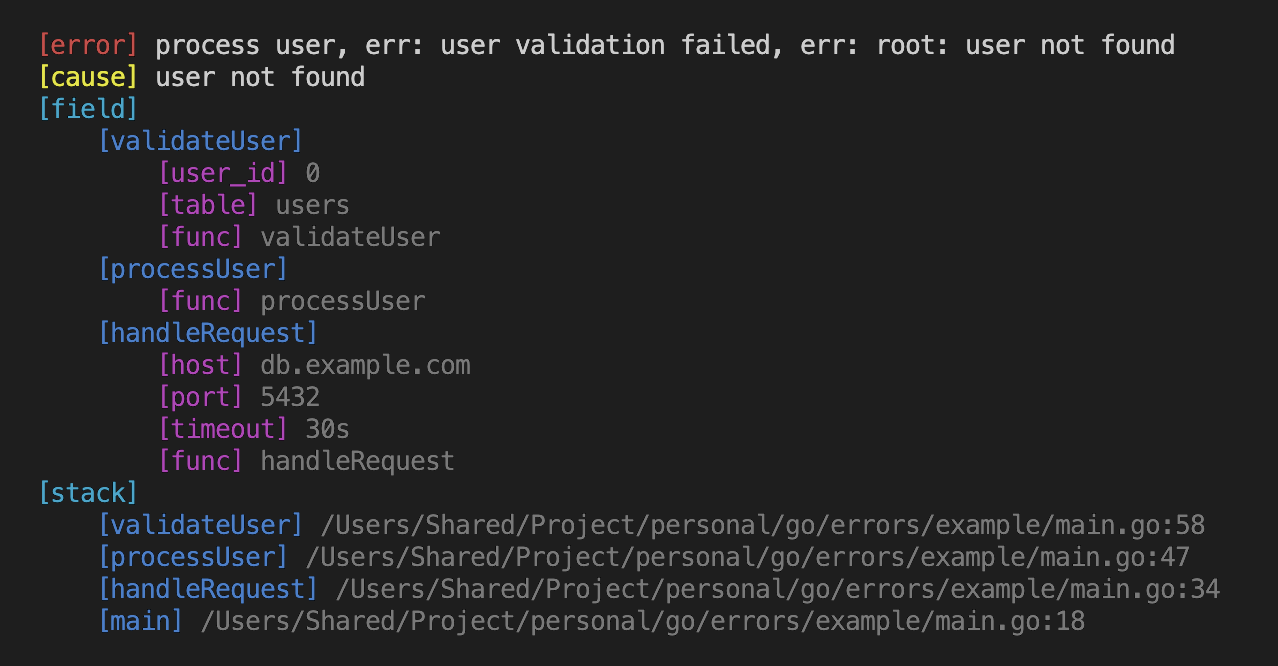
Text
error:
    process user, err: user validation failed, err: root: user not found
cause:
    user not found
field:
    validateUser:
        user_id: 0
        table: users
        func: validateUser
    processUser:
        func: processUser
    handleRequest:
        host: db.example.com
        port: 5432
        timeout: 30s
        func: handleRequest
stack:
    validateUser:
        /Users/Shared/Project/personal/go/errors/example/main.go:58 in validateUser
    processUser:
        /Users/Shared/Project/personal/go/errors/example/main.go:47 in processUser
    handleRequest:
        /Users/Shared/Project/personal/go/errors/example/main.go:34 in handleRequest
    main:
        /Users/Shared/Project/personal/go/errors/example/main.go:18 in main
Colorized
JSON
{
  "cause": "user not found",
  "error": "process user, err: user validation failed, err: root: user not found",
  "field": [
    {
      "function": "validateUser",
      "key": "user_id",
      "value": 0
    }
    // ...
  ],
  "stack": [
    {
      "file": "/Users/Shared/Project/personal/go/errors/example/main.go",
      "function": "validateUser",
      "line": "58"
    }
    // ...
  ]
}
Important Notes
⚠️ Do not use fmt.Errorf
Use
errors.Neworerrors.Errorfinstead for proper compatibility witherrors.Isanderrors.As.
License
 Documentation

Documentation

Overview 
Package errors provides a lightweight error handling library with support for error wrapping, formatting, and error chain checking.
DO NOT use fmt.Errorf to create errors, use errors.New or errors.Errorf instead. 
fmt.Errorf is not compatible with errors.Is and errors.As.
fmt.Errorf("failed to process user %d: %w", userID, err)
is not the same as
errors.Errorf("failed to process user %d: %w", userID, err)
Example: 
// Create an error
err := errors.New("user validation failed").
	With("user_id", 12345).
	With("email", "user@example.com").
	With("attempt", 3)

// Wrap the error
err = errors.Wrap(err, "using wrap to wrap the error")
err = errors.Errorf("%w can also wrap the error", err)

// Format the error
message := err.Error()
textWithStack := errors.Format(err)
jsonWithStack := errors.FormatJSON(err)
colorizedWithStack := errors.FormatColorized(err)

// using Sprintf to format the error
message := fmt.Sprintf("%s", err)
textWithStack := fmt.Sprintf("%v", err)  // equal to errors.Format(err)
jsonWithStack := fmt.Sprintf("%#v", err)  // equal to errors.FormatJSON(err)
colorizedWithStack := fmt.Sprintf("%+v", err)  // equal to errors.FormatColorized(err)

// Check if the error is a specific error
if errors.Is(err, errors.New("user validation failed")) {
	// handle the error
}

var validationErr AnErrorType
if errors.As(err, &validationErr) {
	// handle the error
}
Example 
Example demonstrates how to use the errors package
err1 := New("something went wrong")
fmt.Println(err1.Error())

err2 := &errorStack{
	message: "failed to process user: something went wrong",
	cause:   err1,
	stack:   getStack(0),
	attr:    []attr{},
}
fmt.Println(err2.Error())

err3 := New("database error").
	With("table", "users").
	With("operation", "insert")

fmt.Println(err3.(*errorStack).String())

fmt.Println("JSON:", FormatJson(err3))
fmt.Println("Colorized:", FormatColorized(err3))
Index 
- Variables
- func As(err error, target any) bool
- func Format(err error) string
- func FormatColorized(err error) string
- func FormatJson(err error) string
- func Is(err, target error) bool
- func Join(errs ...error) error
- func Unwrap(err error) error
- type Error
- type Template
- func (t Template) Attrs(lastCaller frame) []attr
- func (t Template) Clone() Template
- func (t Template) Errorf(format string, args ...any) Error
- func (t Template) New(text string) Error
- func (t Template) With(args ...any) Template
- func (t Template) WithMap(m map[string]any) Template
- func (t Template) Wrap(err error, args ...any) Error
- func (t Template) Wrapf(err error, format string, args ...any) Error
Examples 
Constants 
This section is empty.
Variables 
var (
	// SkipRuntimeStackTrace is a flag to skip the runtime stack trace
	//
	// It is useful to skip the runtime stack trace when you want to get the error message
	// without the runtime stack trace
	//
	// It is true by default
	SkipRuntimeStackTrace = true
)
Functions 
func FormatColorized 
FormatColorized formats the error as a colorized string
func Join ¶ added in v1.0.2
Join returns an error that wraps the given errors. Any nil error values are discarded. Join returns nil if every value in errs is nil. The error formats as the concatenation of the strings obtained by calling the Error method of each element of errs, with a newline between each string.
A non-nil error returned by Join implements the Unwrap() []error method.
Types 
type Error 
Error is an interface that wraps the error interface and provides additional methods
It also implements the error interface, so it can be used as an error
type Template ¶ added in v0.0.6
type Template struct {
	// contains filtered or unexported fields
}
Template is a template for creating errors. It contains args that can be used to create an error.
func NewTemplate ¶ added in v0.0.6
NewTemplate creates a new Template.
func (Template) Attrs ¶ added in v0.0.6
func (t Template) Attrs(lastCaller frame) []attr
Attrs returns a copy of the template's attributes with the Function field set to the provided lastCaller frame's Function value.
func (Template) Errorf ¶ added in v0.0.6
Errorf creates a new formatted Error using the template's attributes. It formats the message using fmt.Sprintf with the provided format and args.
func (Template) New ¶ added in v0.0.6
New creates a new Error with the given text message and the template's attributes.
func (Template) With ¶ added in v0.0.6
With creates a new Template by appending additional attributes to the existing ones. It returns a new Template instance without modifying the original one.
func (Template) WithMap ¶ added in v1.0.6
WithMap creates a new Template by appending additional attributes to the existing ones. It returns a new Template instance without modifying the original one.
 Source Files
 Directories