

 README

README


kratos-ts-http
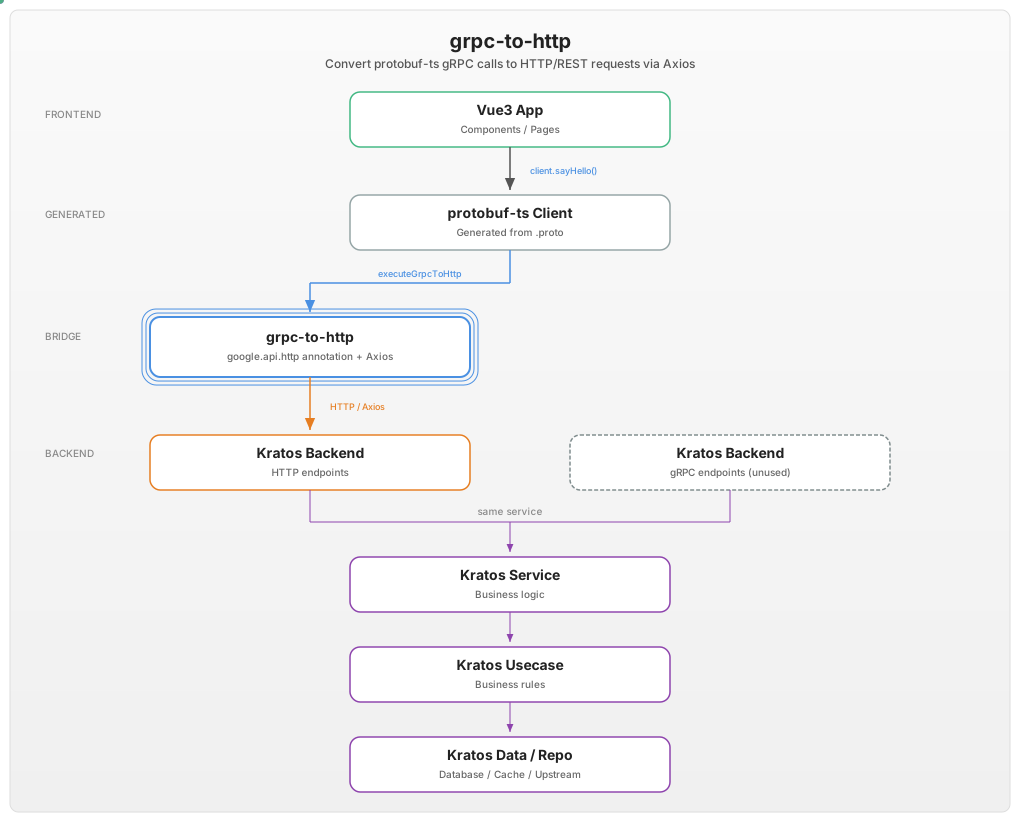
Generate web-safe TypeScript clients from Kratos proto files A protoc plugin that emits HTTP-form clients instead of gRPC Complete type-safe code from the Go backend to the TypeScript frontend Invoke backend APIs just as native functions
CHINESE README
Background
protoc-gen-ts (from @protobuf-ts/plugin) turns proto files into excellent TypeScript, but the clients it emits speak gRPC, which has no native home in the web. Those clients must be rewritten into HTTP form before a frontend can use them.
Doing that as a second pass costs a scratch DIR, a rewrite command in the Makefile, and one DIR name repeated in more than one place. Change one, miss the next, and generation lands somewhere the rewrite does not look — and exits with success.
This package folds the rewrite into generation. The plugin hands the request to protoc-gen-ts, rewrites the *.client.ts files it gets back, then returns to buf. What buf writes to disk is the finished code, so the output DIR is a result instead of an intermediate.
Two Ways to Use
| Route | Entrance | Who drives buf | |
|---|---|---|---|
| ① | protoc plugin, one step | protoc-gen-kratos-ts-http |
The Makefile / command line |
| ② | Embedded in a Go program | kratostshttp.BufGenerate(...) |
The Go code itself |
Both end at the same place, so take the one that suits the workflow.
Installation
Three commands. The chain runs buf → this package's plugin → protoc-gen-ts, so set it up from the bottom up:
# protoc-gen-ts does the proto→TS translation -- REQUIRED, this package invokes it
npm install -g @protobuf-ts/plugin

# this package's plugin, which rewrites what protoc-gen-ts produces
go install github.com/yylego/kratos-ts-http/cmd/protoc-gen-kratos-ts-http@latest

# buf drives the whole thing -- Kratos v3 projects ship it, check with: which buf
go install github.com/bufbuild/buf/cmd/buf@latest
@protobuf-ts/plugin is required. This package does not translate protos on its own, it delegates that work — see the reason. The plugin checks at startup and names what is missing, instead of dying with a bare executable file not found.
Usage 1: protoc Plugin
Two config files. Live copies of both sit in the example, so nothing here is pseudo code:
buf.yaml and
buf.gen.ts.yaml.
buf.yaml says where the protos live and which deps to fetch. Kratos v3 projects ship one, so this might just mean adding the deps line:
version: v2
modules:
  - path: api
deps:
  - buf.build/googleapis/googleapis   # google.api.http comes from here
Run buf dep update once afterwards. It writes a buf.lock that pins the exact googleapis commit, which keeps the generated output stable. Skip this step and generation stops with imported file does not exist.
buf.gen.ts.yaml names the plugin and its options:
version: v2
inputs:
  - directory: api
plugins:
  - local: protoc-gen-kratos-ts-http
    out: .   # the destination is NOT set here, -o on the command line decides it
    opt:
      - ts_nocheck
      - eslint_disable
      - long_type_string
Drive it from a Makefile target:
kratos_ts_http:
	buf generate --template buf.gen.ts.yaml --include-imports -o ../web/src/rpc
One place decides the destination: the -o on the command line. Keep out: . in the template, because buf JOINS the two and naming the same path twice nests the output inside itself. buf creates the DIRs it needs, and what it writes there is the finished client, so there is no staging DIR to take from and no second command to forget.
Then add the runtime to the frontend:
npm install @yylego/grpc-to-http
opt options:
| Option | Effect |
|---|---|
ts_nocheck |
Adds // @ts-nocheck, so generated files skip type checking |
eslint_disable |
Adds /* eslint-disable */, so lint tools leave them alone |
long_type_string |
Maps 64-bit integers to string instead of bigint, which survives JSON |
--include-imports makes buf emit the imported google standard types too, so the client imports resolve. buf pulls those from buf.build once buf.build/googleapis/googleapis is declared in deps inside buf.yaml, so no third_party proto tree is needed on disk.
Should the frontend live in a separate repo, aim
-oat a staging DIR named with a.outsuffix: Go's stock.gitignoreignores*.out, so the staged code stays out of the backend repo.
Usage 2: Drive from Go
import "github.com/yylego/kratos-ts-http/kratostshttp"

// Three params: where to run, where output lands, everything else passed to buf AS IS
err := kratostshttp.BufGenerate(
    "/path/to/the/kratos/project",   // workRoot: buf resolves its relative paths against this
    "/path/to/the/frontend/src/rpc", // outPath: the `-o` value, the end destination
    []string{
        "--template", "buf.gen.ts.yaml",
        "--include-imports",
        "api",
    },
)
This turns "backend edits a proto → frontend has a fresh client" into one function invocation, with no intermediate DIR in between.
What makes the rest a passed-through string slice instead of a struct: those flags are buf's terms, not ours. Modelling them would mean adding a field each time buf grows one, and would shut out anything we did not think of (--path, --exclude-path, --type, …). Passing them through costs nothing and leaves the calling code in charge.
⚠️ Mind how -o relates to the template's out: — out: resolves relative to -o and the two are joined. To land output at outPath itself, write out: . in the template.
⚠️ BufGenerate rewrites nothing itself. It runs buf; the rewrite happens because the template names protoc-gen-kratos-ts-http. Name protoc-gen-ts there instead and this invocation succeeds just the same and returns nil, while the output stays in gRPC form. Success here means "buf ran", not "the aim was reached". That split is deliberate — a template gets written regardless, so the plugin choice has a home of its own.
💡 --config and --template accept a file path, and also the config content itself, so a config built at run time can go straight into bufArgs with no temp file. ⛔ But buf tells the two apart from how the string LOOKS at its end (.yaml / .yml / .json), not from the file existing on disk — so content ending in .yaml (even inside a trailing comment) gets opened as a filename and fails with something like open version: v2, which points nowhere close to the cause. Mind the last line when passing content.
Example
internal/examples/example1 puts the whole chain in one DIR, in the sequence the questions come up:
| File | What it answers |
|---|---|
api/greeter/v1/greeter.proto |
Suppose the API looks like this. The google.api.http line maps SayHello onto POST /v1/greeter/hello |
buf.yaml + buf.lock |
Which protos to read and which deps to fetch. The lock pins the exact googleapis commit |
buf.gen.ts.yaml |
Which plugin to run. out: . keeps the destination out of the template |
Makefile |
install, then generate, then check |
web/src/rpc/ |
Where the client lands: inside the frontend, with no staging DIR between |
golden.ts |
The client you end up with |
Read golden.ts and the whole thing makes sense without running anything. make generate inside that DIR reproduces it, and make check diffs the two.
Design Notes
The output splits in two. Client files (*.client.ts, about 57 lines each) are the sole ones worth touching. Message files (*.ts, about 250 lines each, with more files besides) contain @protobuf-ts/runtime's complete serialization implementation — rewriting those would mean matching that runtime's internals byte to byte, from release to release, and drift crashes the frontend at run time.
Delegating, then rewriting just the few lines we care about, is the cheap and sound trade.
Package API
func RunTsPlugin(stdin io.Reader, stdout io.Writer) (GenStats, error)  // one complete protoc-plugin exchange
func BufGenerate(workRoot, outPath string, bufArgs []string) error  // run one `buf generate`

type GenStats struct{ FileCount, EditCount int }  // what one run reports back
Three symbols, no more: one to each route, plus the counts. The rewrite rules themselves remain inside the package, serving both routes and exposing no contract.
The rewrite is idempotent, so a repeat pass across converted output is safe.
Converting a batch of gRPC-form clients that sit on disk is a separate job, and kratos-vue3 ships the vue3kratos command to do just that.
Related Projects
- grpc-to-http — npm package
@yylego/grpc-to-http, the runtime the generated clients import; converts protobuf-ts gRPC invocations into Axios HTTP requests - protobuf-ts — the upstream
@protobuf-ts/pluginthis package delegates to
Lineage
This package grew out of kratos-vue3, which worked the rewrite as a separate second pass and carried a framework name the generated code did not earn. The rewrite rules here are its direct descendants, now folded into generation, and the package wears a name that describes the output instead of the frontend we happen to use.
kratos-vue3 stays up and keeps working. New projects should start here.
📄 License
MIT License - see LICENSE.
💬 Contact & Feedback
Contributions are welcome! Report bugs, suggest features, and contribute code:
- 🐛 Mistake reports? Open an issue on GitHub with reproduction steps
- 💡 Fresh ideas? Create an issue to discuss
- 📖 Documentation confusing? Report it so we can improve
- 🚀 Need new features? Share the use cases to help us understand requirements
- ⚡ Performance issue? Help us optimize through reporting slow operations
- 🔧 Configuration problem? Ask questions about complex setups
- 📢 Follow project progress? Watch the repo to get new releases and features
- 🌟 Success stories? Share how this package improved the workflow
- 💬 Feedback? We welcome suggestions and comments
🔧 Development
New code contributions, follow this process:
- Fork: Fork the repo on GitHub (using the webpage UI).
- Clone: Clone the forked project (
git clone https://github.com/yourname/repo-name.git). - Navigate: Navigate to the cloned project (
cd repo-name) - Branch: Create a feature branch (
git checkout -b feature/xxx). - Code: Implement the changes with comprehensive tests
- Testing: (Golang project) Ensure tests pass (
go test ./...) and follow Go code style conventions - Documentation: Update documentation to support client-facing changes
- Stage: Stage changes (
git add .) - Commit: Commit changes (
git commit -m "Add feature xxx") ensuring backward compatible code - Push: Push to the branch (
git push origin feature/xxx). - PR: Open a merge request on GitHub (on the GitHub webpage) with detailed description.
Please ensure tests pass and include relevant documentation updates.
🌟 Support
Welcome to contribute to this project via submitting merge requests and reporting issues.
Project Support:
- ⭐ Give GitHub stars if this project helps you
- 🤝 Share with teammates and (golang) programming friends
- 📝 Write tech blogs about development tools and workflows - we provide content writing support
- 🌟 Join the ecosystem - committed to supporting open source and the (golang) development scene
Have Fun Coding with this package! 🎉🎉🎉
GitHub Stars

 Directories

Directories

| Path | Synopsis |
|---|---|
|
cmd
|
|
|
protoc-gen-kratos-ts-http
command
Command protoc-gen-kratos-ts-http generates web-safe TypeScript clients in one step.
|
Command protoc-gen-kratos-ts-http generates web-safe TypeScript clients in one step. |