

 README

README

chill
Terminal lofi radio. Streams the best 24/7 lofi beats from YouTube.
Install
macOS:
brew install mpv yt-dlp
Linux:
sudo apt install mpv pipx
pipx install yt-dlp
Windows:
choco install mpv yt-dlp
Then install chill:
go install github.com/willibrandon/chill@latest
Or grab a binary for your platform from the releases page and put it somewhere in your PATH.
To update an installed copy:
chill update
chill -update, chill --update, and chill upgrade work too. This downloads
the latest release for your platform, verifies its checksum, and updates the
running daemon while preserving playback settings.
Make sure your Go bin directory is in your PATH:
- macOS/Linux:
export PATH="$HOME/go/bin:$PATH" - Windows: Add
%USERPROFILE%\go\binto your PATH
Usage
chill                # play default station (starts daemon automatically)
chill chillhop       # play specific station
chill -i             # interactive mode (repl)
chill --skip         # skip to random station
chill --toggle       # pause/resume
chill --vol 60       # set volume (also +5, -10, up, down)
chill --mute         # toggle mute
chill --status       # show what's playing
chill --stop         # stop playback
chill --list         # show all stations
chill add n url desc # save your own station
chill remove n       # remove a custom station or restore a built-in
chill default n      # choose the station played by chill
chill --sleep 45m    # stop playback after 45 minutes
chill --sleep off    # cancel the sleep timer
chill --version      # show version
chill update         # install the latest release
chill --fg           # run in foreground (no daemon)
Architecture
chill uses a client-server architecture. The first playback command spawns a background daemon. CLI commands and the REPL communicate with that daemon over IPC: a Unix socket on macOS/Linux, or localhost TCP on Windows.
The daemon starts and supervises mpv, sends playback controls over mpv's JSON IPC, and listens for player events to track loading and failures. This second connection uses a Unix socket on macOS/Linux and a named pipe on Windows. mpv uses yt-dlp to resolve YouTube streams.
┌─────────────┐      ┌─────────────┐           ┌─────────────┐
│ chill       │ ◀──▶ │ daemon      │ ◀───────▶ │ mpv         │
│ (CLI/REPL)  │ IPC  │ (server)    │ JSON IPC  │ (playback)  │
└─────────────┘      └─────────────┘           └─────────────┘
This means:
- Music keeps playing after the command exits
- Control playback from any terminal
- Playback controls use the running player; starting a stream still takes time
- The daemon owns reconnects and sleep timers, so they work after the client exits
After installing a newer version, your next command automatically upgrades an outdated daemon. Playback restarts once, preserving your station, volume, mute, pause state, and sleep timer.
Volume, mute, and pause/resume use mpv's native IPC controls, so adjusting the
volume never restarts the stream or resumes paused music. Mute preserves your
volume, and the last volume is remembered across daemon restarts in state.json
beside the station config. Mute itself is temporary.
Status distinguishes loading, playing, paused, failed, and idle.
If a stream drops or fails to load, chill reports the player error and retries
up to three times, after 1, 2, and 4 seconds. Each load has a 45-second timeout.
A minute of successful playback replenishes the retry budget. Errors and retry
progress also appear in the REPL; use play or choose another station to try
again after the retries are exhausted.
Sleep timer
While a station is playing or loading, chill --sleep 45m schedules playback to
stop. Durations accept units such as 30s, 45m, or 1h30m. A new timer replaces
the previous one; chill --sleep off cancels it. chill --status and the REPL
status bar show the remaining time.
The timer continues while paused, switching stations, or reconnecting. When it
expires, playback stops and the daemon becomes idle; chill --toggle starts the
default station again. Explicitly stopping chill clears the timer. Timers are
not restored across daemon restarts.
Stations
| Station | Description |
|---|---|
lofi-girl |
Lofi Girl - beats to relax/study to |
chillhop |
Chillhop Radio - jazzy & lofi hip hop |
chillout |
Chillout Lounge - calm & relaxing |
code-radio |
Code Radio - beats to study & code to |
sleep |
Lofi - beats to sleep/relax to |
study |
Lofi - beats to study/relax to |
Your own stations
Add any YouTube stream with chill add <name> <url> [description], or edit the
station config:
- macOS:
~/Library/Application Support/chill/stations.json - Linux:
~/.config/chill/stations.json(or$XDG_CONFIG_HOME/chill/stations.json) - Windows:
%AppData%\chill\stations.json
{
  "default_station": "synthwave",
  "stations": [
    {
      "name": "synthwave",
      "url": "https://www.youtube.com/watch?v=4xDzrJKXOOY",
      "desc": "Synthwave Radio - retro electronic beats"
    },
    {
      "name": "jazz",
      "url": "https://www.youtube.com/watch?v=HuFYqnbVbzY",
      "desc": "Jazz Cafe - smooth jazz for work"
    },
    {
      "name": "rain",
      "url": "https://www.youtube.com/watch?v=mPZkdNFkNps",
      "desc": "Rain on a window - for deep focus"
    }
  ]
}
A station with the name of a built-in overrides it. chill remove <name> removes
a custom station; removing an override restores the built-in. Built-ins cannot
be removed. chill default <name> chooses what chill, REPL play, and
chill --fg play without a station argument. The initial default is lofi-girl;
removing a custom station that was the default returns to lofi-girl.
Add, remove, and default commands update the running daemon automatically. For
manual file edits, use chill -i then reload, or restart the daemon. Reload
rebuilds the list from the built-ins and the current file, including removals.
Reloading or removing a station does not interrupt a stream already playing.
Interactive Mode
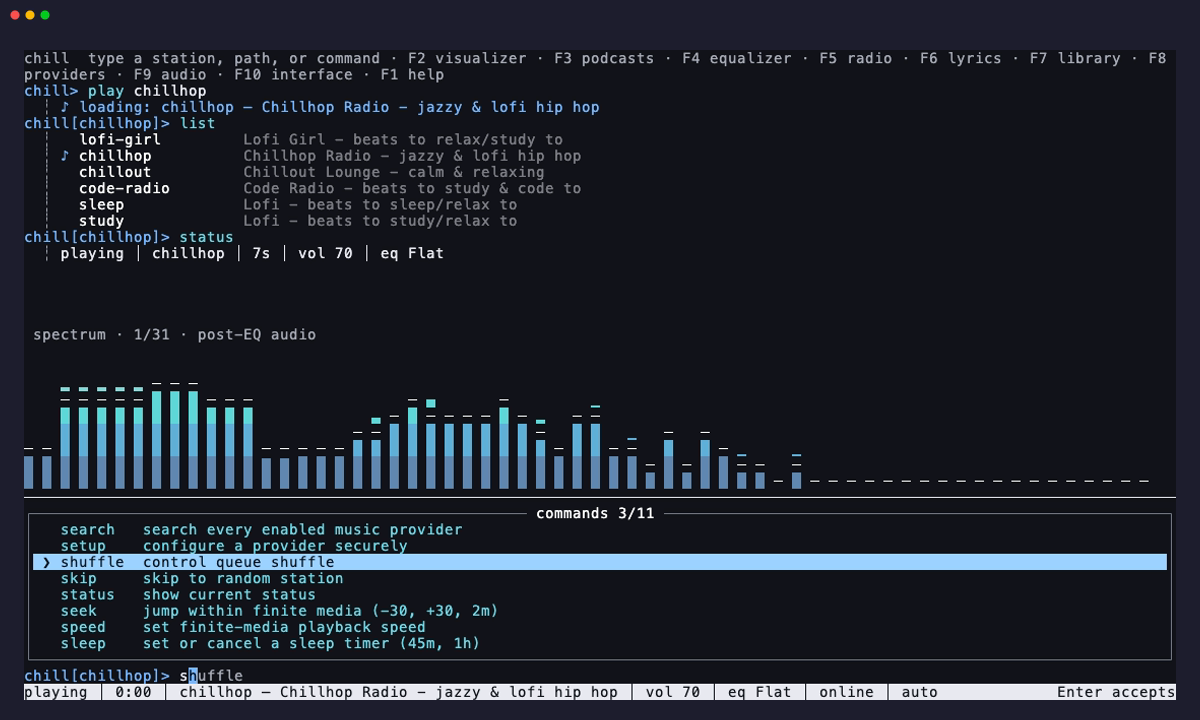
chill -i opens a fullscreen REPL that suggests commands and stations as you type, shown above.
Commands: play, vol, mute, skip, pause, resume, toggle, status, list, add, remove, default, sleep, reload, stop, clear, help, quit. A station name on its own plays that station.
Use sleep 45m or sleep off for the timer. sleep on its own still plays the
sleep station, as does play sleep.
| Key | |
|---|---|
Tab |
complete with the highlighted suggestion |
→ |
take the ghost text |
↑ / ↓ |
pick a suggestion, otherwise walk through history (kept across sessions) |
Enter |
run the line, or take a suggestion picked with ↑ / ↓ |
Esc |
dismiss the suggestions |
PgUp / PgDn |
scroll the transcript, so does the mouse wheel |
Shift+↑ / Shift+↓ |
select lines of the transcript |
y / Enter / Ctrl+C |
copy what is selected |
| mouse | drag to select, right click to copy, or to paste when nothing is selected |
Ctrl+C |
clear the line, when nothing is selected |
Ctrl+L |
clear the screen |
F1 |
help |
Ctrl+Q |
quit, music keeps playing |
Foreground Mode
Use --fg to run in the terminal with mpv controls:
| Key | Action |
|---|---|
q |
quit |
m |
mute |
9 / 0 |
volume down / up |
← / → |
seek |
Build and test
go build .
go test ./...
With mpv installed, run the playback integration test:
CHILL_TEST_MPV=1 go test -count=1 -run TestMPVIntegration -v ./...
License
MIT
 Documentation

Documentation

Overview 
Package main implements chill, a terminal lofi radio that streams 24/7 lofi beats from YouTube. It uses a client-server architecture where a background daemon manages mpv playback and clients communicate over a Unix socket.
Usage:
chill              # play default station
chill chillhop     # play specific station
chill -i           # interactive mode (repl)
chill --vol 60     # set volume (or +5, -10, up, down)
chill --mute       # toggle mute
chill --status     # show what's playing
chill --stop       # stop playback
chill add n url    # save your own station
chill update       # install the latest release
 Source Files